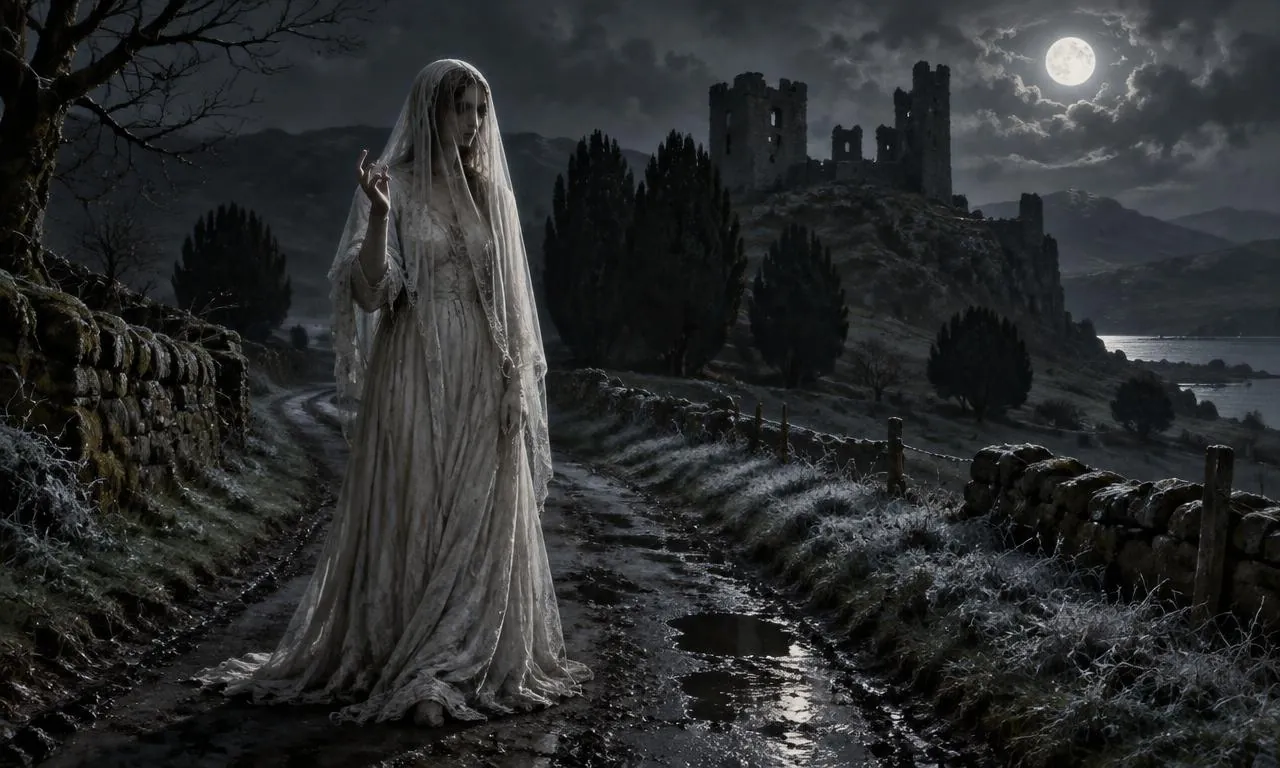
Ask almost any old parish in Wales about a ghost and, sooner or later, someone will mention her: y Ladi Wen, the White Lady. She is seen on lanes and at stiles, by wells and pools, at crossroads and in the broken gateways of castles. She is tall, dressed in white, and often veiled. What she wants depends very much on where you meet her.
Her most famous role is the one Welsh children were warned about on Nos Galan Gaeaf, the eve of winter — our Hallowe'en. As the bonfires burned down on the hillsides, everyone would run for home chanting an old rhyme about the tailless black sow and the headless White Lady who would take the last one left out in the dark. There, the Ladi Wen is pure threat: the thing at the edge of the firelight, the reason you do not dawdle.
Elsewhere she is a guardian of gold. In many Welsh tales a White Lady haunts the spot where treasure has been hidden — beneath a castle floor, under a stone, at the bottom of a pool. She appears to one person, often a young man walking alone, and beckons. If he is brave enough to follow and to do exactly as she asks, the treasure may be his, and her long watch ends. If he flinches, snatches, or tells anyone, the gold vanishes and she is bound to wait again. Tellings from the ruined castles of the south speak of her rising from the ground and pleading for someone to free her, and of the men who failed.
In the north, the stories lean colder. On the lanes of Gwynedd and Môn, a white figure seen standing by a gate or walking ahead of you on a wet road was often a death omen — a sign that someone in the house you were passing, or in your own, would not see the next season. People describe her not as frightening in her looks, but in her stillness: the raised hand, the face you can never quite see, the way she is simply gone when you look again.
And sometimes she is a wronged woman. In tale after tale, the Ladi Wen is a bride abandoned, a girl murdered by a lover, a daughter locked away by a cruel father, a wife who died with a wrong unrighted. She walks because something was left undone, and she will walk until it is.
What makes her Welsh, rather than a stock Victorian ghost in a nightgown, is how rooted she is. Each Ladi Wen belongs to one lane, one well, one ruin, one family. She sits alongside the Gwrach y Rhibyn, the hag of the mist who beats her leathery wings against the window, and the Tylwyth Teg, who dance in the rings on the hill. All three are the land keeping watch on the people who live on it.
Wear Y Ladi Wen and you carry that watchfulness with you: the figure at the end of the lane, pale against the dark hedge, who has been waiting there for a very long time.