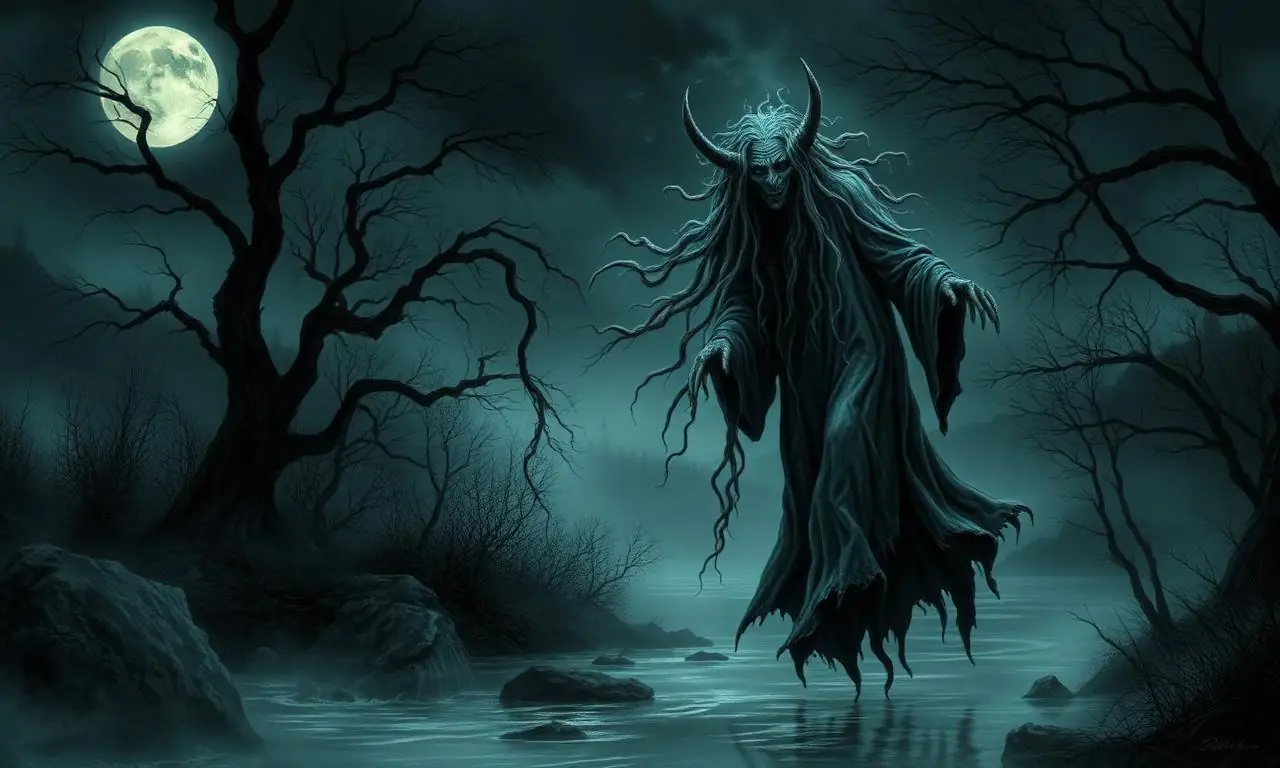
The Gwrach y Rhibyn — pronounced roughly 'goo-rach uh hree-bin', the 'Hag of the Mist' — is one of the most distinctive death-omens in Welsh folklore. She is the Welsh cousin of the Irish banshee, but the Welsh telling has its own particular dread.
She is described as a stooped, withered old woman with long matted black hair, wild teeth, and great leathery bat-like wings folded down her back. She appears at crossroads, by streams, at the windows of houses where someone is about to die. She does not enter. She simply waits, and weeps, and calls.
Her cry is the worst part. The old accounts describe a long, mournful wail in the dark, often calling the name of the dying person — or the name of their child, or their husband, or their wife. To hear the Gwrach call your own name was the worst omen of all. It meant your time had come, and that nothing could be done.
Welsh tradition held that only certain old, established families had a Gwrach y Rhibyn attached to them — the same families who, in Ireland, would be said to have a banshee. She was a strange kind of inheritance: a piece of family history that announced its own endings.
The 19th-century folklorist Wirt Sikes, in his collection 'British Goblins', recorded vivid Welsh accounts of the Gwrach — including one from Cardiff in which a man at an inn heard her wailing on the steps of the church across the road, then went home to find his sister had died at exactly that hour.
The Gwrach y Rhibyn is a quieter horror than a dragon or a kelpie. She does not chase. She does not bite. She just stands in the mist outside your window and tells you, in your own language, what is about to happen. And then she is gone.