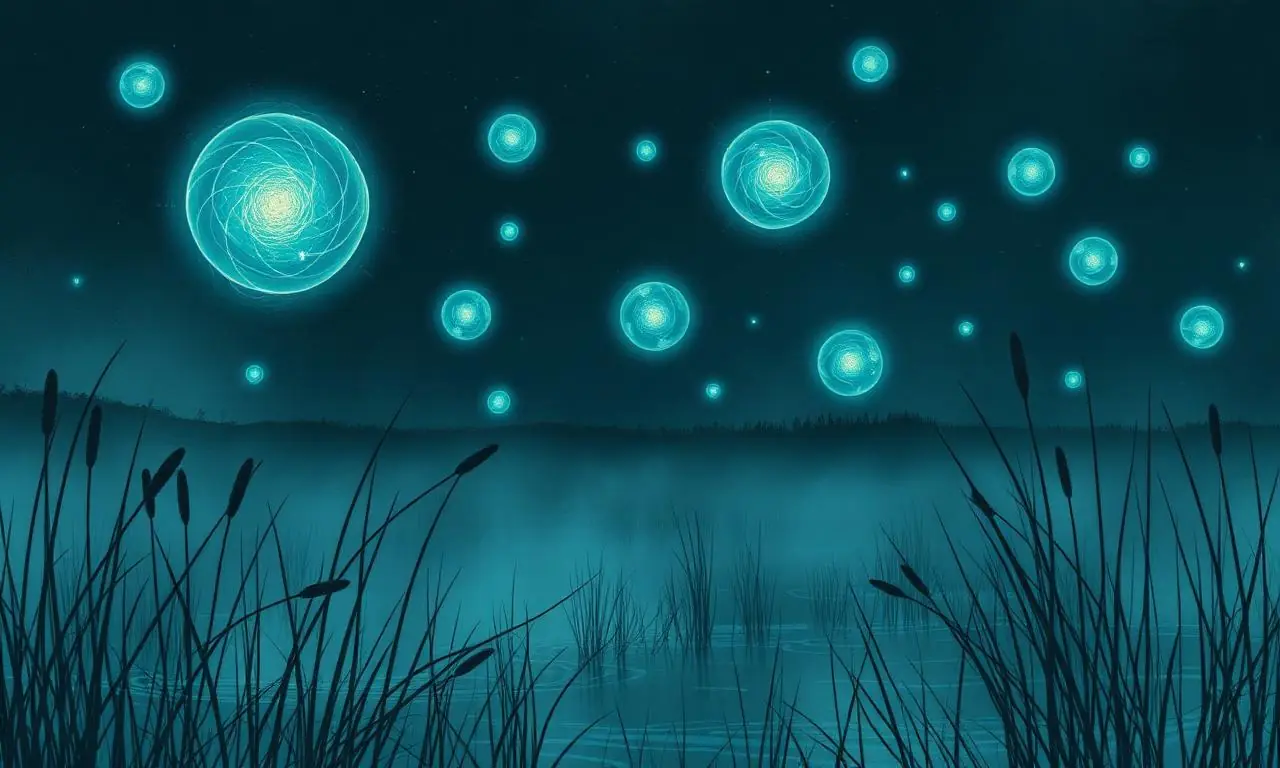
Cross a Scottish bog at night — Rannoch Moor, the Flow Country, the long flat wetlands of Caithness — and the old folk would tell you to keep your eyes on the path. Never on the lights.
The Will-o'-the-Wisp is the English name for a phenomenon known across these islands. In Scottish Gaelic it is Teine Sith, the fairy fire. In the Lowlands it was called Spunkie. The Welsh know it as Canwyll Corff, the corpse candle. Wherever it appears, the warning is the same: a small bluish-green flame, drifting, hovering just above the ground, exactly the height of a lantern carried by a fellow traveller.
If you call out, no-one answers. If you walk towards it, it drifts away — never closer, never further, always just within reach. By the time you realise you've left the path, the path is gone. The bog is around you, the lights are still ahead, and the Spunkie has done its work.
Folklorists now think the lights have a real source: marsh gas (methane) igniting spontaneously above peatland, or possibly bioluminescent fungi. But knowing the chemistry has not killed the fear. Walk a Highland bog on a still autumn night, see one of these things hover, and the rational explanation feels very thin indeed.
Some Scottish traditions describe the Wisps as the souls of the wicked, denied entry to both heaven and hell, condemned to wander the moors with a single coal of hellfire to light their way. Others say they are the malicious lanterns of the fae, lit specifically to draw travellers off the path and into the deep mire.
Our Veiled Will-o'-the-Wisp design captures the moment of the lure — the orbs in the dark, the reeds, the realisation that you are no longer alone on the moor. Beautiful things are not always safe. The bog is patient. The lights are patient. Stay on the path.