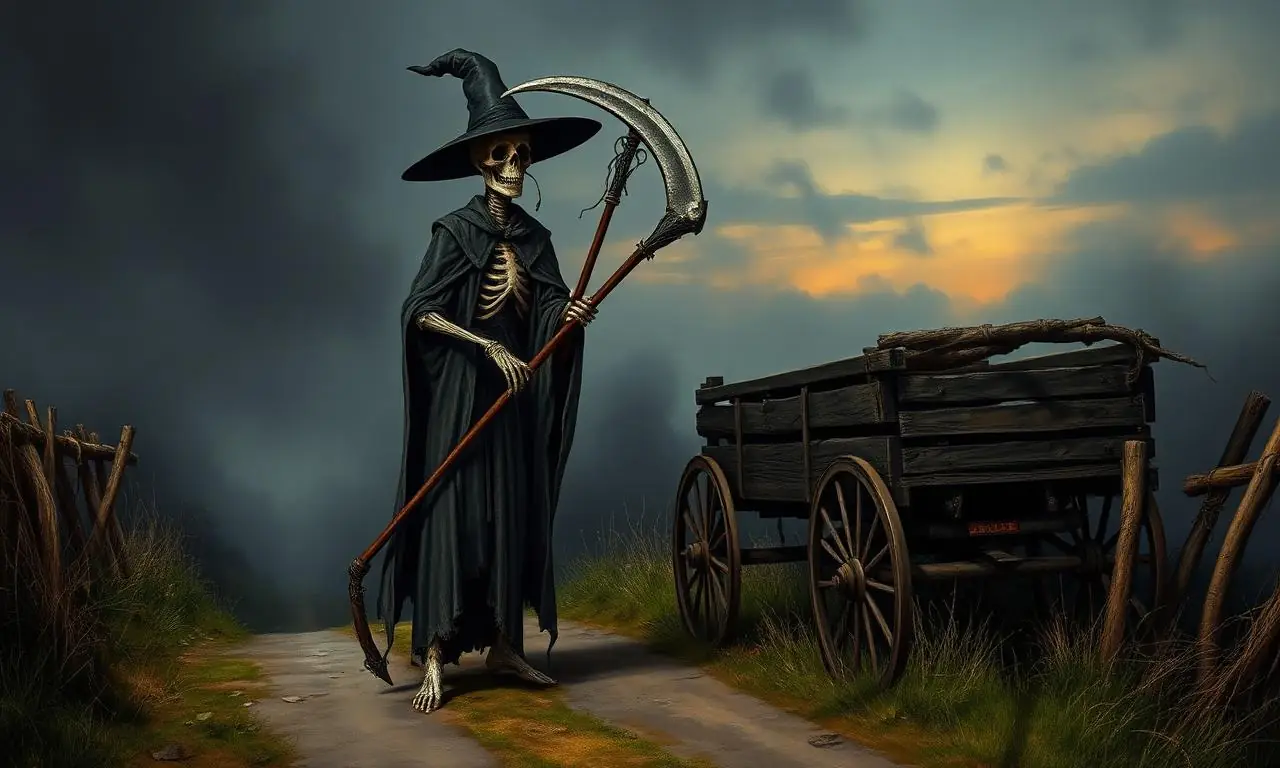
The Ankou — pronounced 'ann-koo' — is the personification of death in Breton folklore, with strong cousins in the Cornish, Welsh, and Irish Gaelic traditions. He is not the devil. He is not a god. He is the one who comes for you when your time is up, and he has been doing it since before there were churches in these lands.
He is described as a tall, gaunt figure, often little more than a skeleton wrapped in tattered grey or black robes. He wears a wide-brimmed hat that hides his face, carries a scythe sharpened in a way no living blacksmith would manage, and walks beside a creaking wooden cart drawn by two pale horses. The cart is for the souls.
In Breton villages, the Ankou was said to be the last person to die in the parish each year. That soul did not pass on. Instead it was bound to the work, and for the next twelve months it walked the lanes at dusk, knocking on doors, collecting those whose hour had come. Hearing the wheels of his cart at night was a warning that someone in the village would not see the morning.
The Welsh have their own versions of him — sometimes simply called Angau, 'death' — and Cornwall remembers him in old graveyard carvings. He appears across the Celtic west precisely because the Celtic west spent so many centuries living close to the sea, the storm, and the harvest, where death rarely waited politely.
What is striking about the Ankou is that he is not cruel. He is not described as gleeful or vengeful. He is exhausted, methodical, and patient. He has a job to do, and he does it. The horror of meeting him is not in malice — it is in the calm certainty that the appointment has been made and you are it.
If you ever hear, on a lonely lane in the Celtic west, the slow turn of a wooden wheel where no road traffic should be, the old advice is unchanged: do not look up, do not call out, and do not, under any circumstance, offer to help him with his cart.