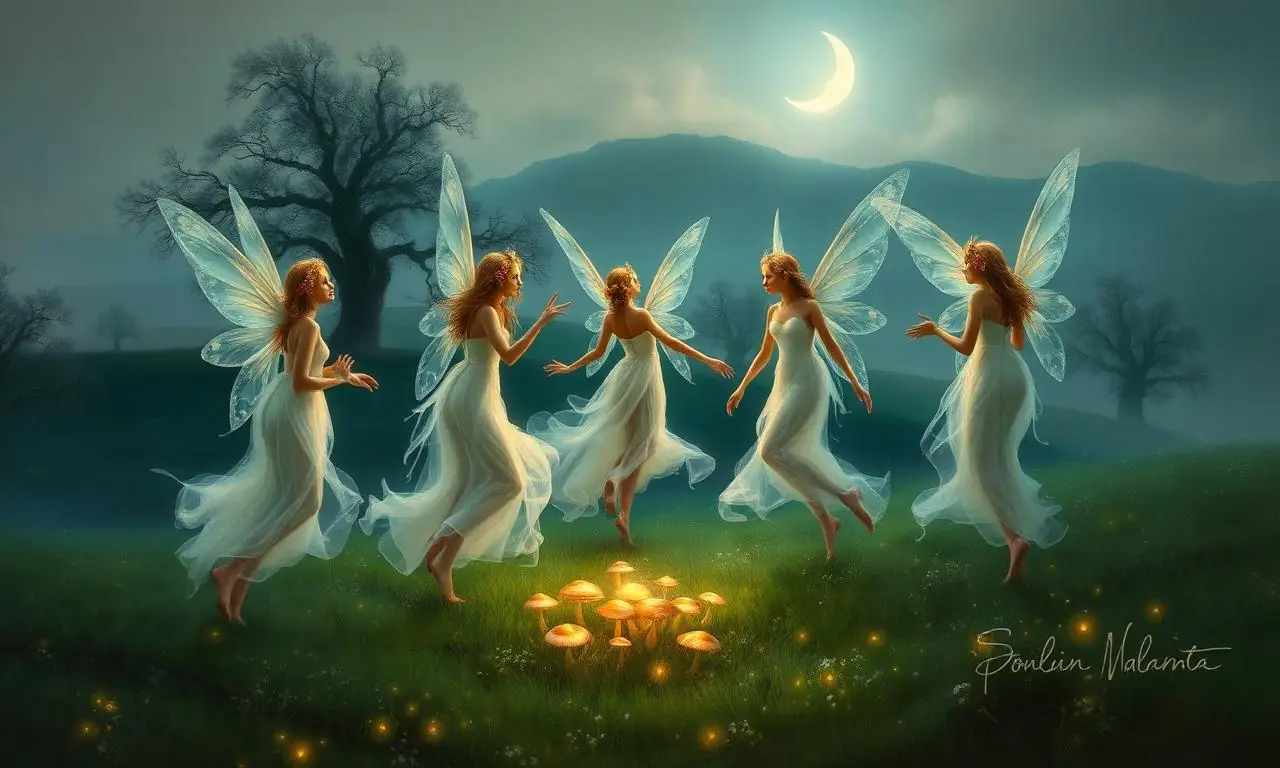
When English speakers say 'fairies' they usually mean something Disney has made small, sweet and harmless. The Welsh have always known better. The fair folk of Wales — Y Tylwyth Teg, literally 'the Fair Family' — are old, beautiful, dangerous, and best not spoken of out loud. In many parts of Wales they are called instead Bendith y Mamau ('Mothers' Blessing') or simply 'them' — anything but their real name, lest they hear you and come.
They live, the stories say, in a hidden country alongside our own. Sometimes that country is reached through a cave on a hillside, sometimes through a door in an oak, sometimes through a gap in time on Nos Galan Gaeaf (Hallowe'en) or Calan Mai (May Eve). Their kingdom is called Annwn — the same otherworld ruled by Arawn in the Mabinogi — and time inside it does not run as it does outside. A night dancing with the Tylwyth Teg can cost a mortal seven years, or a hundred, or his whole life.
Their favourite outdoor amusement is the dance. On moonlit nights they form rings on the hillsides, in clearings, in the soft grass of the upland commons, and where they have danced the grass grows greener and a circle of mushrooms springs up overnight — the cylch y Tylwyth Teg, the fairy ring. Welsh children were warned, and still are warned, never to step inside one. Those who do may find themselves trapped in the dance, unable to leave until released by another mortal who knows the trick — or until centuries have passed.
The most famous Welsh fairy story belongs to the Lady of Llyn y Fan Fach in Carmarthenshire, who rose from the lake to marry a mortal farmer on the strict condition that he never strike her three times without cause. He did, and she returned to the water with all her cattle — but not before passing the secrets of healing to her sons, the Physicians of Myddfai, whose medical knowledge passed into Welsh medicine for centuries. The Tylwyth Teg give as well as take. Carefully.
There are darker tales too. The plentyn newid — the changeling — is a Tylwyth Teg child swapped in the cradle for a healthy human baby. Welsh folklore is full of grim tests for spotting one (boil eggshells in front of it; if it speaks in an old man's voice, you have your answer) and grimmer cures involving fire, cold rivers, and hot iron — most of which we now know describe the way pre-modern communities tried to make sense of disabled children. The Tylwyth Teg, like all fairy lore, sit at the edge of folklore and tragedy.
Above all, they are a code of conduct. Be polite. Leave a little milk out. Don't boast. Don't take what isn't yours. Don't dance where you weren't invited. Treat the hills, the lakes, and your neighbours with care, because something old is watching, and it remembers. Wear the Tylwyth Teg and you wear that older Welsh courtesy — the one that knows the country itself has manners, and expects yours.