The Menai Strait is the narrow tidal channel that separates Ynys Môn from mainland Gwynedd. It is about fourteen miles long, between two hundred yards and a mile wide, and famous for the violence of its tide-races at the Swellies under the Britannia Bridge. It is also, by long Anglesey tradition, the highway of the Tylwyth Teg.
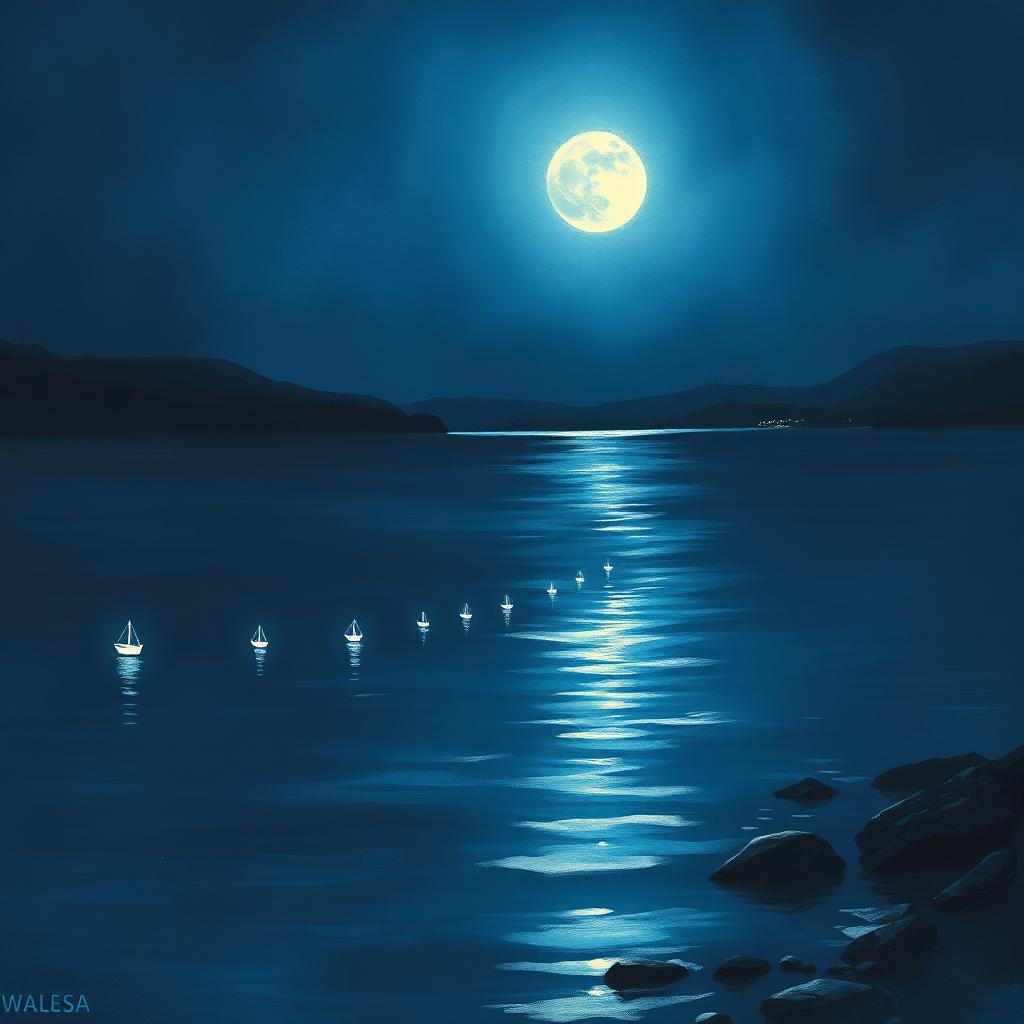
On calm, moonless nights — particularly between Beaumaris and the Menai Bridge — fishermen and shore-walkers have reported, for at least three centuries, a string of pale lights moving low over the water. The lights are described as small, round, slightly greenish, and quite steady. They do not flicker like lanterns on boats. They move in a line, at the speed of an unhurried walk, and they always travel in the same direction: from the foothills of Eryri on the mainland side, across the strait, and into the woods around Llandegfan and Llansadwrn on the Anglesey side.
The standard interpretation — and the people of Menai Bridge will give it to you without hesitation if you ask in the right pub — is that the lights are the lanterns of the Tylwyth Teg, the Welsh Fair Folk, crossing from their hill-homes in Eryri to one of their gathering-places on Anglesey. There is a similar tradition about the reverse journey on certain nights of the year, particularly at Calan Mai (May Eve) and Calan Gaeaf (November Eve). At Calan Mai they cross to Anglesey to dance at Barclodiad y Gawres and Bryn Celli Ddu. At Calan Gaeaf they cross back.
The naturalistic explanations are not hard to find. Marsh gas — methane bubbling up from the tidal mud of the foreshore — has been observed to ignite very rarely under exactly the right conditions, producing the will-o'-the-wisp lights known across the British marshes. The Menai foreshore between Beaumaris and the Lavan Sands is a substantial intertidal flat. There is also the perfectly real phenomenon of fishermen's lights from boats on the Lavan Sands, which can look strange and disembodied at a distance through sea fog.
But these explanations do not really account for the consistency of the tradition: lights, in a line, always low to the water, always moving in the same direction, always between the mainland mountains and the Anglesey woods, and always on still nights. The Tylwyth Teg explanation is the one Anglesey has chosen to keep, and as so often with Welsh fairy lore, it has not yet been embarrassed enough by the natural sciences to give it up.
Wear something inspired by the Tylwyth Teg of Menai and you wear the quiet nightly traffic of Anglesey: small pale lights, low to the water, crossing the strait on the kind of night you would have called calm and ordinary right up until you looked east.