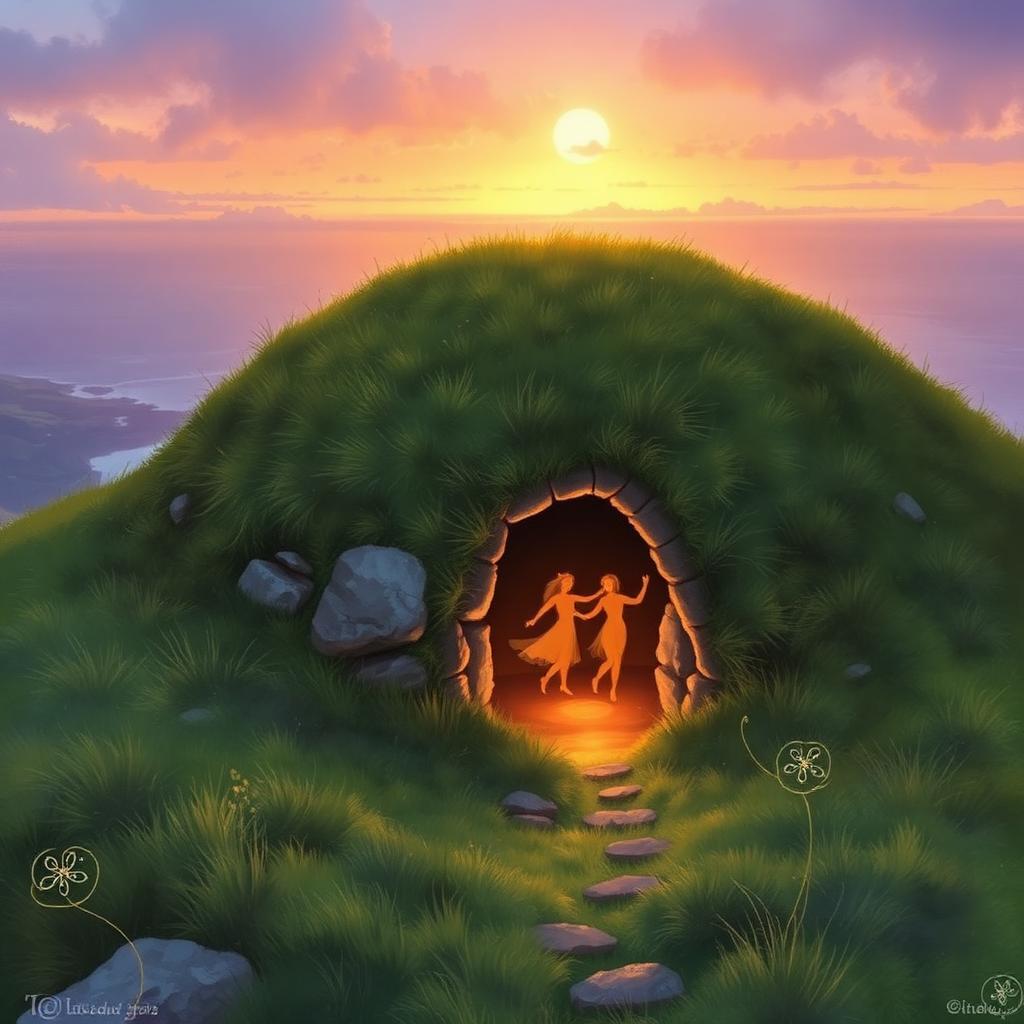
Barclodiad y Gawres stands on the low cliffs at Cable Bay between Aberffraw and Rhosneigr, looking straight out across the Irish Sea. The name is a piece of Welsh folk-etymology: it translates as 'the Giantess's Apronful' — the story being that a great giantess crossing from Eryri to Ireland with a load of stones to build a causeway tripped on the Anglesey shore, her apron-strings broke, and her cargo tumbled out in a heap. The heap is the cairn.
Archaeologically, Barclodiad y Gawres is one of only two passage tombs in Wales with carved interior stones — the other is Bryn Celli Ddu a few miles inland. The carvings, lit now by a low electric lamp, are the same spirals, lozenges and zig-zags found on the great Irish passage tombs at Newgrange and Knowth. It is unmistakably part of the same Atlantic Neolithic culture, built around 3000 BC, and it is almost certainly the work of incomers from the Boyne valley who crossed the sea and continued their building tradition here.
The fairy folklore is a later layer, but it is persistent. The cairn was said, well into living memory, to be a meeting place of the Tylwyth Teg — the Fair Family of Welsh tradition — on midsummer eve. Farmers from Aberffraw would not cross the cliff path on the night of 23 June. Children were warned that if you fell asleep on the grassy mound at dusk you would wake up either in fairyland or, if you were unlucky, a hundred years later in your own field with no one left who knew you.
There is a documented nineteenth-century account, recorded by the antiquary William Owen Stanley, of a Rhosneigr farmer who watched a ring of small figures circling the cairn at dusk and went home and refused to speak for two days. He recovered, but he never went back to that stretch of cliff after dark, and he made his sons promise the same.
The cairn is locked now — you book a key from the village shop in Llanfaelog — and the interior is dim and cold and smells of damp limestone. The carvings come out of the stone slowly as your eyes adjust. The dance of the Tylwyth Teg, if it still happens at all, happens above your head on the grass roof.
Wear something inspired by Barclodiad y Gawres and you wear the long memory of an Anglesey cliff-top: Neolithic builders, an Atlantic god-language carved in stone, and the Fair Folk who turned up later and made the place their own.