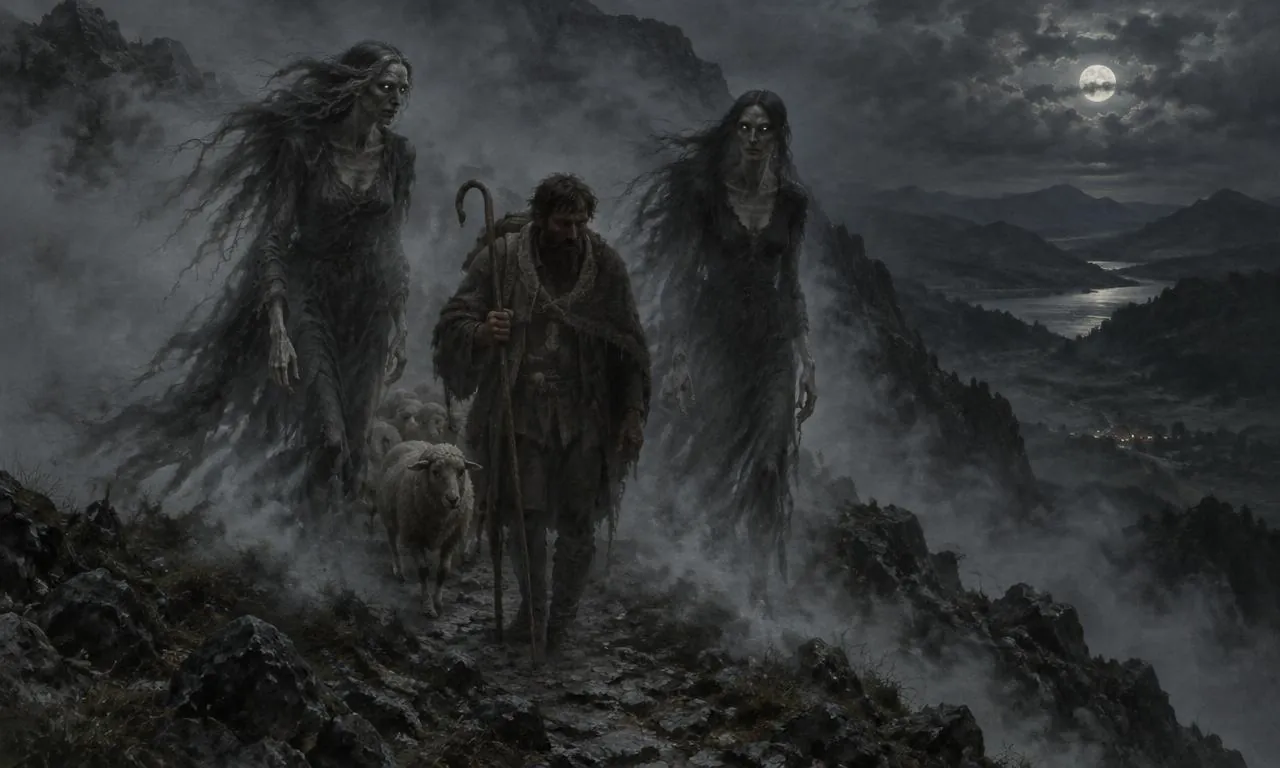
Anyone who has walked the Welsh hills knows how fast the weather turns. One minute the ridge runs clear ahead of you; the next, the cloud has come down and you cannot see your own boots. The path you were on is gone. Every direction looks the same. And that, the old shepherds said, is when the Gwyllion come.
The Gwyllion are the female spirits of the mountain — hags of the heights, older and rougher than the dancing Tylwyth Teg of the valleys. They are usually described as tall, thin and hideous, grey as the rock, wrapped in ragged grey cloaks, with long pale faces. Sometimes they carry a pot or a pail. Sometimes they are hardly there at all, and seem to be made of the mist itself, a shape that thickens and thins as you look.
What they do is simple. They walk with you. A traveller lost on the mountain would find a figure keeping pace just ahead, or just to one side, always seeming to know the way. Follow, and you would be led further and further off the path — into a bog, around in circles, toward the edge of a crag — until dawn found you miles from where you meant to be, or never found you at all.
The best-known of them was the Old Woman of the Mountain, who haunted the hills around Llanhyddel in Monmouthshire. Travellers told of an old woman in a grey cloak and a four-cornered hat, walking ahead of them in the dusk with a pail on her arm. If they called out to her for help, she would answer with a long, mournful cry of 'Wwb!' — and then they would be truly lost. Some said she had been a real woman, a witch in life, who had been doomed to walk the mountain after death.
There were ways to protect yourself. The Gwyllion were said to be terrified of iron, and especially of knives: draw a knife, or even hold one openly in your hand, and they would melt back into the mist. A few old tellings say they would come down into farmhouses on stormy nights to warm themselves by the fire, and the family would leave them in peace, clean water and a clear hearth, and not dare to have a knife anywhere in sight. Politeness helped too. It never paid to insult anything you met in the mountain mist.
They sit in the same dark family as the Gwrach y Rhibyn, the hag who beats at windows to foretell death, and the corpse-candles and marsh-lights that lead travellers into bogs. What they share is a very Welsh understanding of the land: beautiful, yes, but not tame, and not on your side unless you give it reason to be.
Wear the Gwyllion and you carry the high moors with you — the cloud coming down, the path vanishing, and a tall grey figure keeping perfect pace at your shoulder.