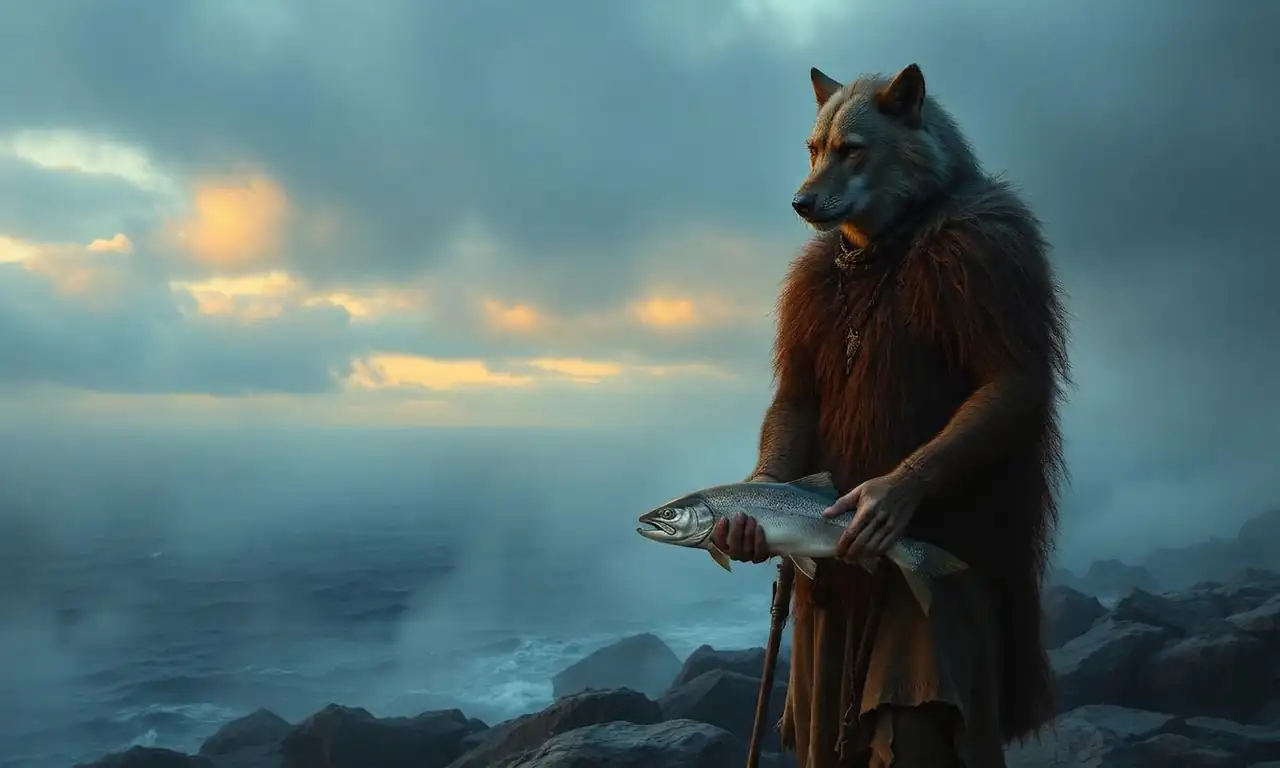
Most of the wolf-headed creatures in European folklore are something to fear. Not the Wulver. On the Shetland Islands, the Wulver was something quite different — a solitary, gentle figure with the body of a man covered in short brown fur and the head of a wolf.
He lived alone in a cave on the side of a steep hill known as Wulver's Hool. He bothered no one. He kept to himself. And he spent his days fishing, sitting patiently on a rock the islanders came to call the 'Wulver's Stane', where he was said to catch more than any human angler.
What made him beloved is what he did with the fish. He left them, quietly, on the windowsills of poor families — widows, the elderly, the sick. He did not knock. He did not ask for thanks. By the time anyone looked outside, he was gone.
The Wulver is one of the loveliest creatures in British folklore precisely because he breaks the rule. Folklore is full of monsters who look human and turn out to be terrible. The Wulver looks like a monster and turns out to be the kindest neighbour on the island.
He survived in Shetland tradition into the 19th century, recorded by the folklorist Jessie Saxby, who described him as 'a kindly being'. A gentle reminder that wildness and goodness are not opposites.
If something brown and quiet ever leaves a fresh fish on your windowsill, the Shetlanders would tell you the same thing: do not be afraid. Just be grateful, and leave a little something out in return.