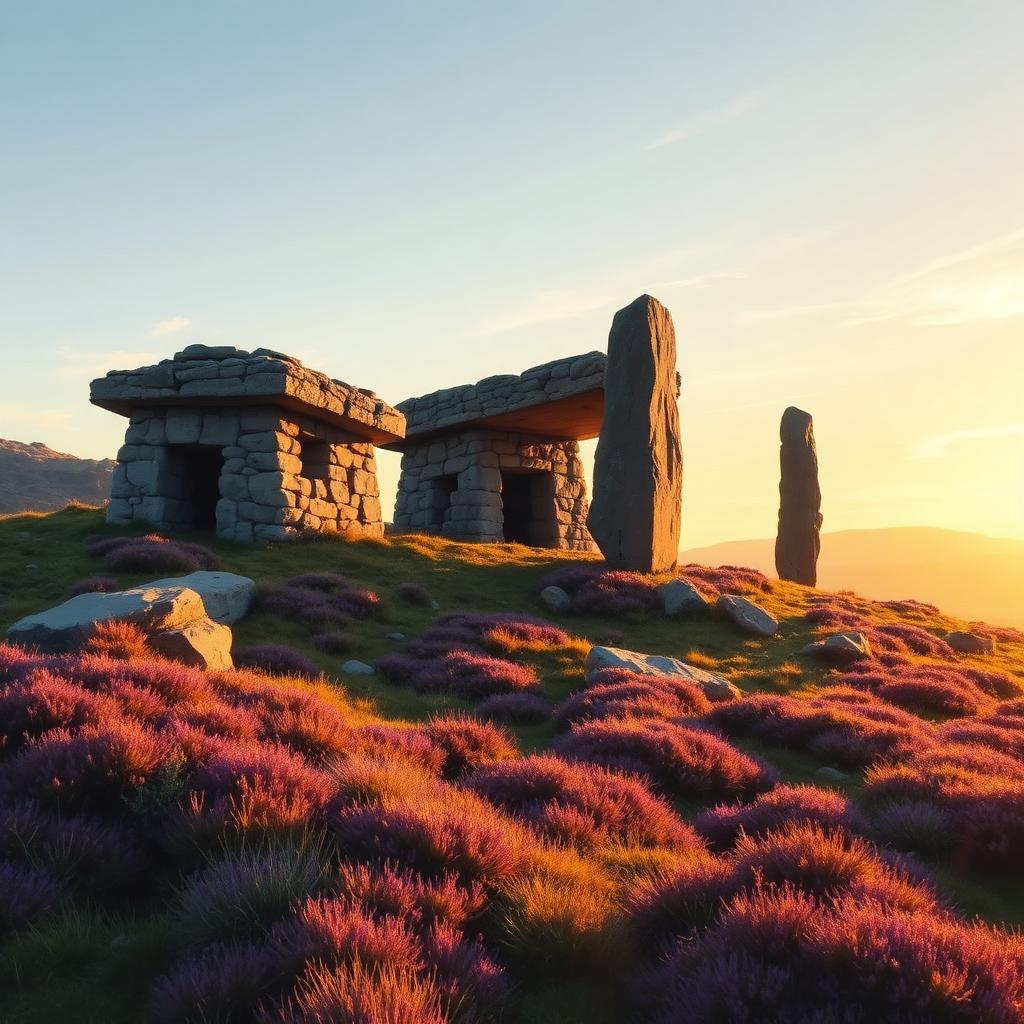
Trefignath is one of the oldest built things on Ynys Môn. The monument — three Neolithic burial chambers built in sequence on a single low rocky outcrop, just outside Trearddur on Holy Island — is now generally dated to between 3750 and 3000 BC. It was excavated in the 1970s and 1980s by Christopher Smith and Frances Lynch, who showed that the western chamber was built first, the central chamber added later, and the eastern chamber added later still, the whole thing developing over something like seven hundred years. By any reasonable measure, the people who finished it were already living among ancestors who had been buried there for thirty generations.
The folk-explanation is much simpler and much faster. Trefignath, the people of Holy Island said, was three sisters. They had been good Christian girls — this is, importantly, a post-Norman, post-conversion version of the story — but one Sunday morning, instead of going to church, they went out to dance on the rocks above Trearddur Bay. A passing saint, depending on the teller either Cybi himself or one of his successors, came up the hill, saw the dance, and cursed them on the spot. They were turned where they stood into three pillars of grey rock, and there they have remained ever since.
The three-sisters-turned-to-stone story is, in fact, attached to a great many British megaliths. The Hurlers in Cornwall are sometimes-Cornish-men turned to stone for hurling on a Sunday. The Merry Maidens of Boleigh are nineteen women turned to stone for the same offence. The Rollright Stones in Oxfordshire are a king and his knights, plus the stones of five whispering counsellors, turned to stone by a witch. Whenever Christianity met a megalith in Britain, the standard local response was to turn the megalith into a punishment.
What is interesting about Trefignath specifically is the calendar of the stones. The orientation of the chambers, particularly the eastern chamber, lines up neatly with the rising sun at the equinoxes. The Neolithic builders of Holy Island, like their cousins at Bryn Celli Ddu and Barclodiad y Gawres, were tracking the sky from the moment they raised the first orthostats. That the story turned, by the eighteenth century, into a story about Sabbath observance is one of those small Welsh ironies: the original builders were almost certainly using the stones to measure exactly the kind of cycle the saint was punishing the sisters for honouring.
Trefignath today is unfenced, unticketed and signposted from the lane. The chambers are roofless, the orthostats lean a little, and three of the largest stones do, if you squint into a Holy Island sunset, look very faintly like three figures caught mid-dance.
Wear something inspired by Trefignath and you wear the older calendar of Ynys Môn — the Neolithic measurement of the year, dressed up by later centuries as three girls who should have been in church.