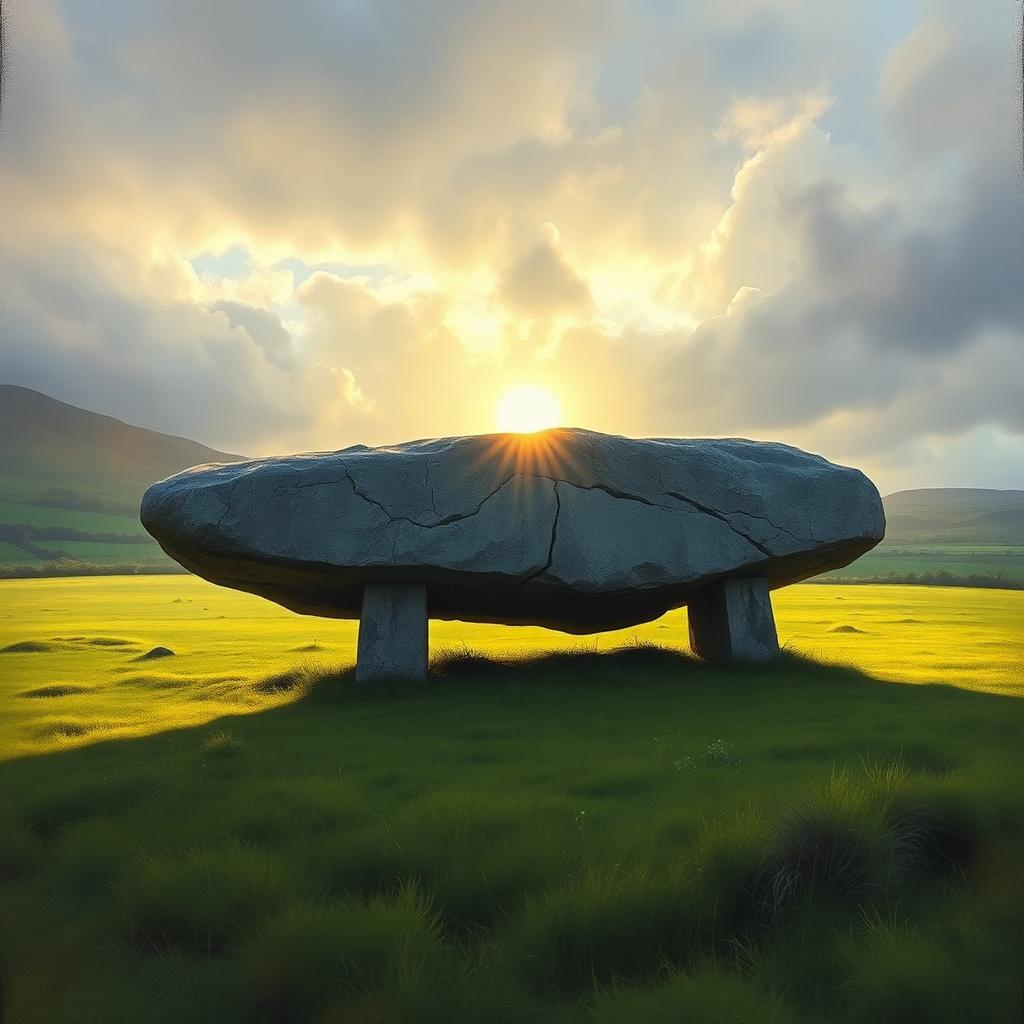
A short walk inland from the cove at Lligwy, in the parish of Penrhosllugwy near Moelfre on the north-east coast of Ynys Môn, there is a Neolithic burial chamber that no one ever forgets after they have seen it. Lligwy Cromlech is built low to the ground — the capstone hangs only about three feet above the grass — but the capstone itself is the thing. It is a single slab of limestone, eighteen feet across, five feet thick, and weighing somewhere in the order of twenty-five to twenty-eight tonnes. It is the heaviest capstone, by a clear margin, of any megalithic monument in Wales.
The chamber underneath it was excavated in 1908 and 1909 by E. Neil Baynes of the Cambrian Archaeological Association. He found, in a small pit cut into the rock floor below the capstone, the disarticulated bones of between fifteen and thirty individuals — men, women, children — together with pottery, bone pins, and the scattered teeth of dogs. The deposit was the work of many generations. The bones were broken and re-broken and re-arranged for centuries inside the chamber, which is how communal Neolithic tombs in this part of Britain were supposed to work. The capstone above the chamber was simply the lid.
Which raises the question that the people of Penrhosllugwy and Moelfre have been asking for at least three hundred years and probably much longer. How was the lid put on? The eight low orthostats supporting the slab are well-placed but unremarkable. The capstone is preposterous. To raise twenty-eight tonnes a yard off the ground in 3500 BC, without metal, without the wheel, and on damp Anglesey clay, you need either an enormous and very well-organised labour force — the modern archaeologist's answer — or one giant.
The folk-tradition picked the giant. He was called, in some versions, simply 'the Cawr of Lligwy,' and he was said to have died of exhaustion immediately after raising the slab, and to have been buried by his sons in the chamber beneath it, with the capstone he had just lifted laid over him as his own personal lid. The bones found in 1908 — the children's teeth, the women's femurs — were politely ignored by the storytellers. The capstone is the giant's grave. Nothing else matters.
The site is in the care of Cadw now, freely accessible, signposted from the lane and a five-minute walk across two fields. The capstone is still very large. If you stand under one corner of it and look up, the explanation involving a giant becomes, briefly, very plausible.
Wear something inspired by the Giant of Lligwy and you wear the most engineering-defying lid in Welsh prehistory — and the long-standing Anglesey conviction that the easiest way to account for it is to put a sleeping giant underneath.