Most people meet the Cyclops the way Homer wanted them to — as Polyphemus, the cave-dwelling shepherd who eats Odysseus's men two at a time and gets a sharpened olive stake driven into his single eye for his trouble. That is the famous story. It is also the late story.
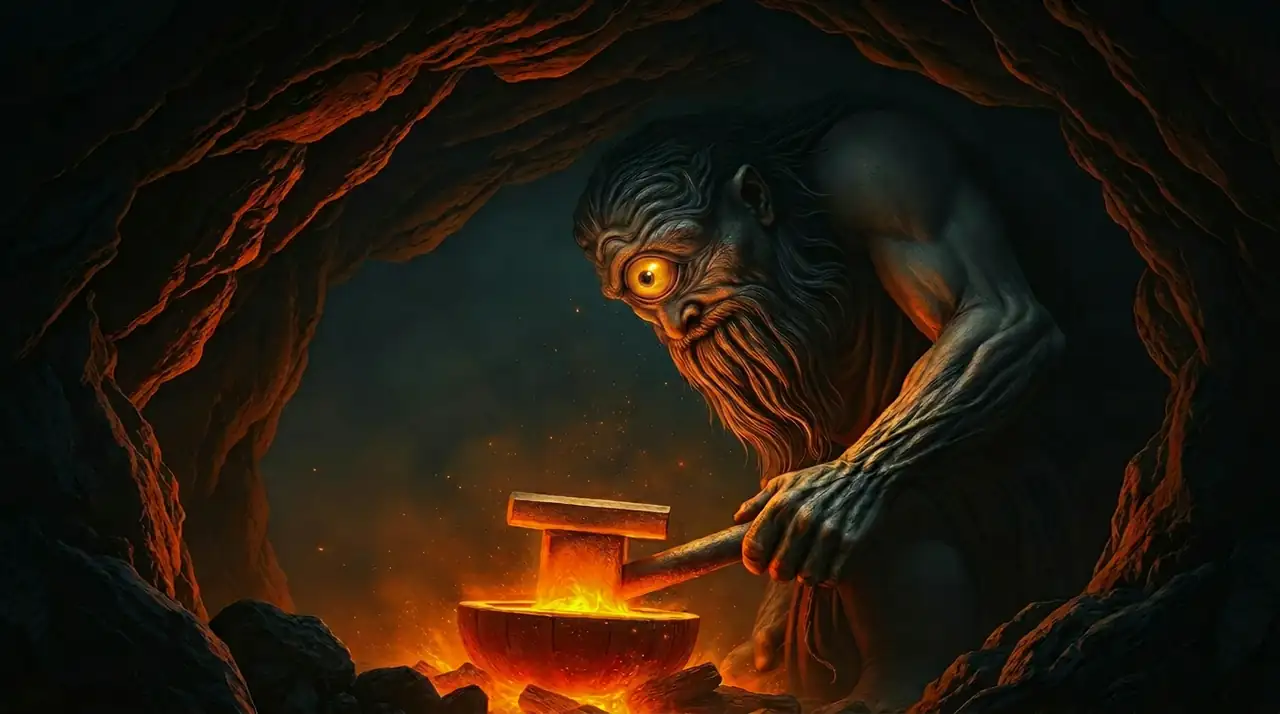
The older Cyclopes were not monsters. They were craftsmen. Hesiod, writing centuries before Homer, names three of them — Brontes, Steropes and Arges, meaning Thunder, Lightning and Bright — and gives them a job: they forged Zeus's thunderbolts. They forged Poseidon's trident. They forged Hades' helm of invisibility. Without the Cyclopes, the gods of Olympus would have been weaponless. They were the first armourers of the universe.
The single eye is the giveaway. Ancient smiths in Greece and Anatolia really did sometimes wear a leather patch over one eye, to protect it while watching molten metal with the other. A whole guild of one-eyed forge-workers in the volcanic hills of Sicily and around Mount Etna may well be the seed of the legend. The cave full of fire and noise. The single bright eye in the dark. The hammer that never stops.
Then Homer came along and gave us Polyphemus, and the older story was almost forgotten. The Cyclops became a brute. But the truth underneath is more interesting — that the gods themselves owed their power to a hidden race of giants who worked in fire, and that 'one eye' once meant 'master craftsman' before it ever meant 'monster'.
Wear the Cyclops and you wear the older meaning. Forge-light. Single focus. The thing that makes the lightning rather than the thing that hurls it.