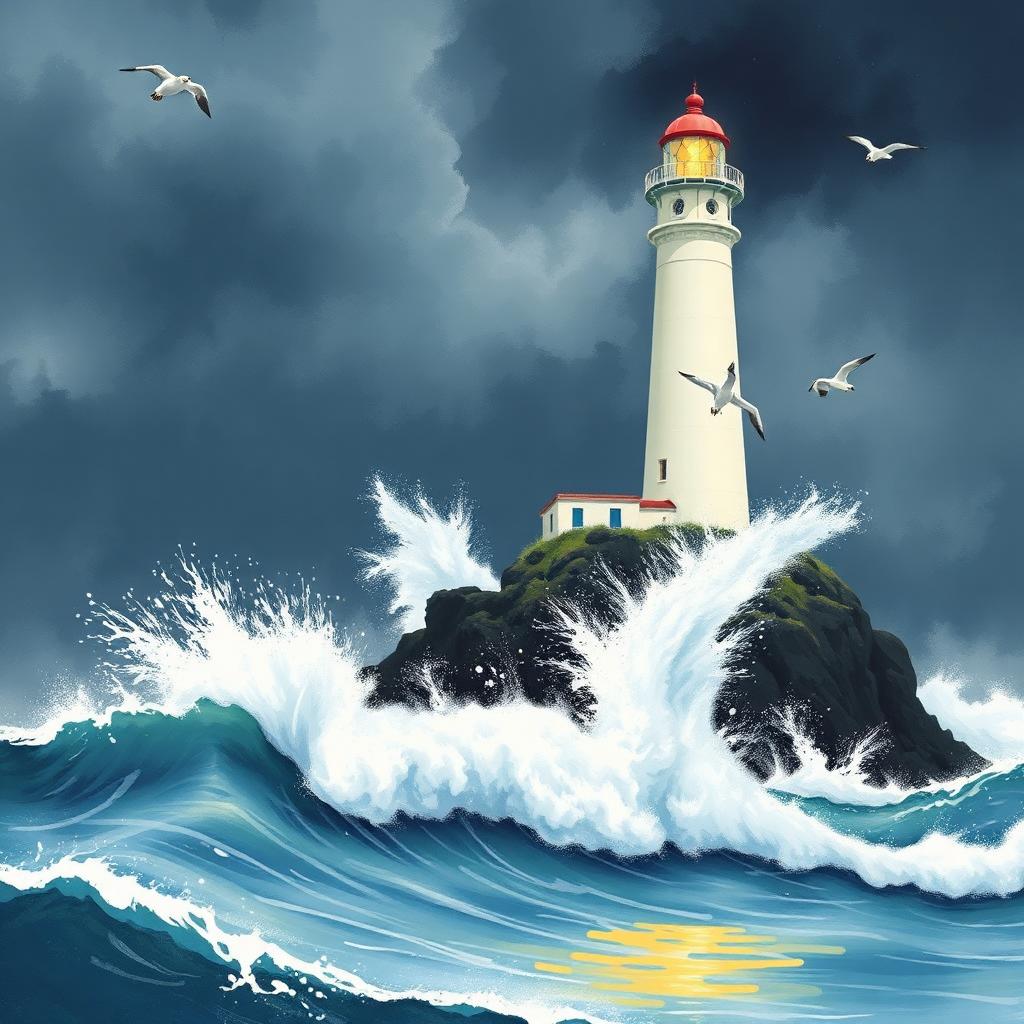
South Stack — Ynys Lawd in Welsh — is the small jagged island of folded quartzite that sits just off the cliffs at the north-western corner of Holy Island. The white lighthouse on its summit was lit for the first time on 9 February 1809 and has not gone dark for any meaningful length of time since. The stack itself is one of the most violent pieces of coastline in north Wales: vertical cliffs of layered Precambrian rock, a sheer four-hundred-foot drop to the Irish Sea, and a tide-race underneath that can run at five knots in either direction.
Long before the lighthouse, the cliffs above South Stack had a reputation. Sailors out of Holyhead and Liverpool said that on the wildest winter nights — south-westerly gales, low cloud, no moon — the rocks themselves sang. The voices were always women's voices. They were always wordless. And they were always loudest when a ship was already in trouble.
The local tradition gives them an origin. The voices were said to belong to women drowned at the base of the stack — wreckers' victims, the wives of fishermen lost at sea, suicides from the cliff-top — whose spirits had become bound to the rock and who now sang to bring others down to join them. They were Anglesey's contribution to the wider Celtic family of sea-women: cousin to the merrow of Ireland, the morgen of Brittany, the morgawr of Cornwall. Holy Island's version was unusually pitiless. The sirens of South Stack did not seduce; they wept, and ships followed the weeping.
There is no shortage of real wrecks to feed the story. The most famous is the *Royal Charter*, the steam-clipper that went down on the rocks at Moelfre on the other side of Anglesey in October 1859 with the loss of more than 450 souls — though her sisters lie all along the western coast. The records of Holyhead Coastguard contain dozens of smaller losses on or near South Stack itself, particularly before the lighthouse was lit. The standing local explanation, in the pubs at South Stack and Trearddur, was always the same: she heard them. She turned. She came in.
The path down to the lighthouse is now a steep four-hundred-step stairway clamped to the cliff, and you can walk across the suspension bridge to the stack itself in any weather but the worst. The seabird colonies in spring — guillemots, razorbills, puffins, the famous chough — make so much noise that there is no chance of hearing anything else. But come back on a December night, when the puffins have gone and the south-westerly is up, and stand on the cliff-top, and listen.
Wear something inspired by the Sirens of South Stack and you wear the western edge of Anglesey at its most dangerous and most beautiful: white rock, white lighthouse, black water, and a song you should never quite be sure you really heard.