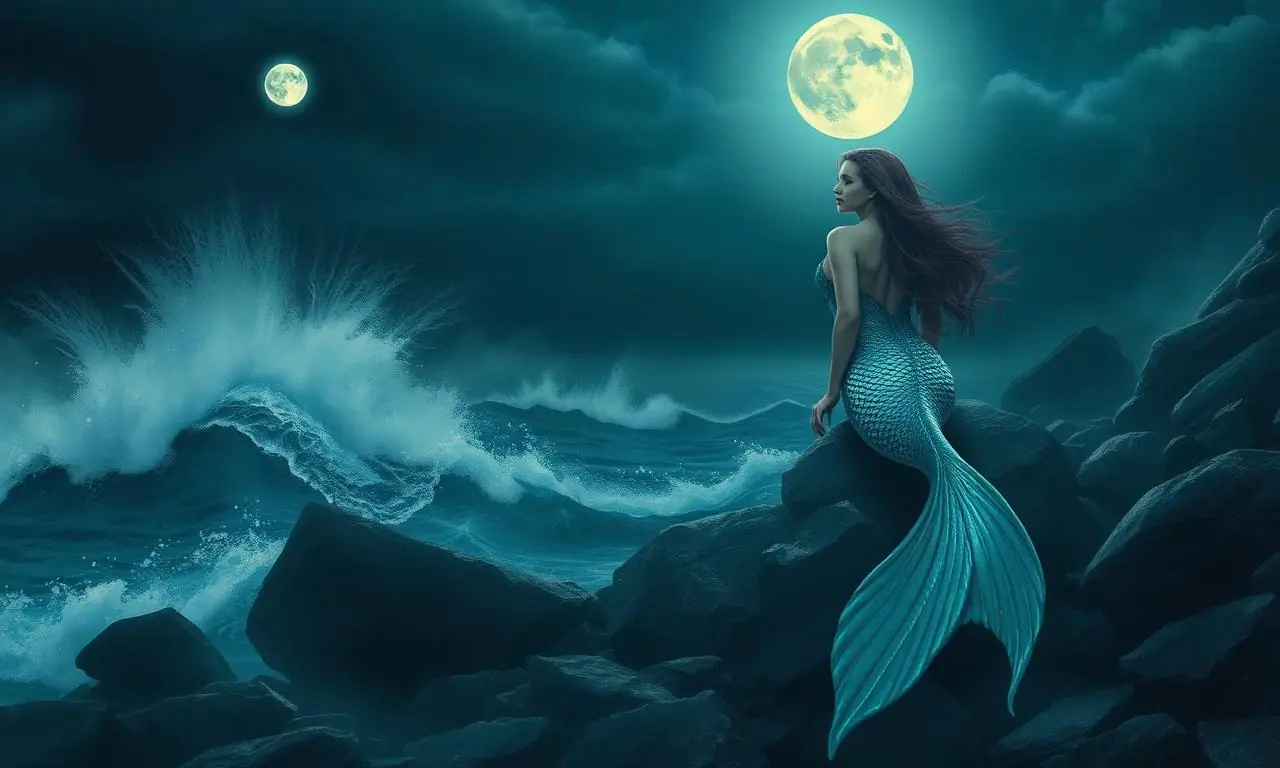
Mermaids appear wherever people live by the sea. Sailors glimpsed them in waves and seal-shapes, heard them in the wind through rigging, and blamed them when ships were drawn too close to rocks. They are beautiful, but their beauty is never safe.
In Celtic coastal folklore, the line between mermaid, sea-maiden, and selkie often blurs. A woman from the water may fall in love with a human, may grant a wish, may demand a promise, or may vanish the moment her seal-skin, comb, or secret name is returned to her.
The mermaid carries the sea's contradictions. She is desire and danger, rescue and wreck, tenderness and tide. She can be a warning to sailors, a guardian of hidden kingdoms, or a symbol of longing for a world just out of reach.
These stories make sense on islands and coastlines. The sea gives life, food, roads, and wonder — but it also takes without apology. To imagine it with a human face is to admit both love and fear.
A mermaid on the rocks is never only a figure of beauty. She is the sea looking back.