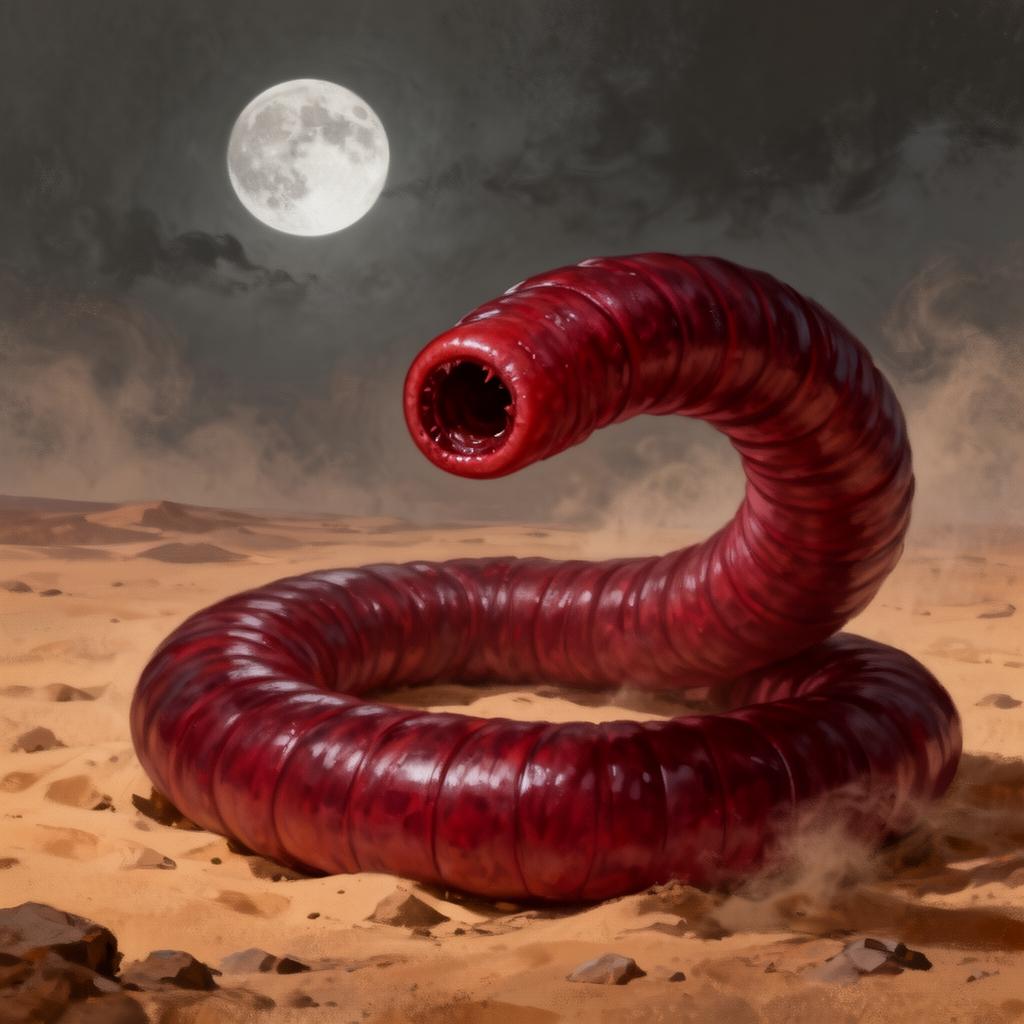
The Mongolian Death Worm — in Mongolian, *olgoi-khorkhoi*, literally "large intestine worm" — is one of the strangest cryptids on Earth, partly because it is so consistently described and partly because almost nobody outside the Gobi Desert has ever heard of it. Nomadic herders of southern Mongolia have spoken about it for as long as anyone has kept records. The British paleontologist Roy Chapman Andrews, hunting dinosaur fossils in the 1920s, recorded the Mongolian Prime Minister himself solemnly describing it to him, and asking him to be careful.
The descriptions barely vary. About four to five feet long. Thick as a man's arm. Bright blood-red, sometimes described as the colour of fresh sausage. Both ends look identical — no obvious head, no eyes — and it moves in awkward sidewinder motions across the sand. It is said to spend most of the year buried in the dunes, surfacing only after summer rains, especially in the southern Gobi.
It is the killing methods that have made it famous. According to the nomads, the worm can spit a yellow corrosive venom that dissolves anything it touches; can deliver an electric shock strong enough to kill a camel from several feet away without making contact; and — in the most dramatic claim — can kill a man simply by being looked at, the way some serpents in older folklore are said to. Touching one is fatal. Approaching one is unwise. The standard advice from herders has always been: if you see it, walk slowly the other way.
Cryptozoologists have spent over a century trying to find it. The Czech explorer Ivan Mackerle led several expeditions in the 1990s, using explosives to try to provoke a sighting (it didn't work). British and American teams have followed. So far, no specimen, no photograph, no skeleton — just a thousand consistent eyewitness accounts from people who live in one of the harshest places on Earth and are not, on the whole, given to fantasy.
Mainstream science suggests it might be a glimpse of a real but undescribed species of amphisbaenian (worm lizard), exaggerated by oral tradition. The Gobi nomads suggest, politely, that the scientists are welcome to think that.
Wear the Death Worm and you wear one of the most unsettling pieces of folklore in central Asia — proof that the desert keeps its own gods, and you are very rarely the first thing buried out there.