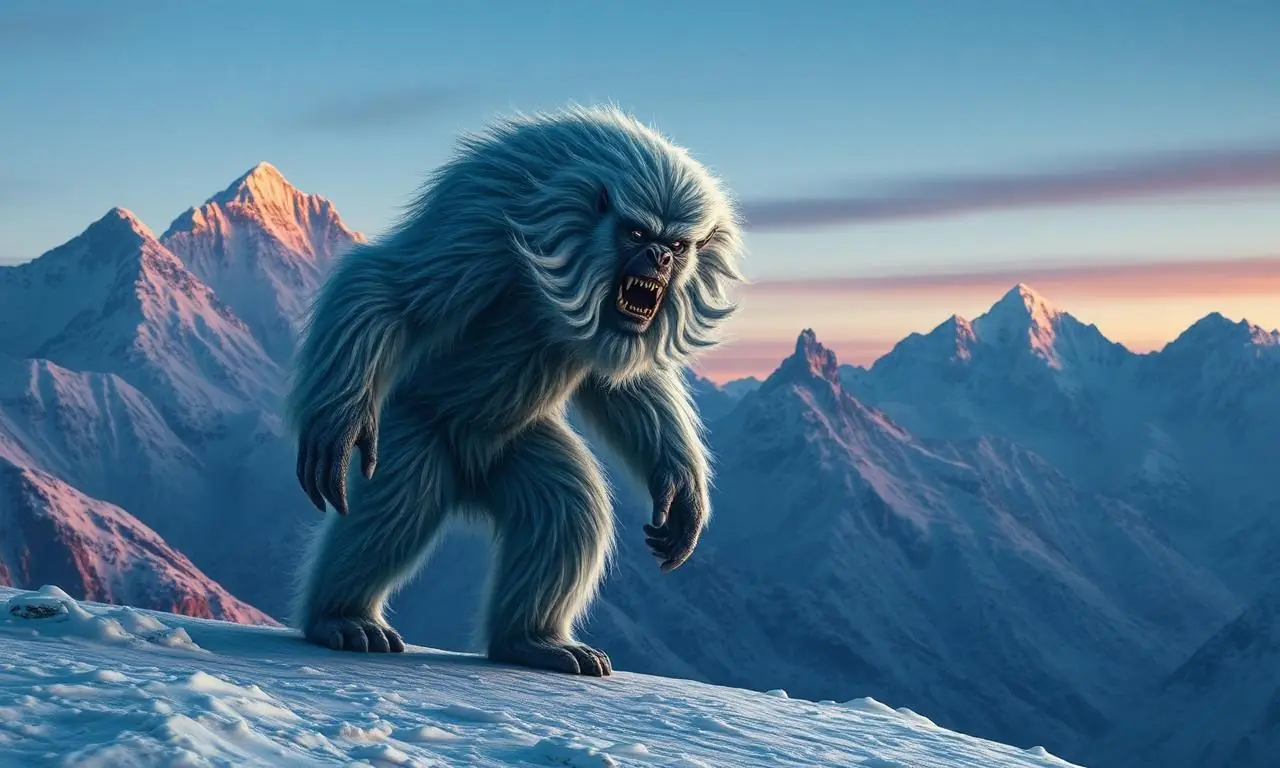
Long before Western mountaineers ever set foot on Everest, the Sherpa and Tibetan peoples of the high Himalaya were telling stories of something living up there with them. They called it Yeh-teh — roughly, 'that thing'. A polite name for a creature you did not particularly want to attract.
In Sherpa folklore the Yeti is not one creature but several. The Dzu-teh is the largest — a great cattle-killing beast of the high valleys. The Meh-teh is the man-shaped one, walking upright on two legs, covered in reddish-brown or white fur. The Mi-go is the smaller, more elusive cousin. All of them belong to the snow line, the borderland between human villages and the empty peaks. All of them are best left alone.
The first European mention came in 1832, when the British naturalist B.H. Hodgson reported a tall, hairy creature seen by his porters in northern Nepal. The legend went global in 1921, when Lt. Col. Charles Howard-Bury, leading the British Mount Everest reconnaissance expedition, reported large humanoid footprints high on the mountain and a Sherpa name his interpreter rendered as 'metoh-kangmi' — the 'abominable snowman'. The name was a mistranslation. The story was unstoppable.
Then came 1951. The mountaineer Eric Shipton, on the slopes of the Menlung glacier near Everest, photographed a single line of enormous footprints in fresh snow. The famous picture — a boot and an ice-axe placed beside one print for scale — has been argued over ever since. Bear? Langur monkey? Footprints melted out of shape by the sun? Or something else? No one has produced a body, and no one has produced a definitive answer.
Modern DNA analysis of supposed Yeti hair samples has consistently come back as Himalayan brown bear or Tibetan blue bear — both of which can stand upright, both of which are huge, and both of which could plausibly explain the prints and the silhouettes. The cryptozoologists are unconvinced. The Sherpa, on the whole, are not interested in the argument.
What everyone agrees on is the silence up there. Above the snow line, in the empty white between the camps, there is a quality of stillness that turns even hardened climbers superstitious. Something walks the Himalaya in human stories whether it walks them in flesh or not. Wear the Yeti and you wear the great white question mark of the world's highest mountains — the one creature that we still, after two centuries of looking, cannot quite catch.