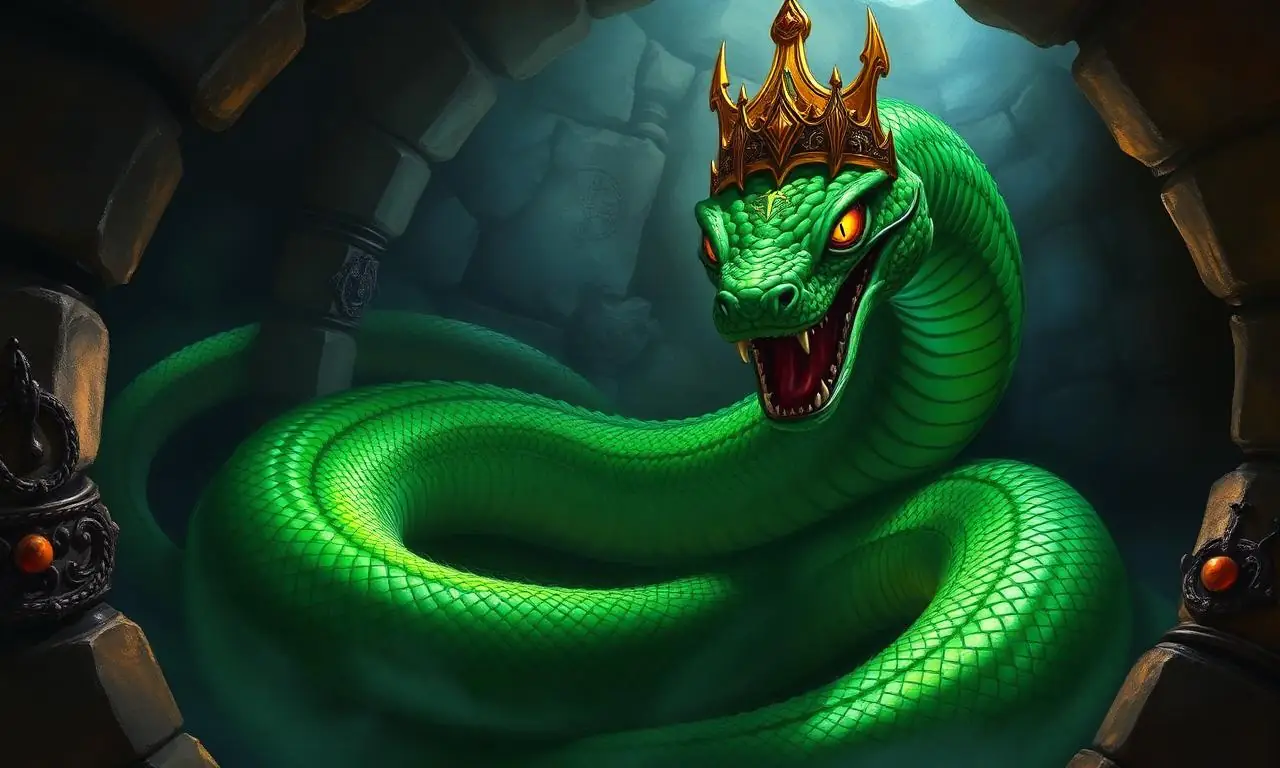
The basilisk is one of the strangest beasts in the medieval imagination — a creature so deadly that, according to the bestiaries, it could kill with a single look, wither plants by passing over them, and crack stone by breathing on it.
The Roman writer Pliny the Elder gave us the earliest detailed account, in the 1st century AD. He described a small serpent from the deserts of Cyrenaica — only a few inches long — with a white crest on its head shaped like a tiny crown. From this crown came the name: basiliskos, 'little king'. To Pliny, it was the king of all serpents, and every other snake fled from it.
By the medieval period the basilisk had grown stranger and far more dangerous. It was now said to be born from a most unnatural birth: an egg laid by an old rooster, brooded by a toad or a serpent, hatched in the dark of a cellar. From this twisted parentage came a creature of pure malice, whose breath was poison and whose eyes carried death.
The defences against it were as strange as the beast itself. A mirror could destroy a basilisk by turning its own gaze back upon it. A weasel — alone of all animals — was said to be immune to its venom and could fight it in its lair. The crow of a rooster would kill it on the spot, which is why medieval travellers were occasionally advised to carry a cockerel.
Real outbreaks were once blamed on basilisks. In 1474, the citizens of Basel in Switzerland tried, convicted and burned a rooster for the crime of laying an egg, in case a basilisk hatched from it. In 1587, an outbreak of plague in Warsaw was attributed to a basilisk lurking in a cellar, and a condemned criminal was sent in wearing a suit of mirrors to slay it.
The basilisk endures because it makes literal something we already half-believe: that there are looks that wound, words that poison, and small things — small kings — that are far more dangerous than they ought to be.