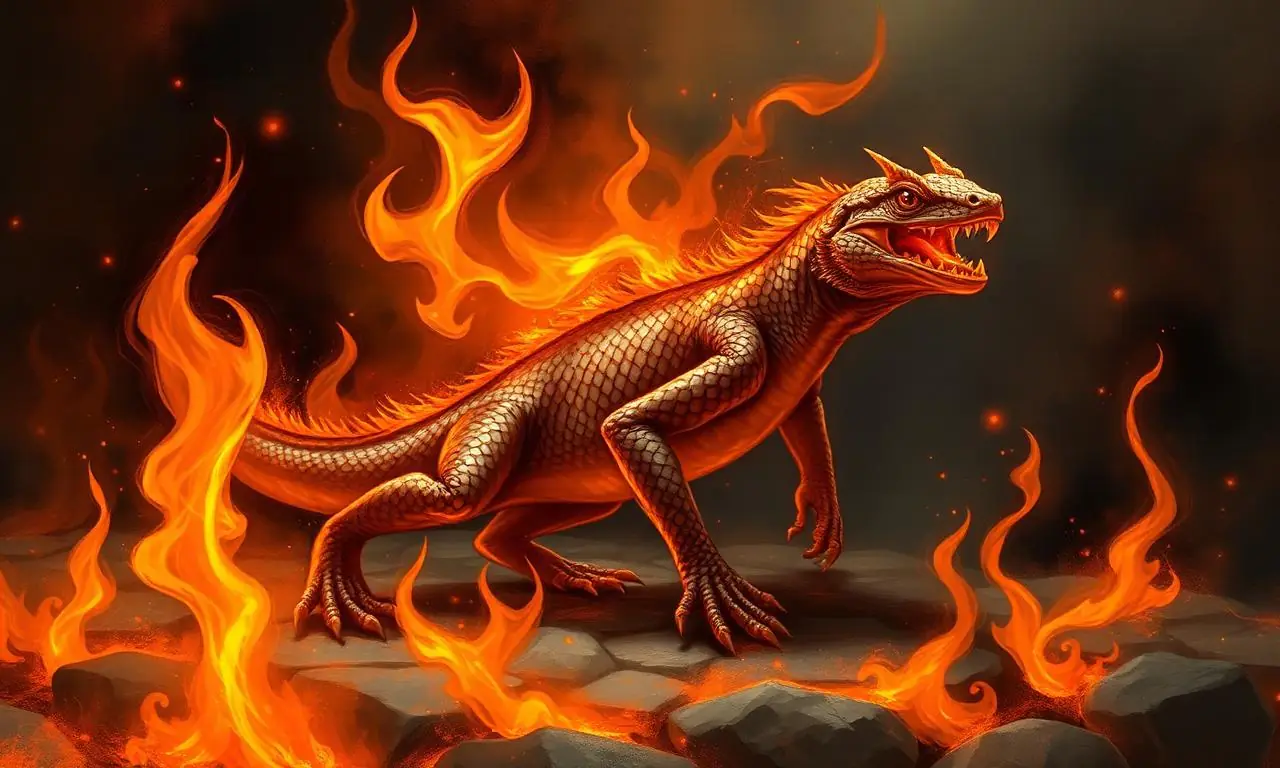
Of all the strange beasts in the medieval bestiary, the salamander is the one that confused everyone the most. A real, living amphibian — small, spotted, cold to the touch — wrapped in centuries of legend that turned it into something half-dragon, half-spirit of the flame.
The story begins with the Roman writer Pliny the Elder. He claimed the salamander was so cold-blooded that it could put out a fire simply by walking through it. By the time the medieval bestiaries were copied in monastery scriptoria across Europe, the creature had grown stranger still: a little lizard born of fire, living in the heart of the flame, unharmed by the heat.
Some said its skin could be woven into a cloth that would not burn — and sceptical readers were occasionally shown 'salamander wool' by travelling merchants, which was actually asbestos. Some said it was so venomous that if it climbed a fruit tree, every fruit became poison. Some said its blood was the only ink that could write a true name in the book of life.
Saint Augustine used it as proof that the souls of the wicked could burn forever without being consumed. Alchemists made it the symbol of the element fire itself, and you will still find a salamander curled in the flames on the title page of half the alchemical manuscripts in Europe.
The truth is gentler. The actual fire salamander, Salamandra salamandra, is a small black-and-yellow amphibian that hides in damp logs. When the logs were thrown on a fire, the salamander would scurry out — and to a medieval audience watching a creature emerge alive from the flames, the legend wrote itself.
We love the salamander because it is one of the rare mythical creatures that asks you to see fire differently. Not as destruction, but as a place something can live. A reminder that the things we fear most are sometimes only somebody else's home.