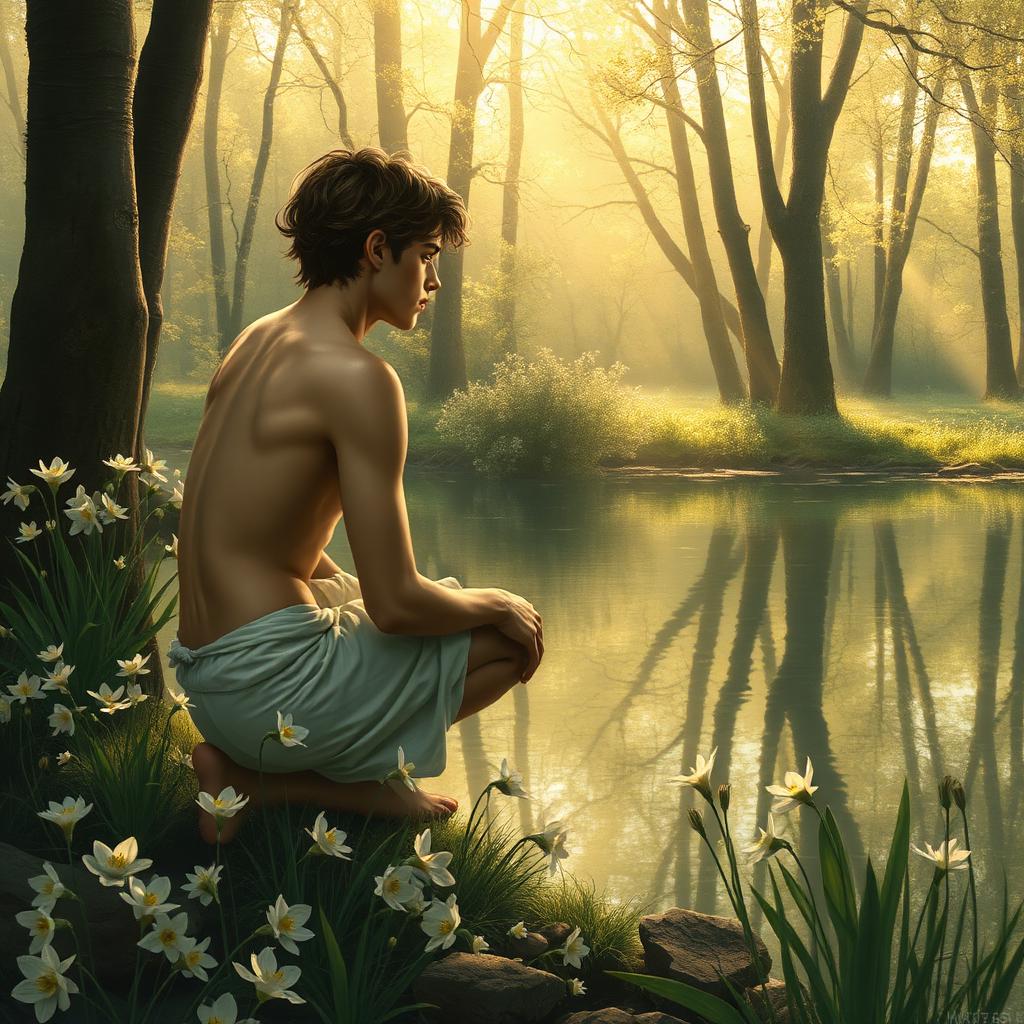
Narcissus was the son of the river-god Cephissus and the nymph Liriope, born in the green hills of Boeotia in central Greece. At his birth, his mother went to the blind prophet Tiresias and asked the standard question every Greek mother asked: would the boy live a long life? Tiresias gave the most Greek answer possible. "Yes," he said, "so long as he never knows himself."
He grew into a young man of such striking beauty that nymphs, gods and mortals all fell for him on sight. He refused them all. The mountain nymph Echo, cursed by Hera to only repeat the last words spoken to her, followed him through the woods one day; when he turned and called "Who's there?" she could only echo him back. He recoiled in disgust. Heartbroken, she faded away into the rocks until only her voice remained.
The other rejected lovers prayed for vengeance, and Nemesis — the goddess of cosmic comeuppance — heard them. She led Narcissus, after a long hunt one summer day, to a perfectly still pool deep in the forest. He knelt to drink.
He saw, in the water, the most beautiful face he had ever seen. He did not realise it was his own. He reached for it; the water broke. He waited; the face returned. He spoke to it; it shaped his words back without sound. He could not leave. He could not look away. The Roman poet Ovid, who tells the fullest version of the myth in his Metamorphoses, has Narcissus understand the trick at the very end — and not be able to stop staring anyway.
He died there at the water's edge, the prophecy fulfilled: he had finally known himself, and the knowing had killed him. Where his body had lain the gods set a single white flower with a golden centre. We still call it narcissus. We also still call obsessive self-love narcissism, after the boy who could not stop looking.
Wear Narcissus and you wear the Greek world's earliest warning about the mirror — that the most dangerous thing you can fall in love with is the version of yourself that only exists when no one else is watching.