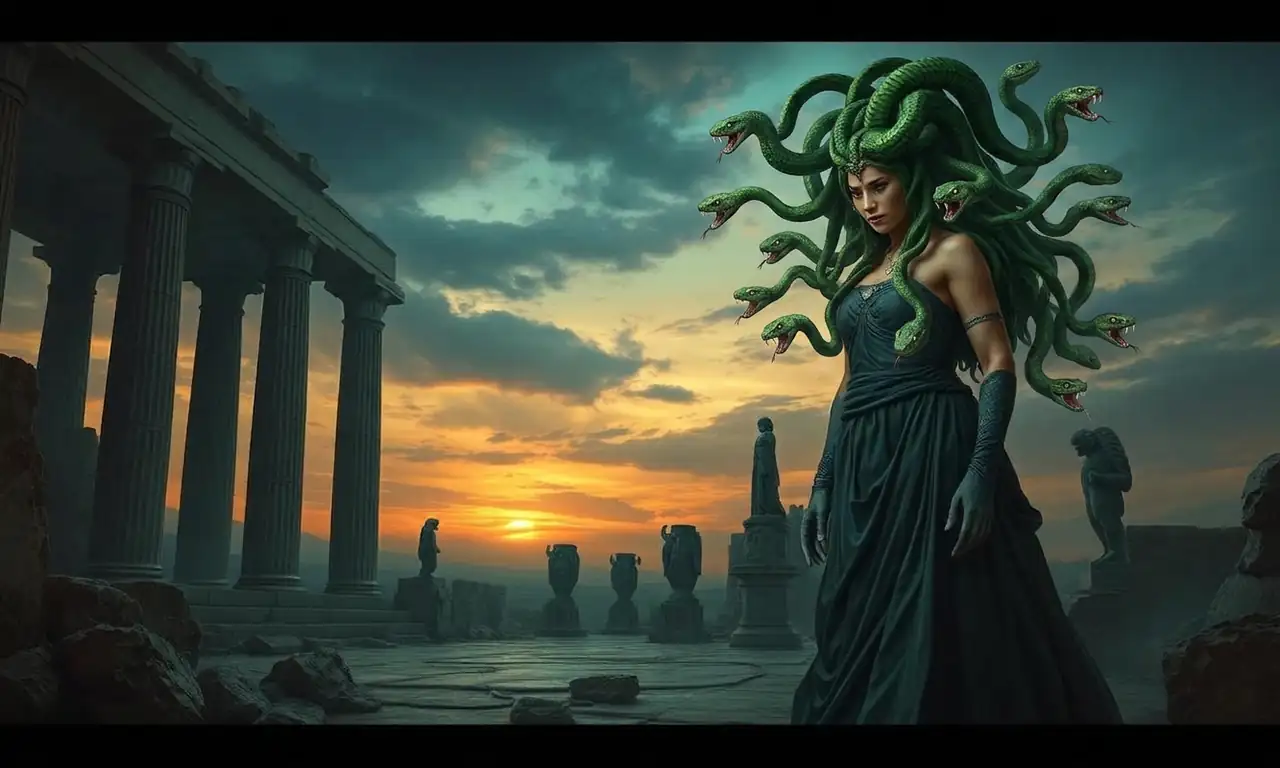
Medusa is one of the most recognisable figures in Western mythology: a Gorgon woman with serpents for hair, a gaze that turned the living to stone, and a head that ended up mounted on the shield of the goddess Athena. The image is everywhere. The full story is told much less often.
In the earliest Greek tellings, Medusa is simply one of three Gorgon sisters — Stheno, Euryale and Medusa — terrifying daughters of the sea deities Phorcys and Ceto. Of the three, only Medusa was mortal, which is the detail that sealed her fate.
The version most people know comes from the Roman poet Ovid, writing centuries later, and it is a darker story than the older Greek one. In Ovid's telling, Medusa was once a beautiful young priestess of Athena, sworn to a life of chastity in the goddess's temple. The sea god Poseidon desired her, pursued her, and assaulted her in Athena's own sanctuary. Athena, enraged at the desecration of her temple — but unable or unwilling to punish a fellow Olympian — turned her fury on Medusa instead. Her hair was transformed into serpents, her face into something no living thing could meet without being turned to stone.
She was banished to a remote island. She lived there alone for years, her gaze a curse she had not asked for, until the hero Perseus arrived under orders from a king who hoped he would not survive the errand. Perseus came armed with gifts from the gods: winged sandals, a polished shield from Athena (so he could see her only by reflection), and a sword from Hermes. He found her sleeping and cut off her head.
From the blood that fell, two creatures sprang fully formed — the winged horse Pegasus and the giant Chrysaor — children Medusa had carried since the night in the temple. Even her death gave the world something. Perseus took the head, used it to turn his enemies to stone, and finally gave it to Athena, who set it on her shield, the Aegis, where the Gorgon's face still glares out at any reader of Greek myth.
Modern readers have gone back to Medusa with new eyes. She is increasingly remembered not as a villain but as a survivor — a woman punished for what was done to her, made monstrous by a goddess who should have protected her, and turned in the end into a symbol that other women have reclaimed.
The serpents in her hair, the stone-cold stare, the long banishment — it is all there in the old myth. But so is something the old myth was not always brave enough to name: that the most fearsome face in Greek mythology belongs to a woman who deserved better.