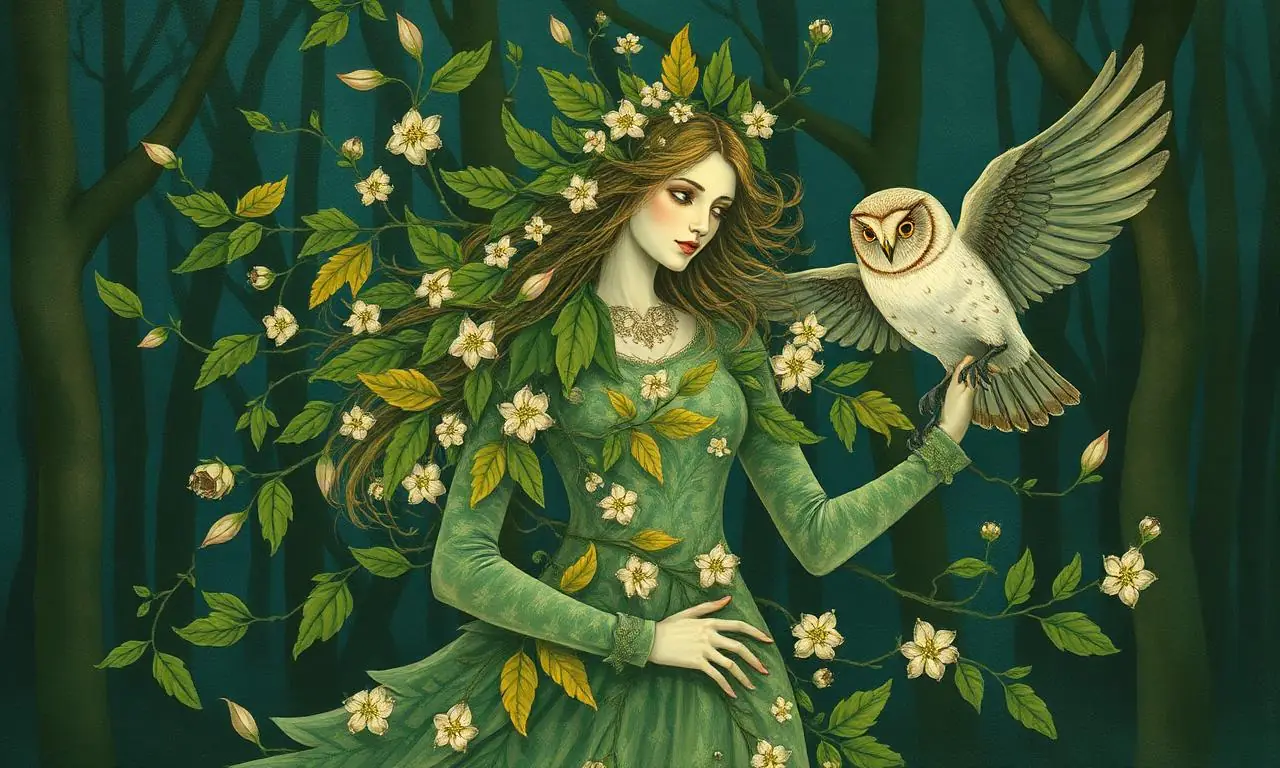
The Fourth Branch of the Mabinogi gives us one of the most strange and beautiful figures in Welsh mythology: Blodeuwedd, the woman made of flowers.
Lleu Llaw Gyffes, the hero of the tale, has been laid under a triple curse by his own mother — he may have no name, no weapons, and no wife of any race that walks the earth. The first two curses are tricked away by his uncle Gwydion. The third requires something stranger.
Gwydion and the great magician Math, son of Mathonwy, gather oak blossom, broom blossom, and meadowsweet. They work their magic over the flowers and shape from them a woman — radiant, gentle, and entirely new to the world. They name her Blodeuwedd, 'Flower-Face', and give her in marriage to Lleu.
But Blodeuwedd was made; she was not asked. And when Lleu is away, she meets a hunter, Gronw Pebr, lord of Penllyn. They fall in love. Together they plot Lleu's death — and because Lleu can only be killed under a near-impossible set of conditions, Blodeuwedd has to coax those conditions out of him in the name of love.
Gronw strikes the blow. Lleu does not die — he transforms into an eagle and flies away wounded. Gwydion eventually finds him, restores him, and returns to take vengeance.
The punishment for Blodeuwedd is the most chilling moment in the Mabinogi. Gwydion does not kill her. He turns her into an owl, condemned to fly only at night, hated and shunned by all other birds. 'Because of the shame you have brought upon Lleu,' he says, 'you shall never show your face to the light of day.'
It is the Welsh origin of the owl — and a story that still asks an uncomfortable question. Was Blodeuwedd evil, or simply the first woman in literature who refused to love a husband she had never been asked to want?