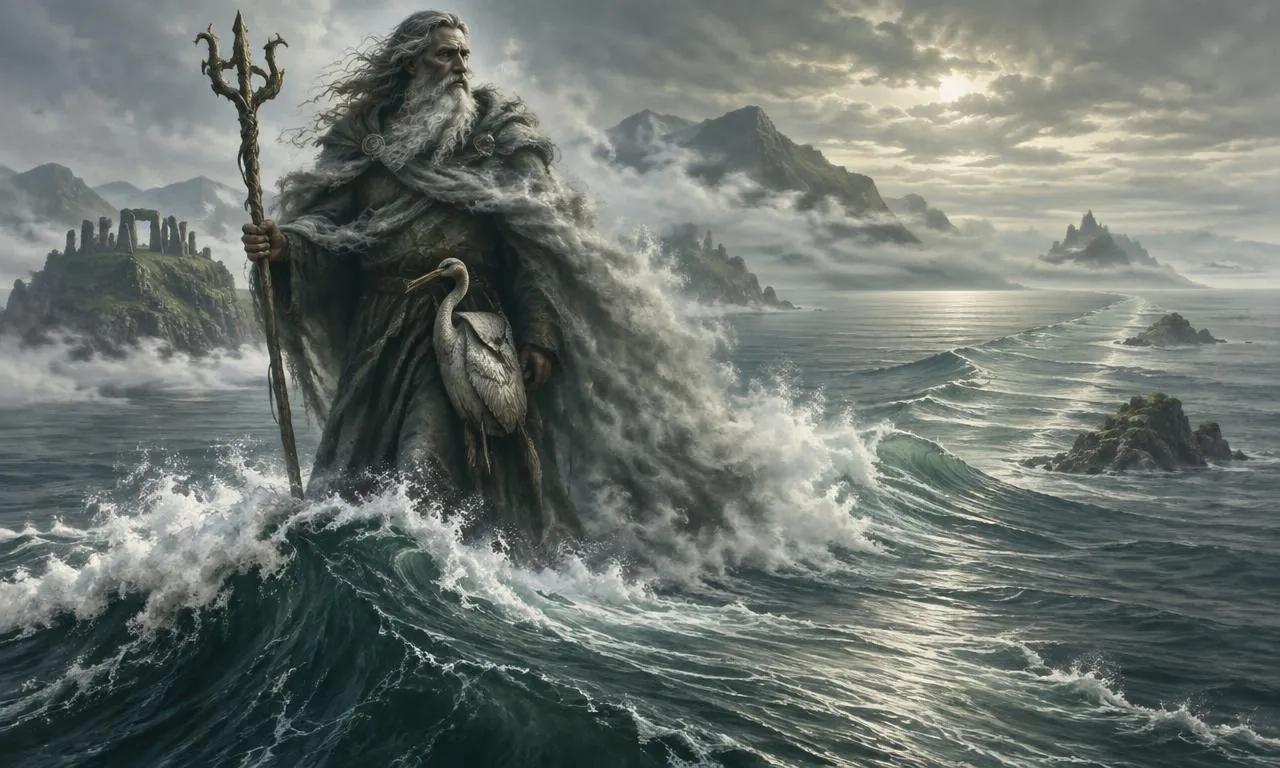
Manannán mac Lir — 'Manannán, son of the sea' — is the great sea god of Irish myth, and one of its strangest, cleverest figures. He is a lord of the Tuatha Dé Danann, but he stands a little apart from them. He is a guardian of the boundary between this world and the Otherworld, and the sea is that boundary.
To Manannán, the sea is not water at all. In the old tale of the Voyage of Bran, Bran and his men are rowing across the ocean when they meet Manannán driving a chariot over the waves. He tells them that what they see as sea, he sees as a flowering plain full of fruit; the leaping salmon are calves and lambs; the waves are fields. He is the god for whom the world's edges are only a matter of how you look at them.
He had marvellous possessions. His horse was Enbarr, who could run over sea as easily as over land. His ship, Scuabtuinne — the Wave-Sweeper — needed no oars or sails, and went wherever its master willed. His sword, Fragarach, 'the Answerer', could cut through any armour. And he had the crane bag, made from the skin of a crane who had once been a woman, which held treasures that could only be seen at high tide.
Most of all he had his cloak of mist. Manannán could draw fog over the sea at will, and with it he hid the Otherworld islands from mortal eyes: Emain Ablach, the Isle of Apples, sometimes placed at the Isle of Arran or the Isle of Man; and Tír Tairngire, the Land of Promise. The Isle of Man takes its name from him in one tradition, and Manx lore says he wraps the island in mist to hide it from enemies. Every sea-fog rolling onto the Irish coast could be his cloak.
He is also a foster-father. Many heroes were raised or protected by Manannán — Lugh among them, in several tellings — and he gave gifts, advice and escapes to those he favoured. He could be a trickster, too, turning up in disguise, playing tricks on kings, and appearing just when the story needed a push.
Manannán has close kin across the water. In Wales, the Mabinogi gives us Manawydan fab Llŷr — 'son of Llŷr' — whose name and family echo his, even though the Welsh stories cast him as a patient, clever craftsman rather than a sea lord. Both descend, in some sense, from Llŷr or Lir, the old sea figure of the Celtic world. The tragic Children of Lir are another thread of the same family of names, and the merrows who live under the Irish sea are, in a sense, his subjects.
Wear Manannán mac Lir and you wear the mist on the western sea — the veil between this world and the next, and the god who decides when to draw it back.