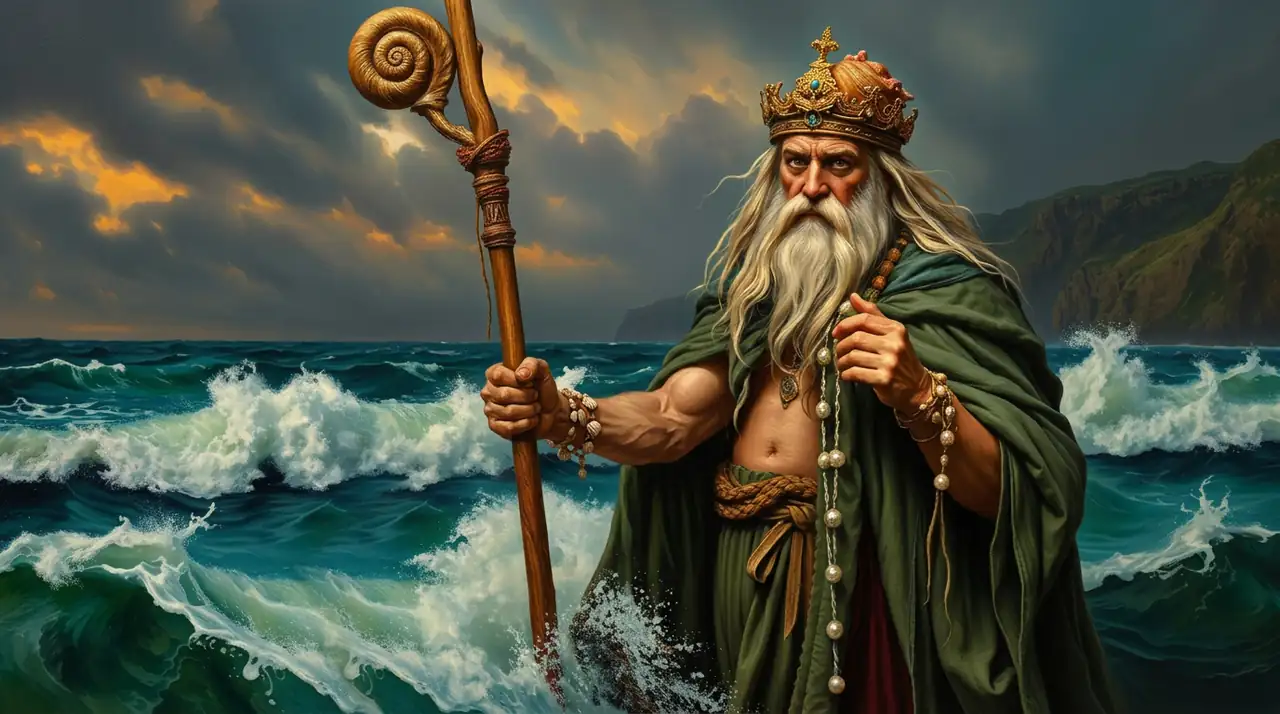
Llŷr is one of the deepest names in Welsh myth — older than the stories that survive, older than the Mabinogi itself. By the time the medieval scribes set down the Four Branches, he was already a half-remembered ancestor figure, known mostly through his children: Branwen, Bran the Blessed (Bendigeidfran), and Manawydan. The Second Branch is in fact called Branwen ferch Llŷr — Branwen, daughter of Llŷr — and the family line is referred to throughout as the Plant Llŷr, the Children of Llŷr.
But who was Llŷr himself? The name comes from a very old Brythonic root meaning 'sea'. In Old Welsh he is essentially the sea personified — the salt water, the Menai Strait, the great green deep that surrounds Britain on every side. He is the British counterpart of the Irish sea-god Lir (father of the Children of Lir, those four siblings turned into swans for nine hundred years), and the same root surfaces a thousand years later in Shakespeare's King Lear, by way of Geoffrey of Monmouth's Historia Regum Britanniae.
In the Mabinogi he is barely an active character — he has done his work generations earlier — but his presence ripples through every page. His son Bran the Blessed is so vast he wades the Irish Sea on foot. His daughter Branwen is married off across that same sea to the king of Ireland, with catastrophic results. His son Manawydan is the Welsh counterpart of the Irish sea-god Manannán mac Lir, walking calmly through enchanted lands. The Children of Llŷr are, in essence, the sea reaching inland — a divine family whose stories all turn on water, crossings, and what the tide brings home.
Welsh tradition placed Llŷr's seat firmly in the north-west — at the mouth of the Menai Strait, looking out across to Ynys Môn. The mound at Caer Llŷr (one of several locations claimed) was said to be his fortress. The strait itself, with its famously dangerous tides between the Anglesey shore and the mainland, was his domain — and to ignore Llŷr's water in those narrows is, even now, to invite disaster.
Geoffrey of Monmouth, writing in the twelfth century, took the name and built the legend of Leir of Britain — the half-mad king who divides his kingdom between three daughters and pays for it. Shakespeare took Geoffrey and made King Lear. The howling old man on the storm-lashed heath is, at the very bottom of the line, Llŷr — the sea-god who became a king who became a tragedy, his name still meaning the same thing it meant before the Romans came: salt water in motion.
Wear Llŷr and you wear the deepest layer of Welsh myth — the tide that all the other stories sit on top of, the ancestor whose children became most of the Mabinogi, the sea between Anglesey and the mainland that never quite forgets him.