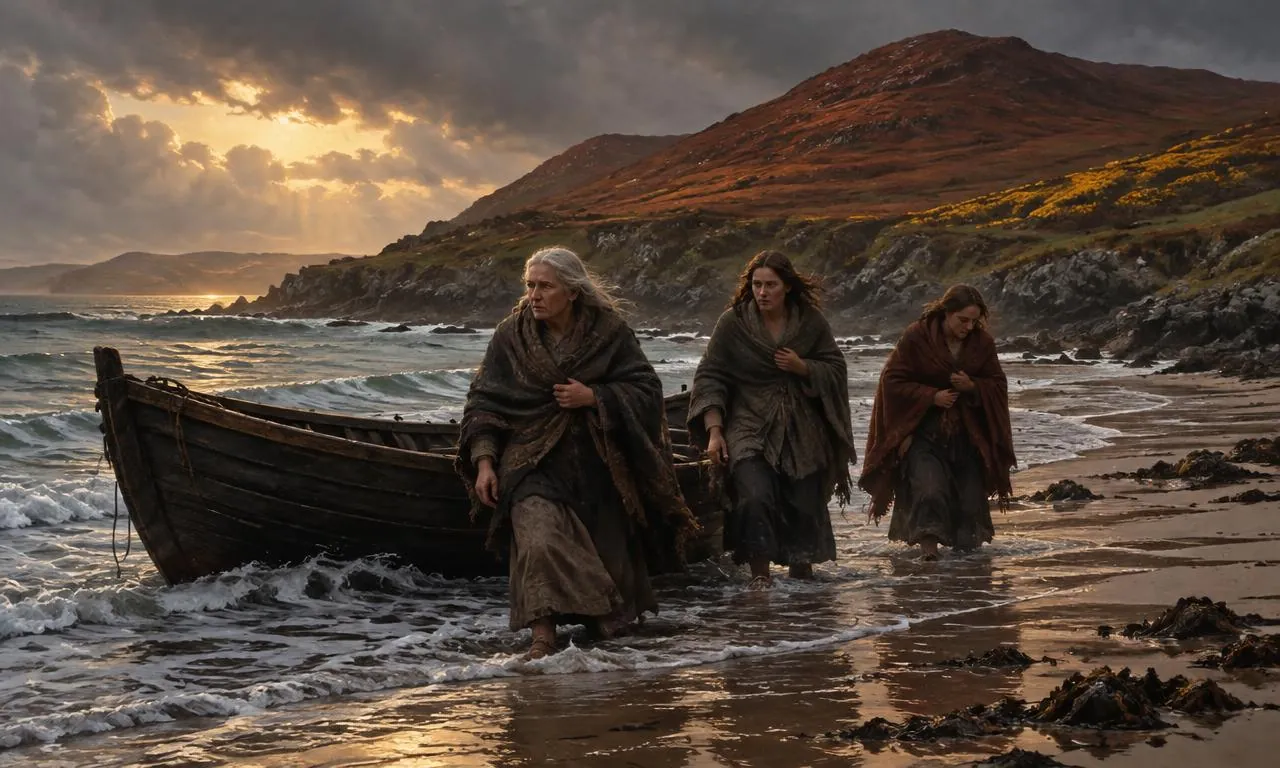
On the eastern side of Ynys Môn, where the land drops down to the wide sands of Red Wharf Bay, sits Llanddona. It is a quiet place now: a church, a scatter of houses, a steep lane down to a beach that empties to the horizon at low tide. But for centuries, if you said the name Llanddona anywhere else on the island, people would lower their voices. This was where the witches lived.
The story begins with a boat. One grey morning, so the tellings go, the people of the shore saw a vessel drifting in on the tide with no oars and no rudder. It had not been sailed there. It had been sent. Inside were a handful of men and women, half-starved and burned by salt, speaking a language no one on the beach could understand. Some said they came from Ireland; others insisted they were Spanish. Everyone agreed on one thing: they had been cast adrift as punishment, set on the sea to let God decide their fate.
The folk of the shore were not keen on God's decision. They tried to push the boat back out, and the strangers were too weak to fight. Then — and every version keeps this detail — one of the women struck the sand, and a spring of fresh water welled up where there had been none. The villagers took that as a sign, or a threat, and let them stay.
They settled on the rough common land above the bay, under the red-brown hill. The men were said to live by smuggling and fishing, slipping in and out of the coves at night. The women lived by something harder to name. They sold charms, told fortunes, and begged from door to door across Môn — and it was very unwise to refuse them.
The curses of Llanddona became legendary. A farmer who turned a witch away might find his cattle sickening, his butter refusing to churn, his cart wheel splitting on a dry road. Some women were said to keep a fly tied in a knot of their neckerchief; if they loosed it over your beasts, the beasts would fall ill. Others could lift a curse as easily as lay it, for a price. People learned to give them milk, bread and a civil word, and to walk quickly.
It is worth saying what the story is and what it is not. These were outsiders who arrived with nothing, kept to themselves, and were blamed for every sick cow in the parish — a pattern as old as villages. But the Llanddona tales also carry a strange respect. The witches were feared, yes, but they were also needed: healers, charmers, the people you went to when the minister could not help. For generations, families on the island claimed a little of the gift had come down to them through a Llanddona grandmother, and they said it with more pride than shame.
Stand on Llanddona beach now with the tide far out and the hill behind you, and it is easy to imagine the boat grounding on the sand, the strange voices, the spring bubbling up where a woman's hand came down. The island took them in, grudgingly, and they became part of it — as the sea-folk of Môn always do.
Wear the Witches of Llanddona and you wear the island's oldest warning, and its kindest: be generous with strangers at your door. You never know what they can do.