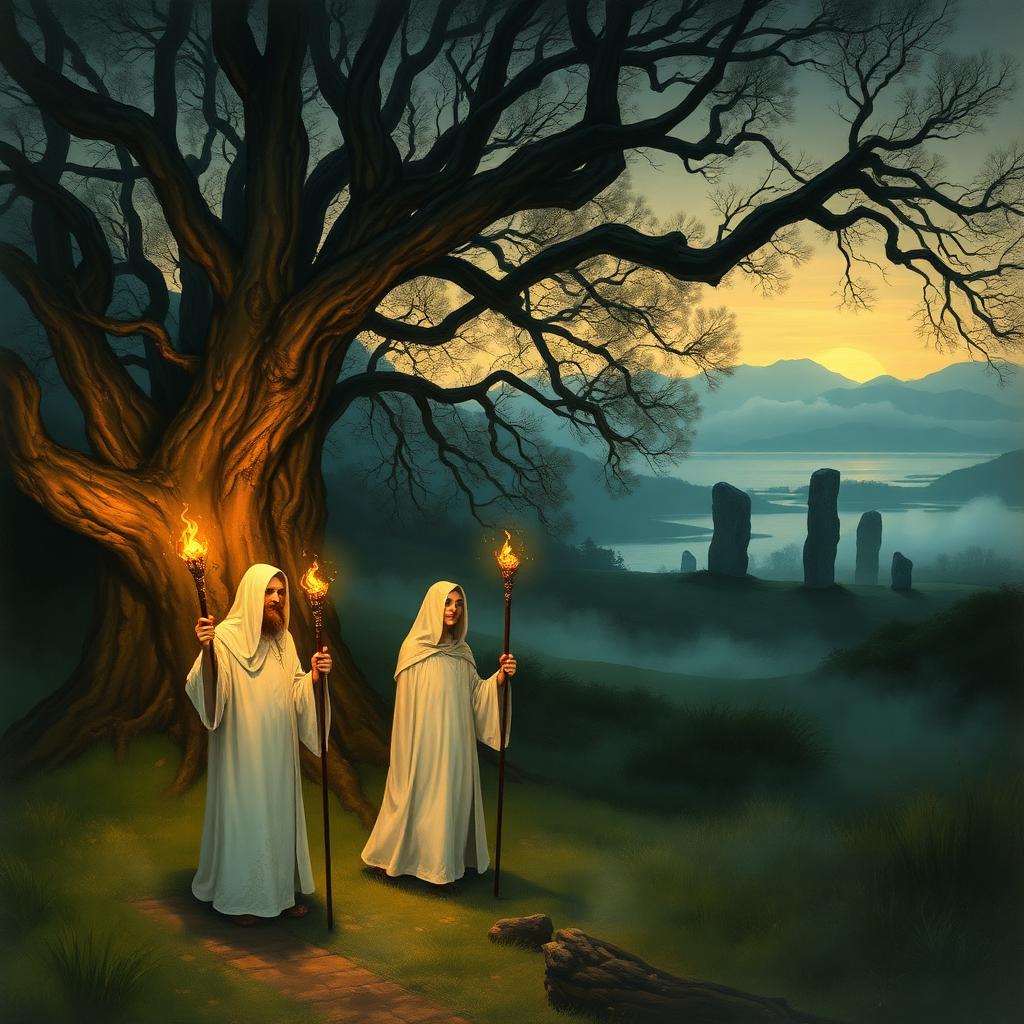
Long before saints, before kings, before the slow medieval business of cathedrals and castles, Ynys Môn was already sacred. To the Iron Age peoples of Britain and Gaul it was simply 'Mona' — the island where the druids lived, taught, and kept the old knowledge. Aspiring druids from as far away as southern Gaul are said to have crossed the sea to study here, spending up to twenty years memorising the law, the genealogies, the star-lore and the names of the gods. Nothing was written down. The island itself was the library.
Why Anglesey? Practically, it was perfect. It was an island, defensible, surrounded by a treacherous tidal strait. It was fertile enough to feed a large priestly population without needing to trade. It was the western edge of the known world, with the Irish Sea beyond — the threshold of the otherworld. And it was already thick with the sanctity of an older people: the Neolithic builders of Bryn Celli Ddu, Barclodiad y Gawres and the cromlechi at Lligwy and Din Dryfol had been laying down sacred geography on Ynys Môn for three thousand years before the first druid set foot here.
What the druids actually did on the island has to be pieced together from hostile Roman sources and the silent evidence of the ground. They presided over the law, settled disputes between tribes, divined the future from the flight of birds and the entrails of sacrifices, and kept calendars of the moon and the stars. Their sacred groves — nemeta — were enclosures of mature oak, often around a spring or a pool. The pool at Llyn Cerrig Bach, where bent swords and broken chariots were flung in across two centuries, is the clearest surviving glimpse we have of how a druidic site actually worked.
The Romans loathed them. Julius Caesar, writing a hundred years before Mona fell, claimed the druids burned men alive inside huge wicker effigies. Pliny accused them of cannibalism. Tacitus, the most reliable of the lot, simply records that in AD 60 the governor Suetonius Paulinus decided the druids had to go, and marched the Fourteenth and Twentieth Legions to the Menai Strait. What he saw on the far bank entered Roman literature and never left it: a dense line of warriors, women in black running between the ranks with their hair loose, and druids with their arms raised to the sky pouring curses on the legions.
For a moment, Tacitus says, the Romans froze. Then their officers shamed them forward, the cavalry waded the strait, the infantry crossed on flat-bottomed boats, and the slaughter began. The sacred groves were cut down. The altars were broken. The druids who survived the day were hunted across the island. It was, in every meaningful sense, the end of organised druidry in Britain — and the moment Ynys Môn became the place it has been ever since: a quiet, beautiful, slightly haunted island that remembers something the rest of Britain has forgotten.
The druids never quite went away, of course. Their nemeta became holy wells under the saints. Their calendar leaks through the Mabinogi. Their oak-and-water sanctity is still legible all over the Anglesey map — Llyn Cerrig Bach, Llanddwyn, Penmon, Clorach — and modern Welsh druidry, however reconstructed, still treats this island as its motherland. When you walk the lanes at midsummer dusk and the mist rises off a field, you are walking through their landscape.
Wear something inspired by the druids of Ynys Môn and you wear the deep memory of the island: the white robes in the oak-grove, the bent swords in the lake, the legion on the far bank, and the long quiet centuries afterwards in which the place simply went on being sacred.