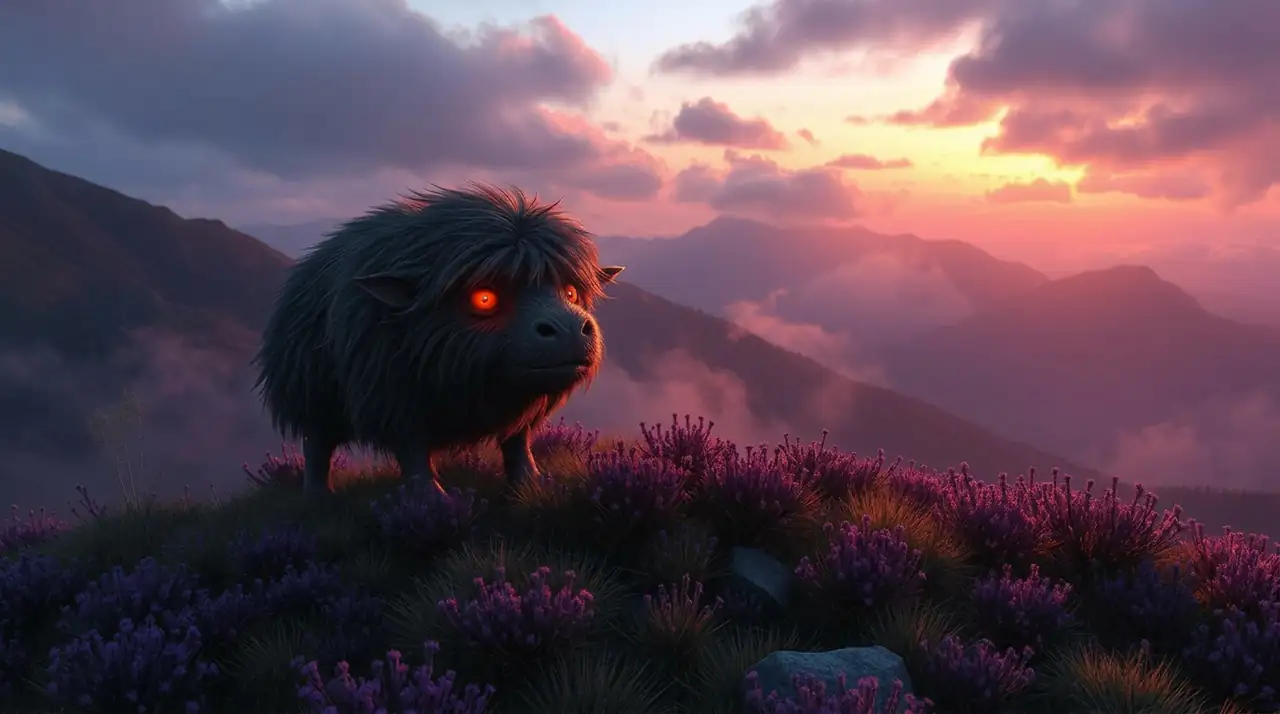
Ask a Scot, dead straight, what a haggis really is, and you may get one of two answers. The honest one — sheep's pluck, oats, onions and spice in a pudding — or the older, much more fun one: a small, shaggy, four-legged creature that gallops sideways across the heather on the slopes of the Cairngorms.
The Wild Haggis (Haggis scoticus, if you're being formal) is Scotland's great affectionate joke on the rest of the world. The creature is said to be roughly the size of a small terrier, covered in thick windswept fur, with two short curved horns and — most importantly — legs of unequal length. The left pair, in some tellings, are noticeably shorter than the right, allowing the haggis to run at terrific speed around the hillside in a single anti-clockwise direction. Try to chase it the other way, and it tumbles helplessly downhill.
Hunting the wild haggis was, for generations, a rite of passage played on visiting English cousins, on tourists, on anyone gullible enough to stand in a damp field at dusk holding a sack. A 2003 survey by a haggis-maker famously found that nearly a third of American visitors believed the haggis was a real Highland animal. It is one of the great triumphs of folklore over fact.
But like all the best jokes, the wild haggis has roots in something genuine. Scotland is full of small, secretive creatures — pine marten, wildcat, mountain hare — that the casual eye never sees. The haggis is, in a way, the spirit of all of them: shy, fast, native to the heather, glimpsed only by the patient.
Our Scottish Veiled Haggis design honours the legend with a wink and a torch held high. Because every country needs a national beast — and Scotland is the only one whose national beast is also dinner.