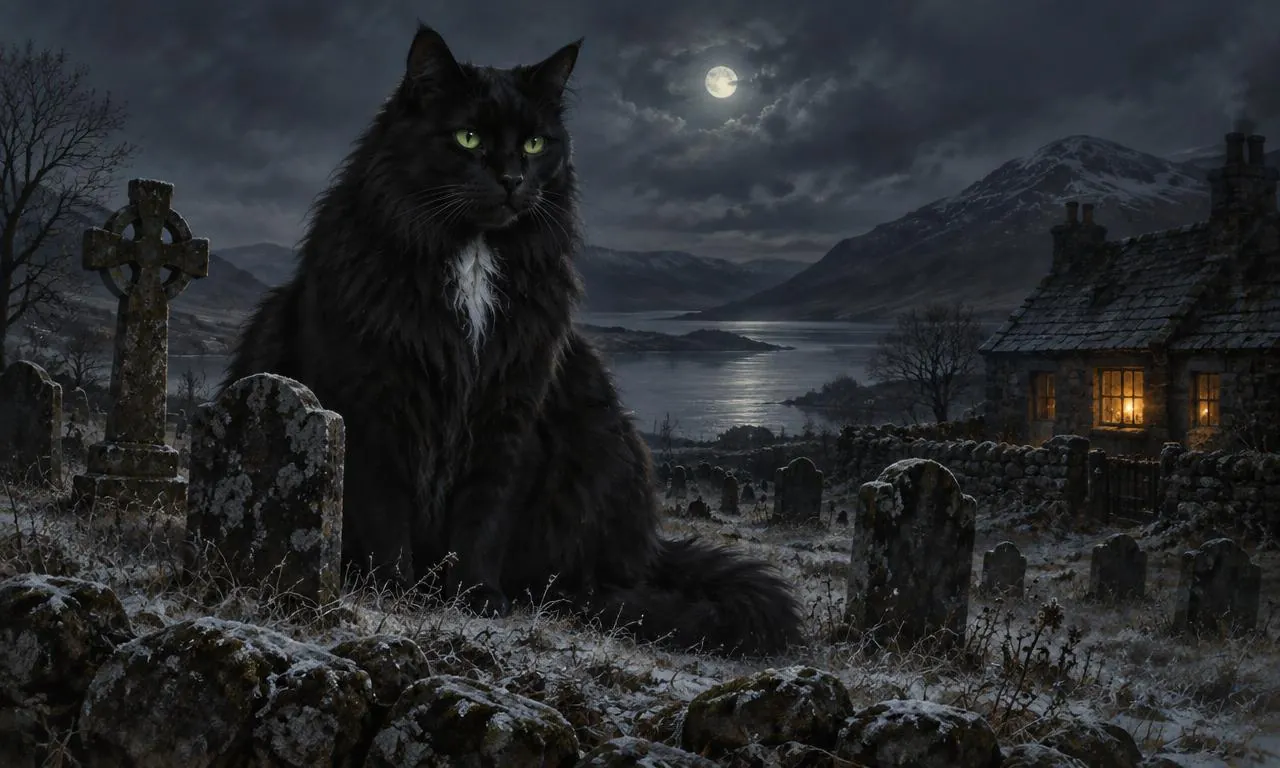
The Highlands have their share of ordinary black cats. The Cat-Sìth is not one of them. Scottish Gaelic tradition describes it as a fairy cat, entirely black except for a single white spot on its chest, and as large as a dog. It has an arched back and bristling fur, and it walks with the absolute confidence of something that knows it belongs to another world.
Its most feared habit concerned the dead. In the days between a death and the burial, the body lay in the house, and it was believed that the Cat-Sìth might come and pass over the corpse before it was laid in the ground. If it did, it would claim the soul for the fairies — or for something darker — before the gods could receive it.
So the household kept watch. The Féill Fhadalach, the Late Wake, was held through the night, and the watchers did everything they could to keep the cat away. Fires were not lit in the room, because warmth was said to draw it. Catnip was scattered anywhere but near the body. The mourners played games of leaping and wrestling, told riddles and made music, both to stay awake and to distract any cat that came calling. It was solemn work, but it could also be surprisingly lively.
The Cat-Sìth could also be summoned, and the ritual used to do it — the taghairm — was one of the cruellest in Highland lore. The tellings describe men roasting live cats over a fire for days on end, until the king of the cats appeared and granted whatever was asked, simply to make it stop. The stories are grim, and they were meant to be.
The taghairm is remembered as a condemned, desperate rite — not something the stories invite anyone to copy.
At Samhain, the old Celtic new year, the Cat-Sìth was believed to walk among the houses. A family that left out a saucer of milk would be blessed through the year ahead. A family that forgot might find their cows' milk had dried up by morning. Plenty of Highland households kept that custom long after they stopped believing in the reason for it.
Some later tellings suggest the Cat-Sìth was really a witch who could take the shape of a cat nine times — and if she went back into cat form a ninth time, she stayed a cat forever. Others connect it to the Kellas cat, a real, rare black hybrid wildcat found in the north-east of Scotland. Whatever its origin, it sits in the same shadowed company as the Cù-Sìth, the fairy hound, and the Sluagh, the host of restless dead: things that come for souls, and must be watched for.
Wear the Cat-Sìth and you wear the watcher at the Highland wake — beautiful, black, and absolutely not to be trusted near the coffin.