Where Wales has the white-and-red Cŵn Annwn, the Scottish Highlands have the Cù-Sìth — pronounced roughly 'koo-shee'. The name means simply 'fairy dog', but there is nothing simple about it.
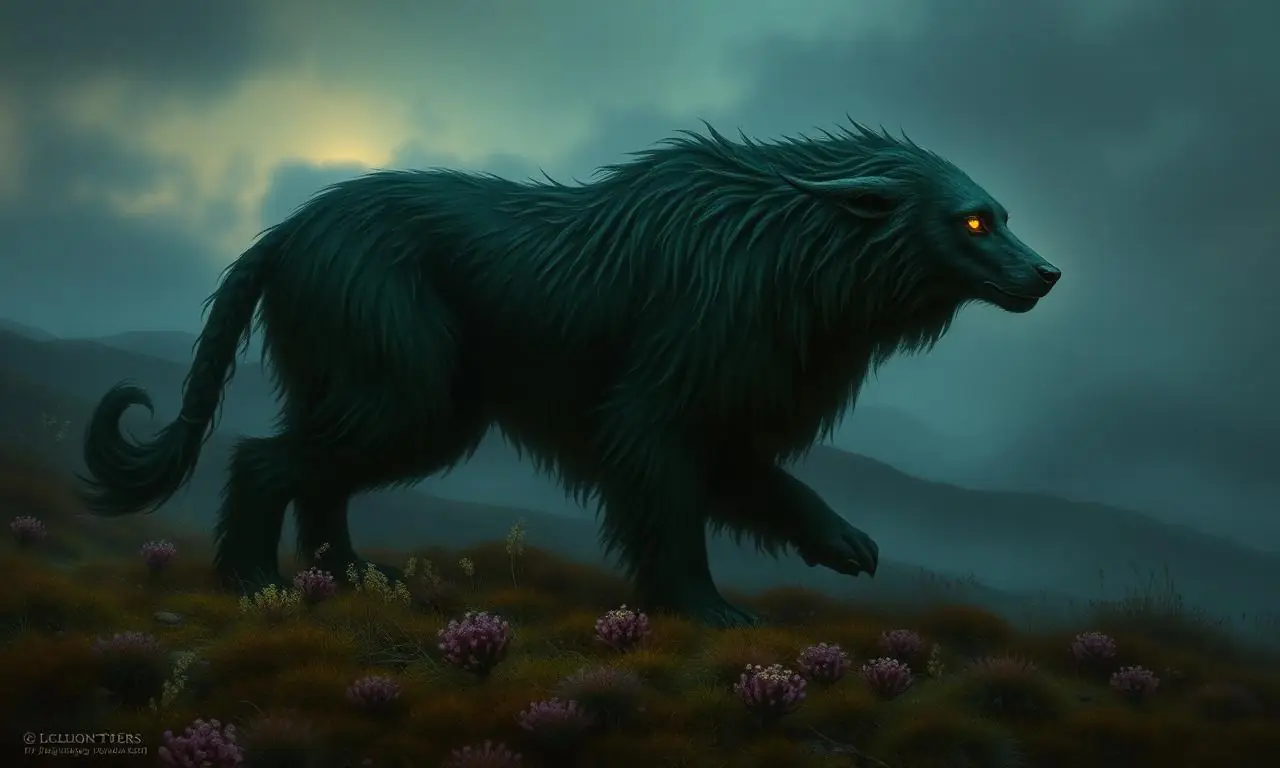
The Cù-Sìth is described as the size of a young bullock, with shaggy dark-green fur, a long braided tail curled across its back, and paws as broad as a grown man's hand. Its prints, the old shepherds said, could sometimes be found in soft mud or snow on the moor — wide, deep, and unmistakable.
What made it terrifying was not its size but its silence. The Cù-Sìth hunted without a sound. It did not bay as it ran. It crept across the heather in long, low bounds, fast as a horse, and gave no warning at all — until it stopped, planted itself, and barked three times.
Three bays of the Cù-Sìth, carried on the wind. That was the warning. Anyone within hearing had to reach the safety of their own hearth before the third bark, or be carried off — usually nursing mothers, who were said to be taken to the fairy mounds to suckle the children of the Sìth.
Like the Welsh hounds of Annwn, the Cù-Sìth belongs to the otherworld. It is a creature of the in-between places: dusk, mist, lonely paths and lonely lochs. It reminds you that the hills are not empty, and that some company is best avoided.
If you ever hear three deep, distant barks on a Highland evening, the old advice holds: do not stop, do not look back, and get yourself indoors.