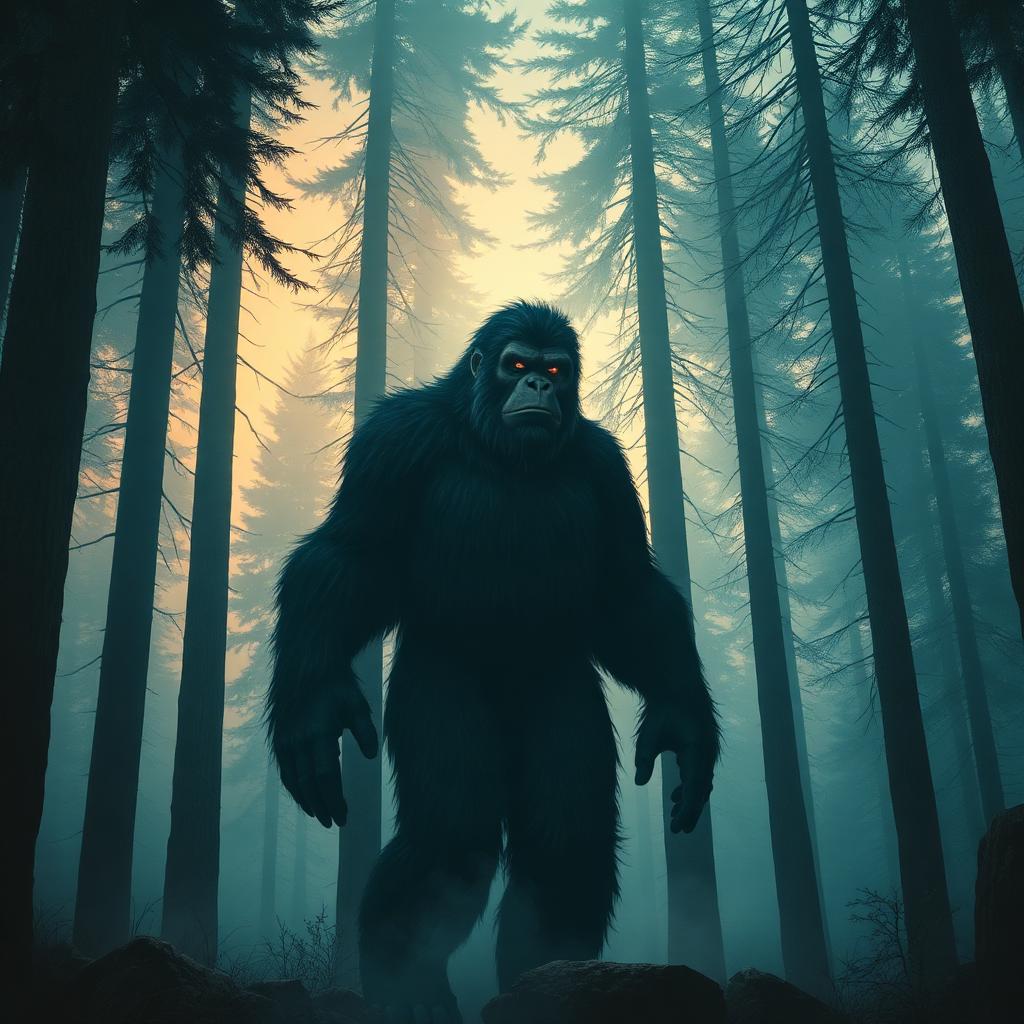
Long before Bigfoot was a cryptid, he was Sasquatch — an anglicisation of *sásq'ets*, a word from the Halq'eméylem language of the Sts'ailes people of British Columbia. The First Nations of the Pacific Northwest had stories of a giant, hair-covered, forest-dwelling being for centuries: the Salish *Stiyaha*, the Lummi *Ts'emekwes*, the Yakama *Qah-lin-me*. Almost every nation along the Cascade and Coast Ranges had a name for him, and almost every name carried the same warning — he is real, he watches, and you do not follow him into the trees.
The modern Bigfoot was born in the summer of 1958, when a logger named Jerry Crew cast a plaster mould of a sixteen-inch human-shaped footprint at a construction site near Bluff Creek, California. A local paper called the maker "Bigfoot." The name stuck. Nine years later, on October 20th 1967, Roger Patterson and Bob Gimlin filmed 59 seconds of grainy footage at the same creek of a tall, dark-furred figure walking calmly across a clearing and glancing back at the camera. That film is still, sixty years on, the single most argued-over piece of cryptozoological evidence in existence.
The descriptions hardly vary. Seven to ten feet tall. Covered in dark hair. Long arms, conical head, an arch-less foot that leaves a flat, splay-toed print. A musty, sour smell. Almost never aggressive. Almost always seen at twilight, in heavy timber, by someone alone. He does not roar so much as *hoot* and knock wood — a behaviour described in field reports from northern California to Vancouver Island in language so consistent it is hard to explain away.
Mainstream science has, very reasonably, never accepted him. There is no skeleton, no body, no clean DNA sample. Bears stand on their hind legs. Hoaxers wear costumes. Memory is unreliable. All of this is true. And yet for the people who live in the deep timber of the Olympic Peninsula or the BC interior, Bigfoot is not a debate; he is a fact you learn to walk around.
We love Bigfoot because he is the perfect modern myth — old enough to be indigenous, new enough to be on film, and shy enough that he might still be right behind us in the trees we have not yet logged.
Wear Bigfoot and you wear the oldest and most stubborn of all human suspicions — that the forest is not empty, and it is not entirely ours.