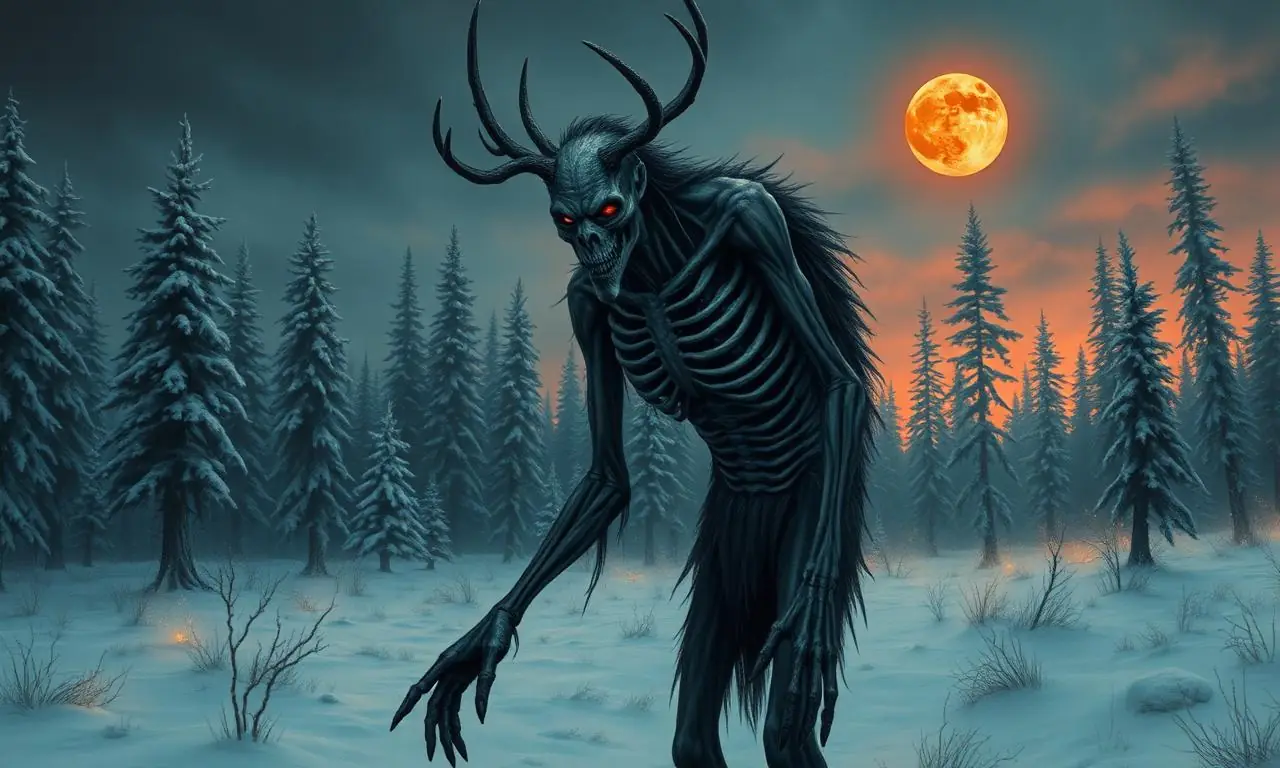
Long before the trappers came, the Algonquian peoples of the northern forests — Ojibwe, Cree, Innu, Naskapi — already knew the name of the thing that walks the tree-line in deep winter. They called it Wendigo. It is not a monster you summon. It is a monster you become.
The story is brutally simple. When the snow lies too long, when the game vanishes and the cold settles into the bone, a starving human may eat what no human is meant to eat. The moment they do, something opens in them. They grow tall. Their lips peel back from their teeth. Their hunger does not stop, no matter how much they devour. They become Wendigo — gaunt, antlered, bottomless, and condemned to walk the snow forever, eating and never being filled.
Older descriptions are stranger than the modern horror-film version. Some Cree storytellers describe the Wendigo as a giant of ice, with a heart of frozen stone, so cold that animals die when it passes. Others say it is barely there at all — only a smell, a shadow, the cracking of branches just behind you, and a hunger so loud you mistake it for the wind.
What gives the Wendigo its lasting power is the moral underneath. It is a warning carved into the cultures that survived the longest, hardest winters on the continent: the moment you put your own survival above another human life, the cold has already entered you. The transformation is just the body catching up.
Wear the Wendigo and you wear the oldest northern warning — that some hungers, once fed, never end.