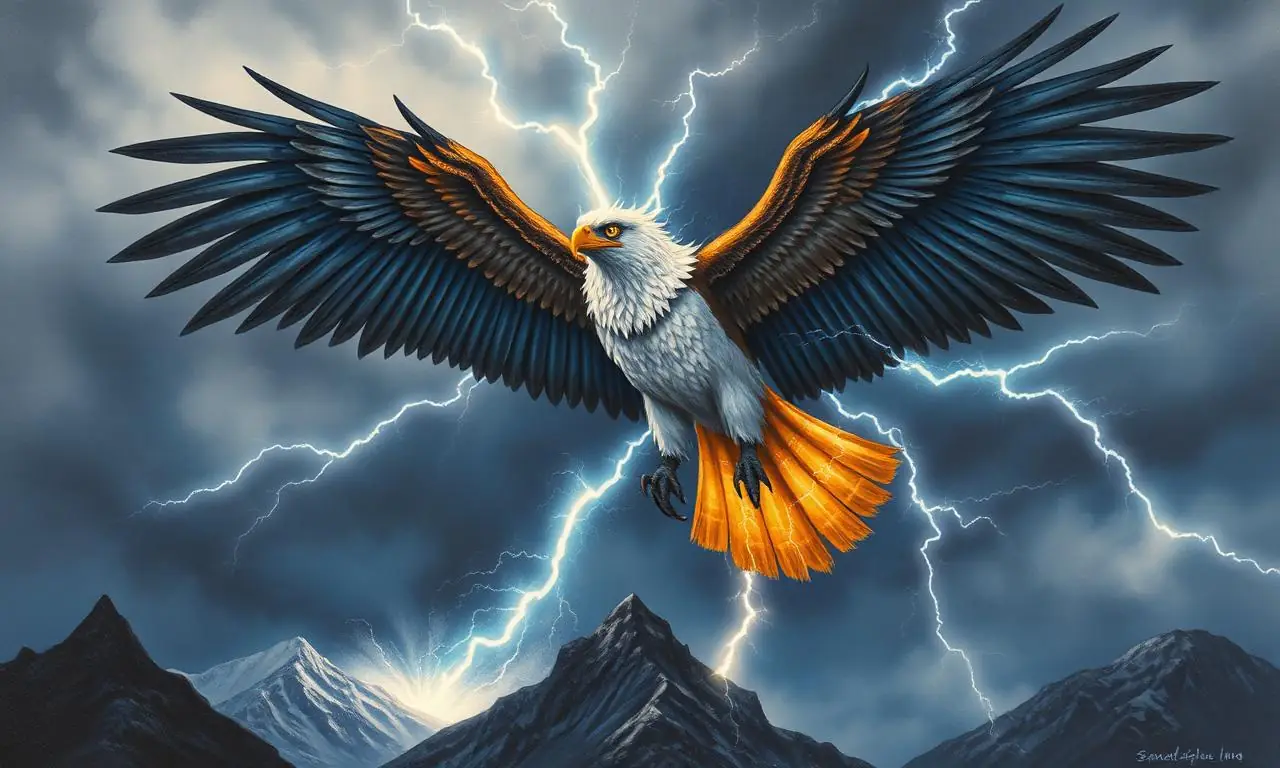
From the Pacific Northwest down through the Plains and into the woodlands of the Great Lakes, one figure dominates the sky in Indigenous North American myth — the Thunderbird. The Lakota call him Wakíŋyaŋ. The Ojibwe say Animikii. To the Kwakwaka'wakw of the coast he is Kwankwanxwalige', who can lift a whale from the sea in his talons.
The detail is consistent across hundreds of nations. He is enormous — wings the width of a war canoe, sometimes the width of a mountain. The flap of those wings is the rumble of thunder. The flash of his eyes is the lightning that splits the sky. Where he lands, the rain follows. Where he hunts, the storms gather.
He is not a monster. He is the necessary force. Indigenous storytellers across the continent describe him as a guardian who fights the underwater serpents — the Mishipeshu, the great horned panthers of the deep — that would otherwise drown the world. The eternal battle between sky and water is what gives us weather. It is why summer storms feel like a fight.
Carved Thunderbird crests still rise on the totem poles of the Northwest Coast, wings spread wide above the family stories of the houses they belong to. Plains nations painted him on shields and tipis. The Ojibwe still tell of seeing his shadow pass over the lakes of Minnesota and Ontario in summer.
We tell this story because the Thunderbird belongs to a world view that is too often left out of the European myth canon. The sky is not empty. The storm has a face. And the face is older than any of us.
Wear the Thunderbird with respect, and you wear the oldest sky-prayer of a continent.