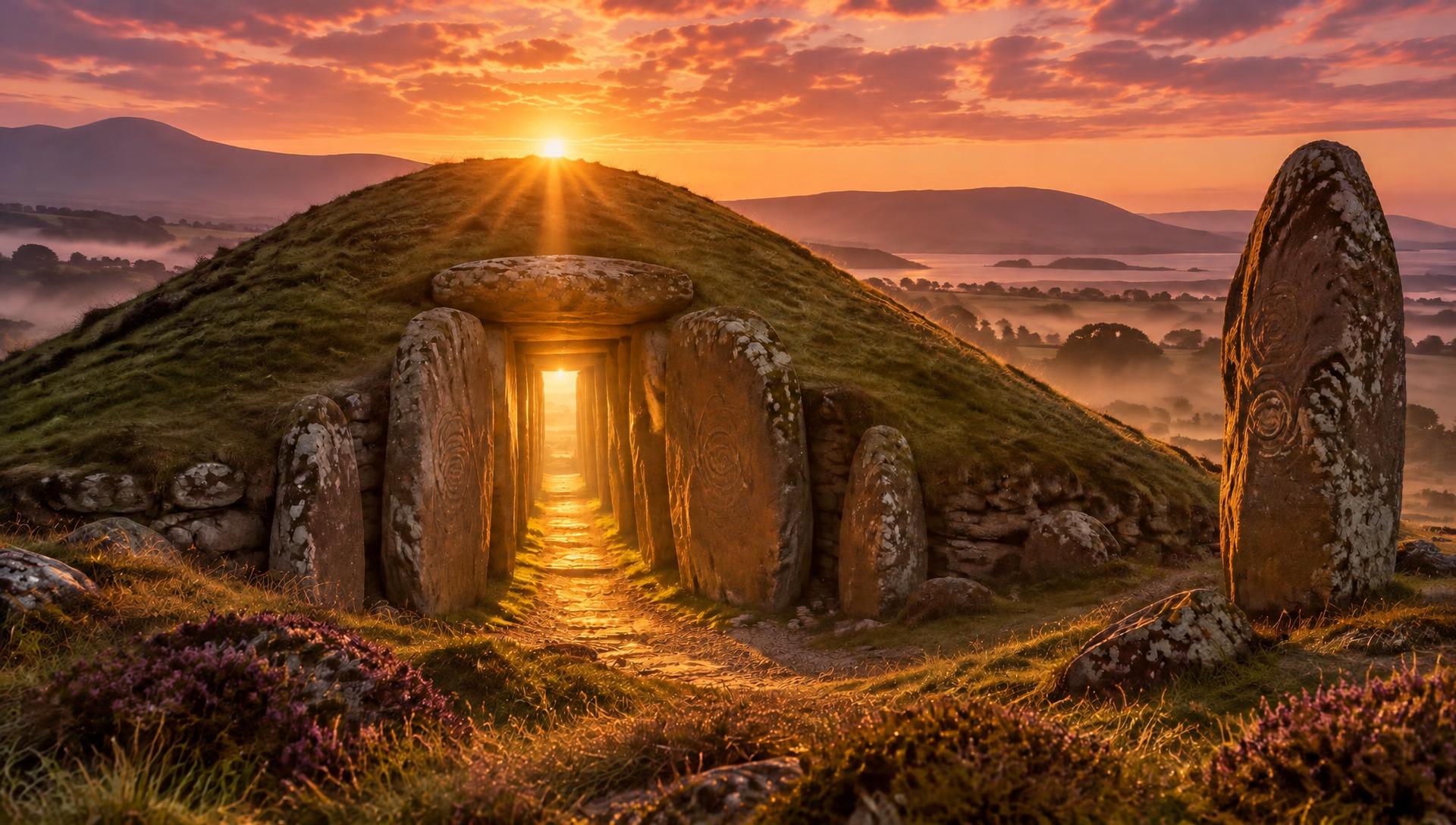
Ynys Môn is one of the richest prehistoric landscapes in Britain. Long before the druids made their final stand here, Neolithic and Bronze Age people raised standing stones, built burial chambers, and shaped the island into a place of ritual and memory. Many of these sites still stand, and many of them later became woven into Welsh mythology and folklore.
Bryn Celli Ddu
One of the finest passage graves in Wales, Bryn Celli Ddu sits in the heart of Anglesey. Aligned with the midsummer sunrise, it was built around 3000 BC. Later folklore and the island's reputation as a sacred place have given it an additional layer of meaning — a doorway between worlds as well as a tomb.
Barclodiad y Gawres
On the western coast, this decorated passage tomb contains stones carved with spirals, chevrons, and other motifs. The art is rare in Wales and links Anglesey to the wider Atlantic tradition of megalithic building. Local stories have long treated such places with caution and respect.
Standing Stones and Stone Circles
Anglesey has numerous standing stones and the remains of stone circles. While many lost their original purpose, they remained important in later folklore. Some were said to be people turned to stone; others marked places where the Tylwyth Teg gathered or where the boundary with the Otherworld was thin. The stones themselves became characters in the landscape.
Myth and the Land
What makes Ynys Môn unusual is how closely its prehistoric monuments sit alongside its later mythological reputation. The same island that holds Bryn Celli Ddu and Barclodiad y Gawres was also the last stronghold of the druids and a setting for stories of the Tylwyth Teg, water spirits, and ancient kings. The landscape did not simply host these stories — it helped shape them.
Walking among the stones today, it is still possible to feel why generations of people treated this island as sacred. The myths did not appear from nowhere. They grew out of a place that already felt charged with meaning.
Read about the island's druids and the Tylwyth Teg, or walk the ancient places yourself on our free Anglesey walking trails.