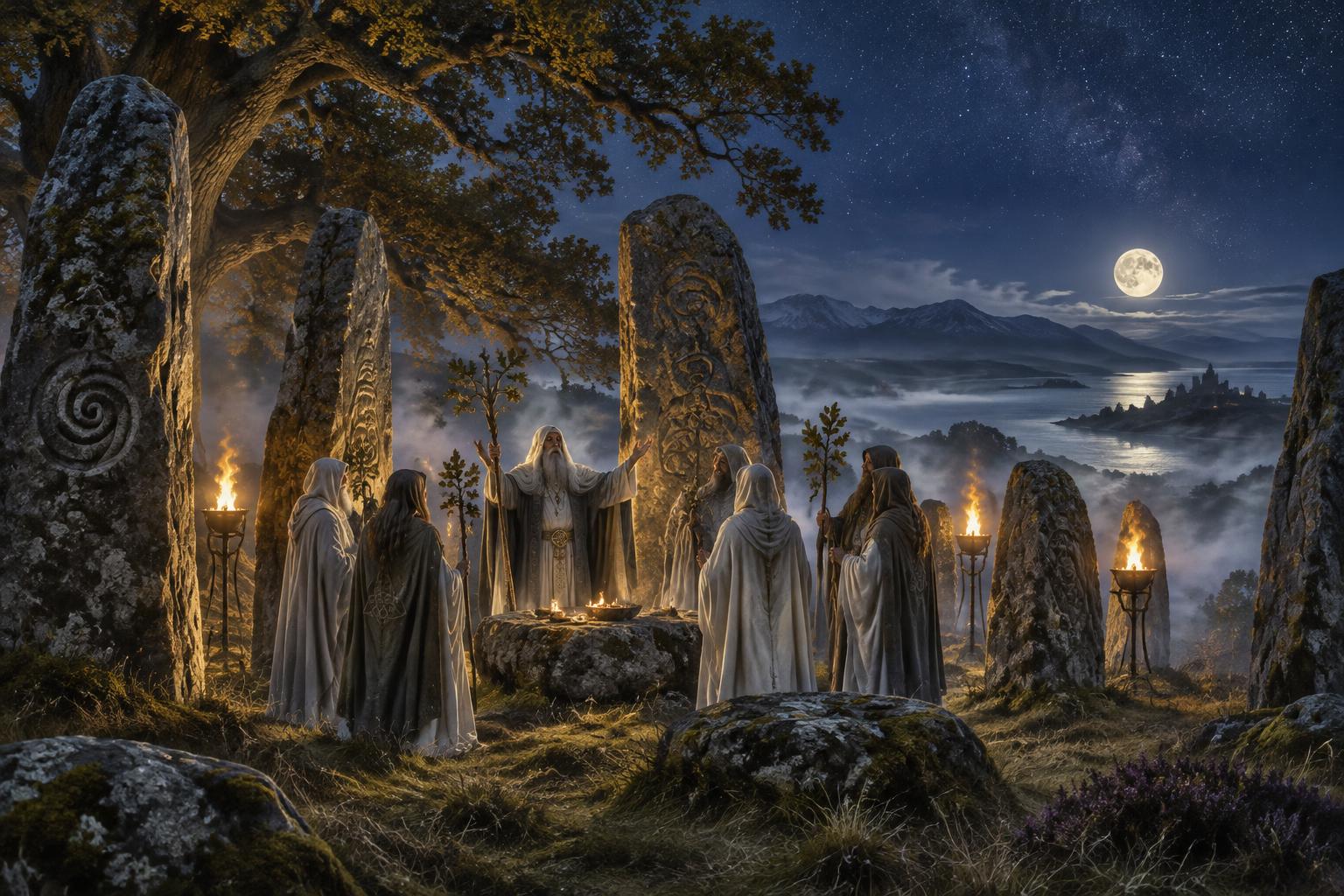
Ynys Môn — the Isle of Anglesey — was once the sacred heart of the Celtic world. For centuries it was home to the druids, the priestly class of ancient Britain and Gaul who held both spiritual and political power. When the Roman general Suetonius Paulinus crossed the Menai Strait in AD 60, he was not simply invading an island. He was attempting to destroy the last great stronghold of the druids.
Roman writers described the scene with a mixture of horror and awe. On the shores of Anglesey stood the druids, arms raised, calling down curses, while women dressed in black ran between them with torches. The Roman soldiers hesitated. Then they crossed the water and burned the sacred groves.
Who were the druids?
The druids were far more than priests. They were judges, teachers, philosophers, and keepers of oral tradition. They trained for up to twenty years, memorising vast bodies of knowledge because their laws and lore were not written down. They conducted sacrifices, interpreted omens, and acted as intermediaries between the people and the gods.
Anglesey's position made it ideal. Separated from the mainland by the Menai Strait yet close enough to influence the tribes of north Wales, it became a centre of learning and resistance. Classical sources, particularly Tacitus, identify Mona (the Roman name for Ynys Môn) as the place where the druids made their final stand.
The Roman attack and its aftermath
The campaign of AD 60 was brutal and effective. The sacred groves — places where the druids performed their rites — were cut down and burned. Many of the island's religious leaders were killed. The Romans then moved on to deal with the revolt of Boudica in the south, but the damage on Anglesey had already been done.
Yet the memory did not die. Later Welsh tradition preserved fragments of older belief, and the island continued to be regarded as a place of special power. Medieval Welsh literature, including parts of the Mabinogion, still carries echoes of a world in which certain landscapes and certain people stood closer to the divine than others.
Anglesey today
Modern Anglesey still holds the physical traces of that ancient sacred landscape: burial chambers such as Bryn Celli Ddu and Barclodiad y Gawres, standing stones, and the quiet fields where the druids once gathered. The island's identity as a place where myth and history overlap remains strong.
For a studio based on Ynys Môn, the druids are not a distant historical footnote. They are part of the reason the island feels different — a place where the old stories still seem close to the surface.
Read more island legends in our lore library, or explore Anglesey on our free walking trails.