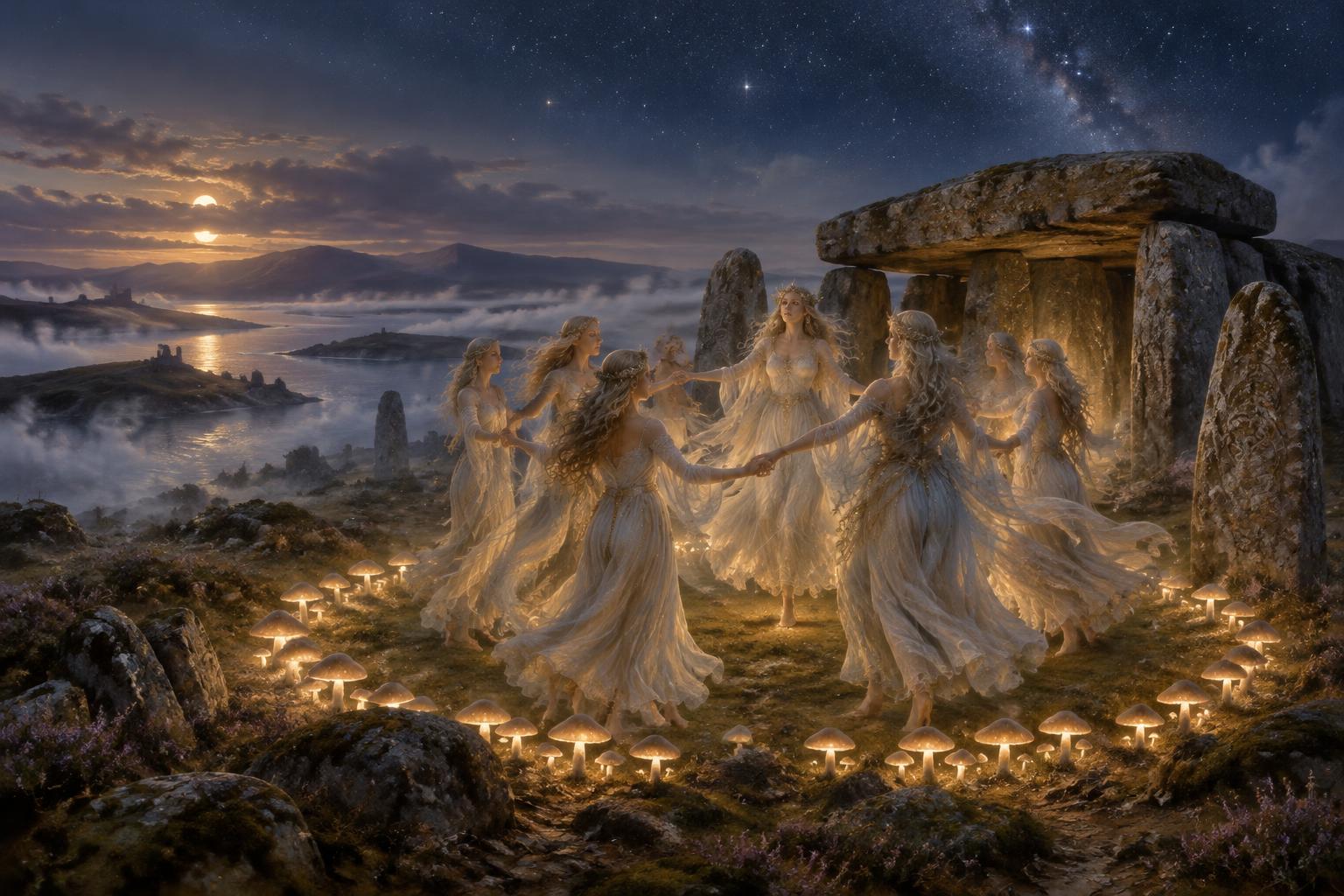
In Welsh, they are called the Tylwyth Teg — the Fair Family. They are not the small, winged sprites of Victorian children's books. They are the old fair folk of Wales: tall, beautiful, dangerous, and bound to the thin places between this world and the next.
On Ynys Môn, the island once known as the sacred heart of the Celtic world, stories of the Tylwyth Teg have long clung to the land. They live in the hills and the hollows, beneath the lakes, and inside the rings of mushrooms that appear overnight in the fields. Step inside one of those rings, the old stories warn, and you may not come back the same — or at all.
Who are the Tylwyth Teg?
The name simply means "the Fair Folk" or "the Beautiful People." Unlike some of the more openly monstrous creatures of Welsh folklore, the Tylwyth Teg are often described as strikingly attractive: fair-haired, finely dressed, and graceful. They dance, they feast, and they make music that can lure the unwary.
But beauty is not the same as kindness. The Tylwyth Teg are proud and easily offended. A careless word, a broken promise, or the wrong kind of curiosity can turn them against you. They are known to steal children, leaving a changeling in the cradle. They can lead travellers astray on the hills. And those who accept their hospitality sometimes find that a single night in the Otherworld has lasted years in the human world.
They are closely tied to the land itself. On Anglesey, where the veil between worlds has always felt thin, the Tylwyth Teg are said to inhabit the ancient places — the standing stones, the burial chambers, and the quiet lakes. Some stories place their courts beneath the hills; others say they move with the mist that rolls in from the Menai Strait.
Fairy rings and the rules of the Otherworld
One of the most enduring warnings concerns the fairy ring. A perfect circle of mushrooms (or, in some tellings, of darker grass) is not simply a natural curiosity. It is a doorway. To step inside it, especially at dusk or on certain nights, is to risk entering the realm of the Tylwyth Teg.
The rules are old and consistent across Welsh tradition:
- Do not step into a fairy ring.
- Do not accept food or drink from the fair folk unless you know exactly what you are doing.
- Never thank them too directly — gratitude can be seen as placing yourself in their debt.
- Iron, salt, and certain herbs are said to offer protection, though the stories rarely promise safety.
These are not casual superstitions. They are the practical knowledge of a people who lived close to a landscape that still feels, on certain evenings, as though it might open.
The Tylwyth Teg and the Mabinogion
The fair folk appear throughout the Mabinogion, the great collection of medieval Welsh tales. In Pwyll, Prince of Dyfed, the Otherworld (Annwn) is a place of beauty and danger that can be reached through specific gateways. In other branches, figures who cross between worlds often do so at the cost of ordinary time and ordinary safety.
While the Tylwyth Teg are not always named explicitly in the oldest texts, the idea of a parallel, beautiful, and perilous Otherworld is woven through Welsh mythology. Later folklore simply gave that world a more familiar name and set it closer to home — in the fields, the hills, and the mushroom rings of places like Ynys Môn.
A living tradition
The Tylwyth Teg never fully left. Even into the 19th and 20th centuries, people in rural Wales still avoided certain hills after dark and treated fairy rings with caution. On Anglesey, where the landscape is both ancient and intimate, those stories feel particularly close. The same island that was once a stronghold of the druids still holds quiet places where the boundary between worlds seems permeable.
For a small studio on Ynys Môn, these stories are not distant mythology. They are part of the ground underfoot. The Tylwyth Teg remind us that the island has always been a place where myth and landscape meet — and that some of the most beautiful things in Welsh folklore are also the ones that demand the most respect.
Explore more island legends in our lore library, or walk the ancient places yourself on our free Anglesey walking trails.