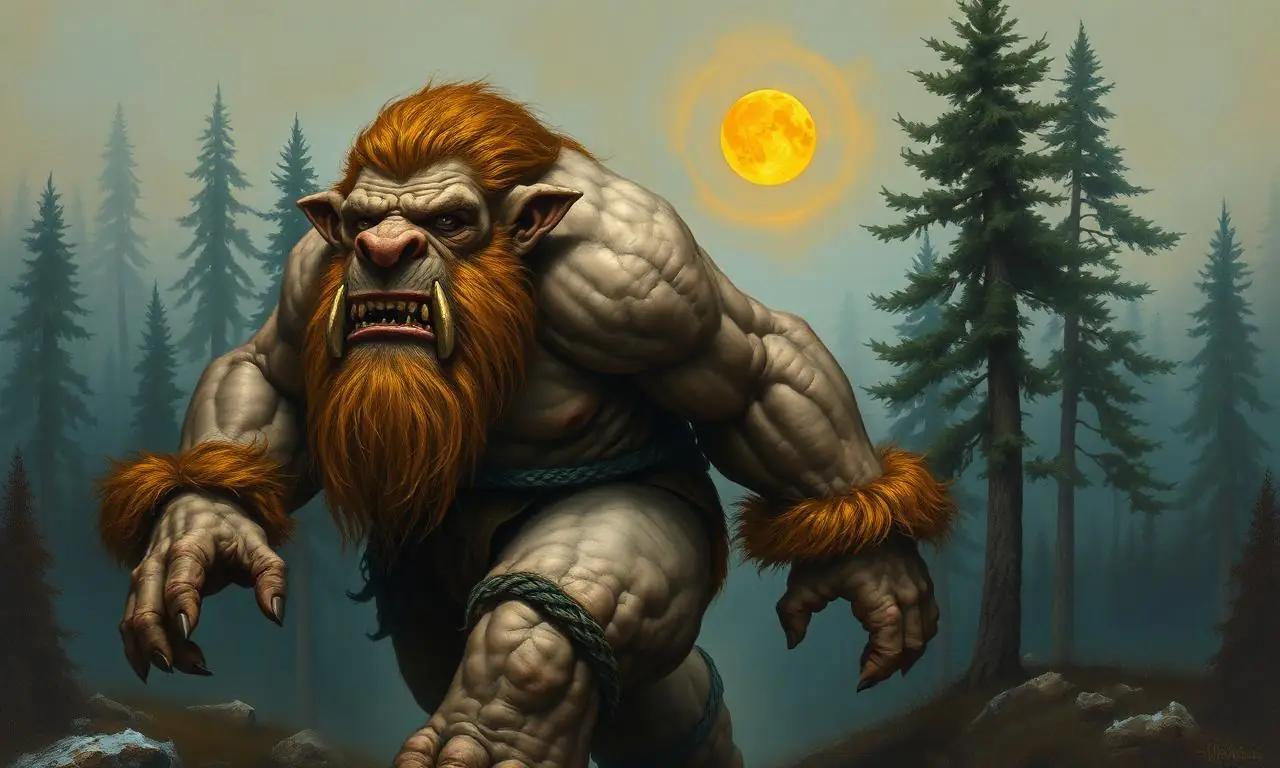
Strip away the children's-book version — the rude, comical creature under the bridge — and the troll of Old Norse and later Scandinavian folklore is something far older and far more frightening. He is the spirit of the wild land itself, made flesh: the boulder, the cliff, the storm, the dark fjord. He is what the mountains do when they decide to walk.
In the Eddas and the sagas, trolls (Old Norse troll, plural tröll) are huge, ancient beings related to the jötnar, the giants who pre-date the gods themselves. They live in caves, under mountains, in the deep forests. They hate the noise of church bells. They are immensely strong, slow-witted by hero standards but cunning in their own way, and almost impossible to kill by sword alone.
Their great weakness is the sun. A troll caught in daylight does not merely die — he turns to stone, locked forever in the shape he was when the first ray hit him. Travel the Norwegian fjords today and you will be shown standing stones, sea stacks and mountain crags that locals will tell you, with a perfectly straight face, are trolls who didn't make it home before dawn. The Trolltunga rock above Lake Ringedalsvatnet — 'the Troll's Tongue' — is one of the most famous.
Folklore divides them broadly into two kinds. The mountain trolls (bergtroll, jötunn-kin) are the vast lumbering ones, miles tall in some sagas, hurling boulders at churches and uprooting trees for clubs. The forest and household trolls are smaller, sometimes only human-sized, sneaking into farms after dark to steal cattle, swap babies for changelings, or simply listen at windows.
They fill Norse heroic poetry as the natural enemies of the gods and of mortal heroes alike. Thor, the thunder god, is forever off in the east 'killing trolls' between visits to Asgard — a kind of cosmic pest control. In the Viking age, to call someone trollr was no compliment: it meant either a being of evil power, or a human practising dark magic.
Even as Christianity arrived in Scandinavia and the old gods faded, the trolls stayed. Medieval Norwegian and Icelandic farmers still left bowls of porridge by their barns. Children were warned not to wander into the forest at dusk. The bridge-troll of the fairy-tale Three Billy Goats Gruff is a domesticated leftover of a much darker tradition.
Wear the troll and you wear that older Scandinavia — the one where the mountains have opinions, the dark woods are inhabited, and the sunrise is a weapon.