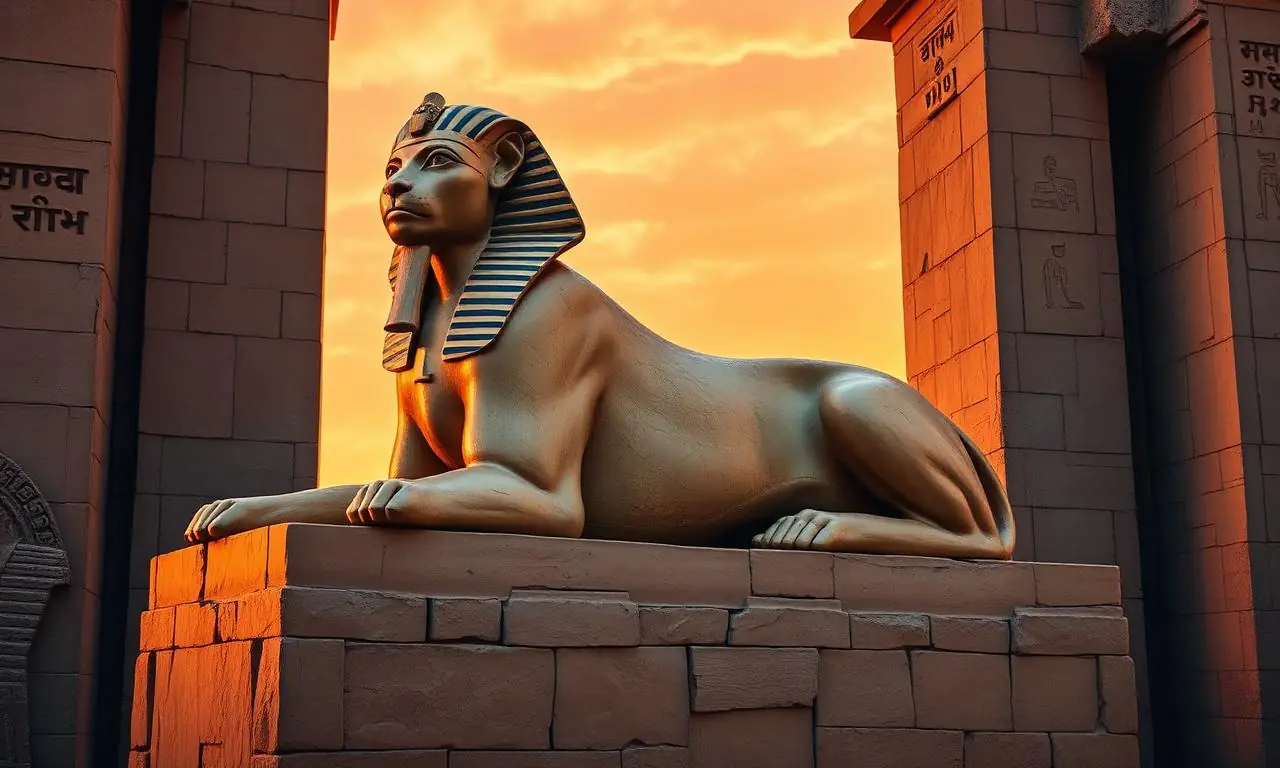
There are two Sphinxes, and people forget. The Egyptian one is a guardian — male, calm, lion-bodied, gazing east into the rising sun for four and a half thousand years. The Greek one is a monster — female, winged, hungry, perched on the cliffs above Thebes and devouring anyone who answers her wrong.
It is the Greek Sphinx that gives us the most famous riddle in the world. 'What walks on four legs in the morning, two legs at noon, and three legs in the evening?' Every traveller on the road into Thebes was asked. Every wrong answer was eaten. The city was strangling because no one could pass.
Then Oedipus came up the road. He looked at her and said, simply: a man. A man crawls as a baby, walks upright as an adult, and leans on a stick in old age. The Sphinx, beaten by her own riddle, threw herself from the rocks. Oedipus walked into Thebes a hero — and into the worst tragedy in Greek literature.
What we sometimes miss is that the riddle is not really about legs. It is about the shape of a human life: how short it is, how quickly the strong become the frail, how the answer to every grand question is usually just 'us, and not for very long'.
The Sphinx survived the fall. She is in the desert outside Cairo. She is in the gates of every empire that wanted to look both wise and dangerous. She is the original test at the threshold — answer, or don't pass.
Wear the Sphinx and you wear the oldest contract a story ever made with its reader. Knowledge has a price. The clever survive. The clever also still die.