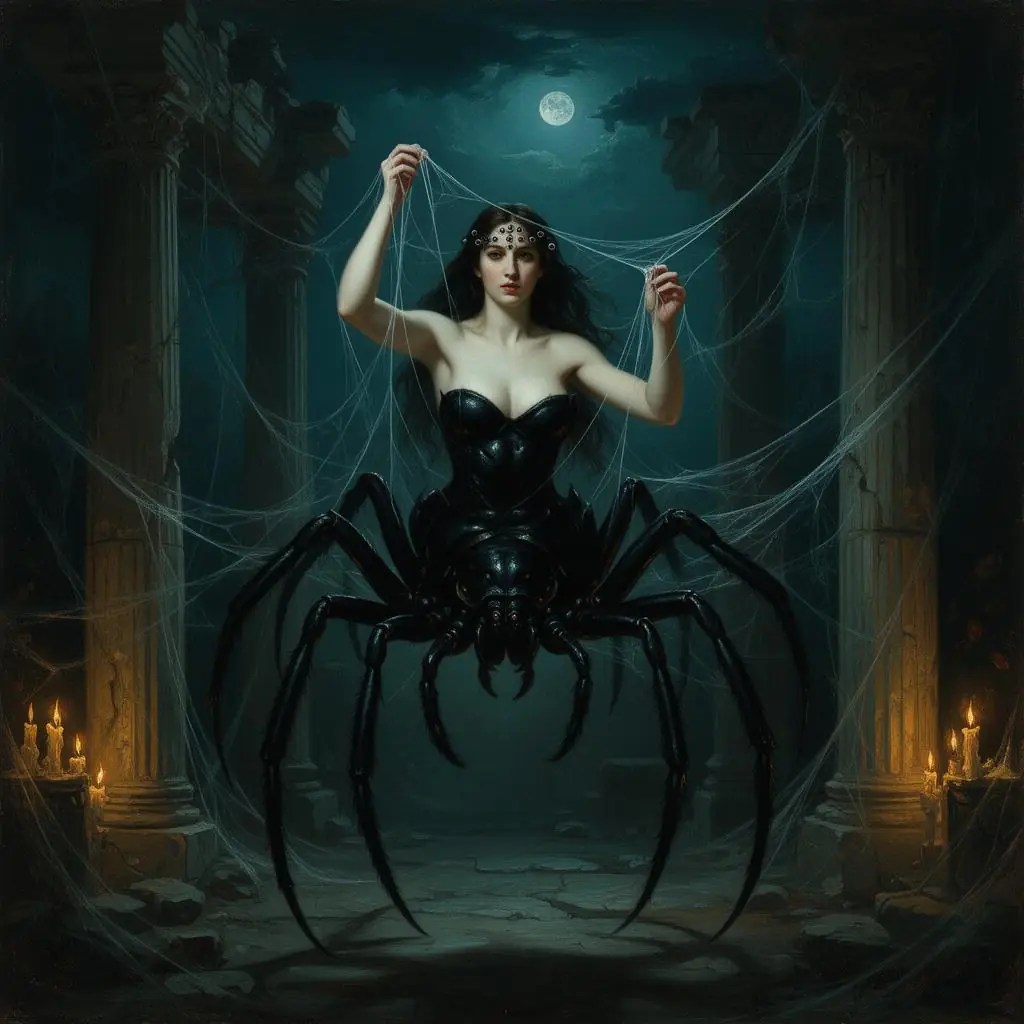
Every spider queen in folklore — Lady Vespera in her cathedral of silk, Arachnyx in her violet-eyed silence, every eight-limbed weaver-woman in every old story — descends from one Greek girl who refused to back down. Her name was Arachne.
Ovid tells it best. Arachne was a mortal weaver from Lydia, so skilled that the nymphs of Tmolus and Pactolus left their woods just to watch her work. The goddess Athena heard the praise, came down disguised as an old woman, and warned the girl to acknowledge that all her gift came from the gods. Arachne refused. She challenged Athena to a contest of the loom.
Athena wove the gods in their majesty. Arachne wove the gods in their crimes — Zeus as a swan, Zeus as a bull, Poseidon as a stallion, all the abductions and betrayals stitched in colours so true that Athena could find no flaw. The goddess, enraged not by the skill but by the truth, struck the tapestry with her shuttle. Arachne, in despair, hanged herself. Athena loosened the rope, took pity, and changed her — not back to a woman, but into something that could weave forever. Her body shrank, her arms multiplied, and the first spider walked out into the world still trailing the thread that had killed her.
From this single transformation comes a whole lineage of spider queens. Lady Vespera, the silk-gowned matriarch of the gothic tradition, drapes her hall in mourning veils and waits for visitors who never quite leave. Arachnyx, the violet-eyed weaver of fantasy and tabletop myth, sits at the centre of a web that holds whole cities still. Both are Arachne with the centuries added — beautiful, intelligent, patient, and not very interested in your apology.
Wear the Spider Queen and you wear the oldest argument in mythology: that a mortal can out-make a god, and that the price for being right is sometimes a body that no one will ever look at the same way again.