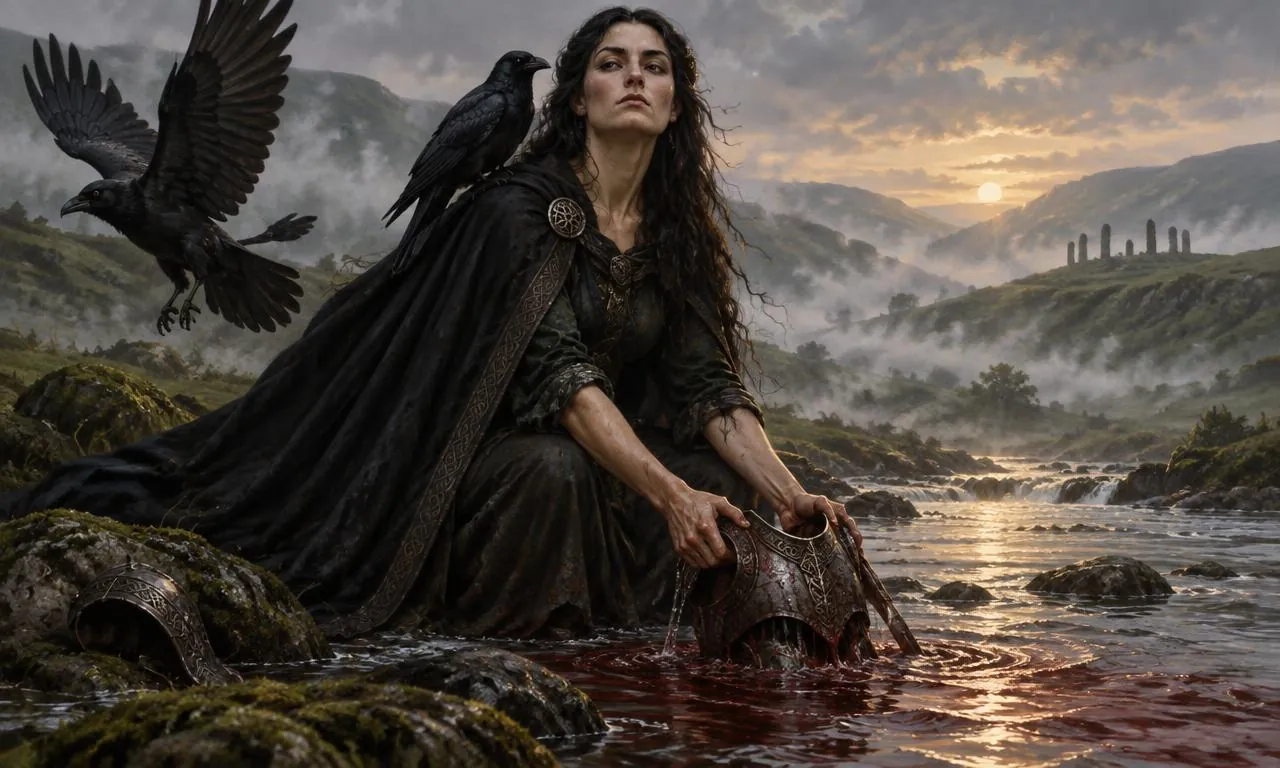
Her name is usually translated as 'Phantom Queen' or 'Great Queen', and both fit. The Morrígan is one of the most powerful and most misunderstood figures in Irish myth. She is frequently described as a triple goddess, sometimes appearing alone, sometimes as three sisters — the names Badb, Macha and Nemain are among those linked with her. She haunts battlefields as a hooded crow, but to call her only a war goddess misses the deeper point.
The Morrígan is bound up with sovereignty — with the land itself, and the right to rule it. In the old Irish way of thinking, a king did not simply take power; he was married to the land, and the land had to accept him. The Morrígan was one of the faces of that land. She chose. She foretold. She could grant victory, and she could take it away.
In the Second Battle of Mag Tuired, the great war between the Tuatha Dé Danann and the Fomorians, she meets the Dagda at a river on the eve of battle, lies with him, and promises her aid. Then she goes to the battlefield and turns the tide, and afterwards she speaks a prophecy of peace — and a darker prophecy of the end of the world.
Her most famous story is with Cú Chulainn, the hero of Ulster. She comes to him as a beautiful young woman and offers herself and her help. He turns her away, rudely, not knowing who she is. So, while he fights at a ford, she comes against him in three shapes: an eel that coils around his legs, a grey she-wolf that stampedes cattle towards him, and a red-eared white heifer leading the herd. He wounds her each time. Later, disguised as an old woman milking a cow, she tricks him into blessing her three times, healing each wound.
Before his last battle, the tellings say, Cú Chulainn passes a young woman at a ford, washing bloody armour in the water. It is his armour. That washer at the ford — a figure the Morrígan shares with the Scottish Bean Nighe — is a sign that the one whose armour is being washed will soon be dead. And at the very end, with Cú Chulainn bound upright to a standing stone so that he can die on his feet, a crow lands on his shoulder. Only then do his enemies dare approach.
Her cries on the battlefield have been compared with the keening of the banshee, and in later centuries some of her shadow seems to have passed into that figure too. But the Morrígan is older and larger. She is prophecy, fate, the land's judgment on those who would rule it — and the crow that waits to see who stays standing.
Wear the Morrígan and you wear the queen at the ford: the one who decides, long before the fighting starts, how the story ends.