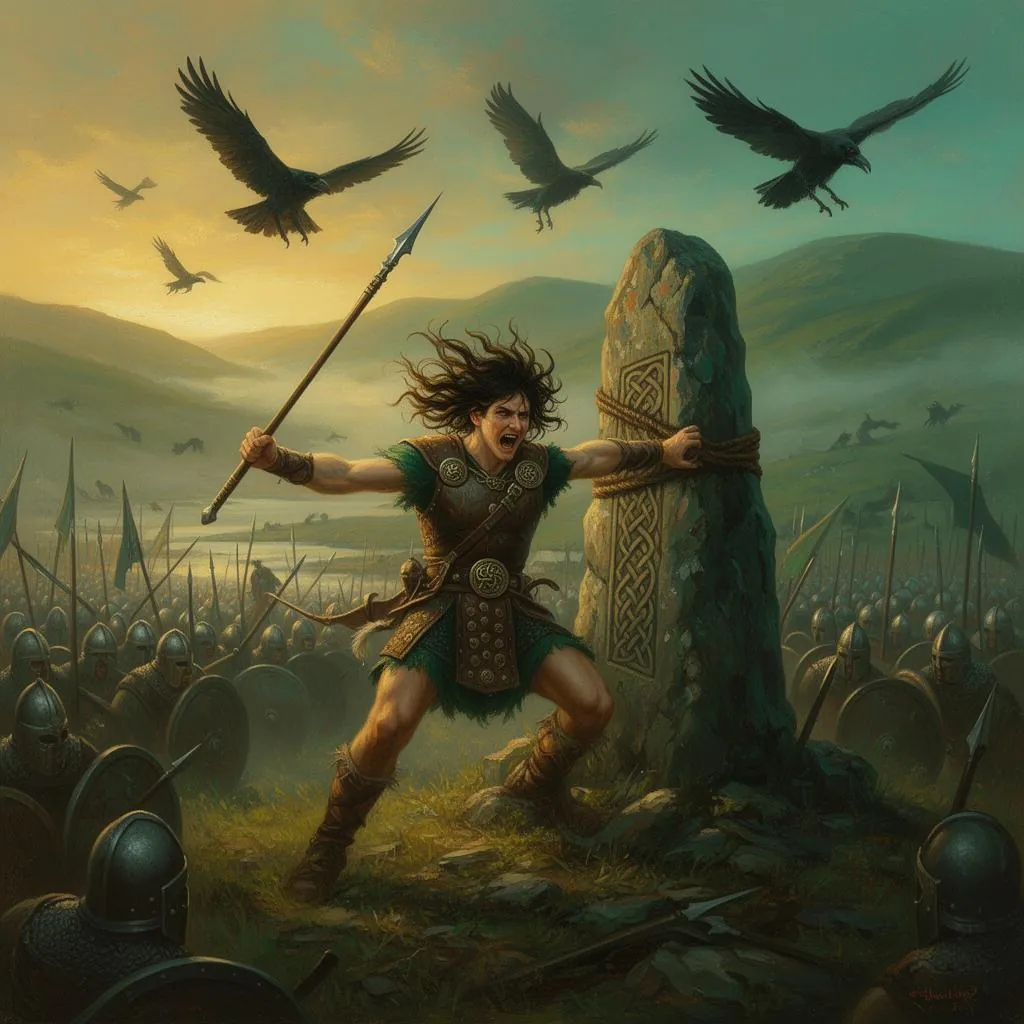
Cú Chulainn — pronounced roughly 'koo-KHULL-in', the 'Hound of Culann' — is the central hero of the Ulster Cycle, the great body of Irish legend that grew up around the court of King Conchobar mac Nessa at Emain Macha in what is now County Armagh. He is to Irish myth what Achilles is to the Greek: the impossibly gifted young warrior whose death is already written into his life.
He was born Sétanta, son of the god Lugh and a mortal mother. As a small boy he killed the enormous hound of the smith Culann with his bare hands, and offered to guard the smith's house himself in the hound's place until a new one could be reared. From that day his name was Cú Chulainn — the Hound of Culann — and the obligation of guardianship stayed with him for the rest of his short life.
At seventeen he stood alone at a ford on the border of Ulster and held back the entire army of Queen Medb of Connacht, which had come to steal the great brown bull of Cooley. The Ulstermen were under a curse that left them bedridden in pain for nine days and nine nights; only Cú Chulainn, because of his half-divine blood, was untouched. So he fought single combat after single combat at the ford for weeks, sleeping in snatches, killing every champion Medb sent against him, until his own people finally rose from their beds. This is the Táin Bó Cúailnge, the Cattle-Raid of Cooley, and it is the longest sustained piece of pre-Christian narrative the British Isles produced.
When his battle-fury came on him — the riastrad — he twisted inside his own skin. One eye sucked back into his skull, the other bulged out on his cheek. His hair stood on end and dripped sparks. A jet of dark blood rose straight up from the crown of his head. The text of the Táin describes it in detail because it terrified the storytellers themselves. In that state nothing on a battlefield could stand against him.
He carried Gáe Bolg, a barbed spear thrown with the foot under water, which opened thirty wounds inside the body of anyone it pierced. He killed his own foster-brother Ferdiad with it after three days of single combat at the ford, weeping as he did it. He killed his own only son Connla with it without knowing who the boy was. The hero's life in Irish myth is not a life of victories — it is a life of irreversible mistakes.
He died standing up. Mortally wounded at last by a triple geis (a sacred prohibition cleverly turned against him), he tied himself to a standing stone on the Plain of Muirthemne so that he would die on his feet facing his enemies. No one dared approach him until the goddess Morrígan, in the shape of a crow, landed on his shoulder. Only then did they know he was gone.
Wear something inspired by Cú Chulainn and you wear the boy who took the hound's place at seven, the warrior who held the ford alone, and the hero who tied himself to a stone rather than fall — the fiercest, saddest figure in the whole Ulster Cycle.