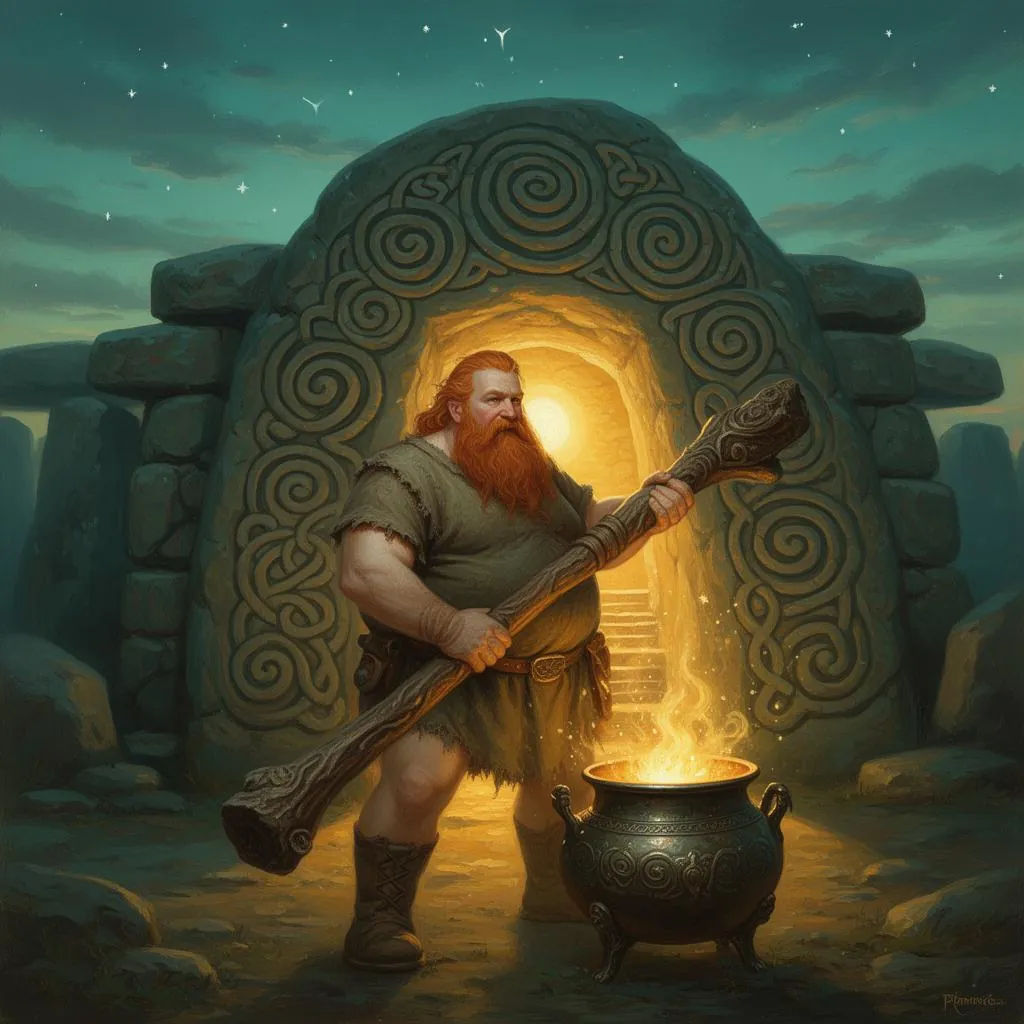
An Dagda — literally 'the Good God', not 'good' as in virtuous but 'good at everything' — is the father-figure of the Tuatha Dé Danann, the old gods of pre-Christian Ireland. He is huge, red-bearded, scruffy, and forever wearing a tunic too short for him. The medieval Irish monks who wrote down his stories clearly enjoyed him: he is the least dignified of the great gods and possibly the most powerful.
He owned three of the most famous treasures in Irish myth. The first was the Coire Ansic, the Cauldron of Plenty, which no company ever left from unsatisfied — one of the Four Treasures of the Tuatha Dé Danann, brought from the mythic northern cities. The second was the Lorg Mór, his enormous club: one end of it killed nine men with a single blow, and the other end could bring those nine men back to life. He dragged it behind him on a wheel because it was too heavy to carry. The third was the Uaithne, his living oak harp, on which he played the three noble strains of music — the sleep strain, the laughing strain, and the weeping strain. The seasons of Ireland only changed when he played the harp; if the harp was silent, the year stood still.
The Dagda is the master of Brú na Bóinne — Newgrange, the great passage-tomb in the bend of the River Boyne, where the rising sun of the winter solstice still strikes straight down the central passage every December. In the Irish tradition Brú na Bóinne is not a tomb at all. It is the Dagda's house, the sídhe-mound he built and later gave (or had tricked out of him, depending on which version you read) to his son Aonghus, the god of young love.
He had a famous and very Dagda-shaped affair with the goddess Morrígan. She met him at the ford of the River Unius at Samhain, washing herself with one foot on each bank, and they lay together standing in the river. In exchange she promised him victory in the second Battle of Mag Tuired, the great war between the Tuatha Dé Danann and the monstrous Fomorians — and her promise held. The Tuatha Dé won.
Before that battle, the Fomorians tried to humiliate him by serving him an enormous pit of porridge — eighty gallons of milk, with whole sheep, pigs, and goats boiled into it — and demanding he eat the lot or be killed. The Dagda took out a wooden ladle large enough for a man and a woman to lie down in together, sat by the pit, and ate the entire thing. Then he walked away across the plain so full that, the text says, his stomach was bigger than a great house's cauldron, and a Fomorian woman afterwards still found him handsome enough to lie with.
He is, on the surface, comic. Underneath, he is the father of the gods, the keeper of plenty, the master of the great solstice tomb on the Boyne, and the one who held the year in tune. When the Tuatha Dé Danann lost Ireland to the Milesians, it was the Dagda who divided the sídhe-mounds among them so that the old gods could keep on living, invisibly, under the hills of the country they had lost.
Wear something inspired by the Dagda and you wear the cauldron that never empties, the club with a killing end and a healing end, and the harp that calls the seasons — the scruffy, generous father-god of pagan Ireland, still keeping house inside the mound at Brú na Bóinne.