In the far south-west corner of Wales, where Pembrokeshire narrows to a headland and the Irish Sea takes over, there is a small city that is really a village with a cathedral in it. The Welsh call it Tyddewi — David's house. The English call it St Davids. Either way, it is the smallest city in Britain, and it exists because of one man: Dewi Sant, Saint David, the only patron saint of Wales who was actually born Welsh.
The details of his life come mostly from a biography written by Rhygyfarch around 1090, some five hundred years after David died — so the tellings come with salt. By that account he was born on the Pembrokeshire coast, traditionally at a place now called St Non's, during a storm, and the spot is marked by a ruined chapel and a holy well. He became a monk, founded monasteries across south Wales and beyond, and finally settled his community in the remote valley of Glyn Rhosyn, where the cathedral stands today. His rule was famously hard: the monks pulled the plough themselves, drank only water, and ate bread with salt and herbs. David himself is said to have stood neck-deep in cold water reciting psalms, which earned him the nickname Dewi Ddyfrwr — David the Waterman.
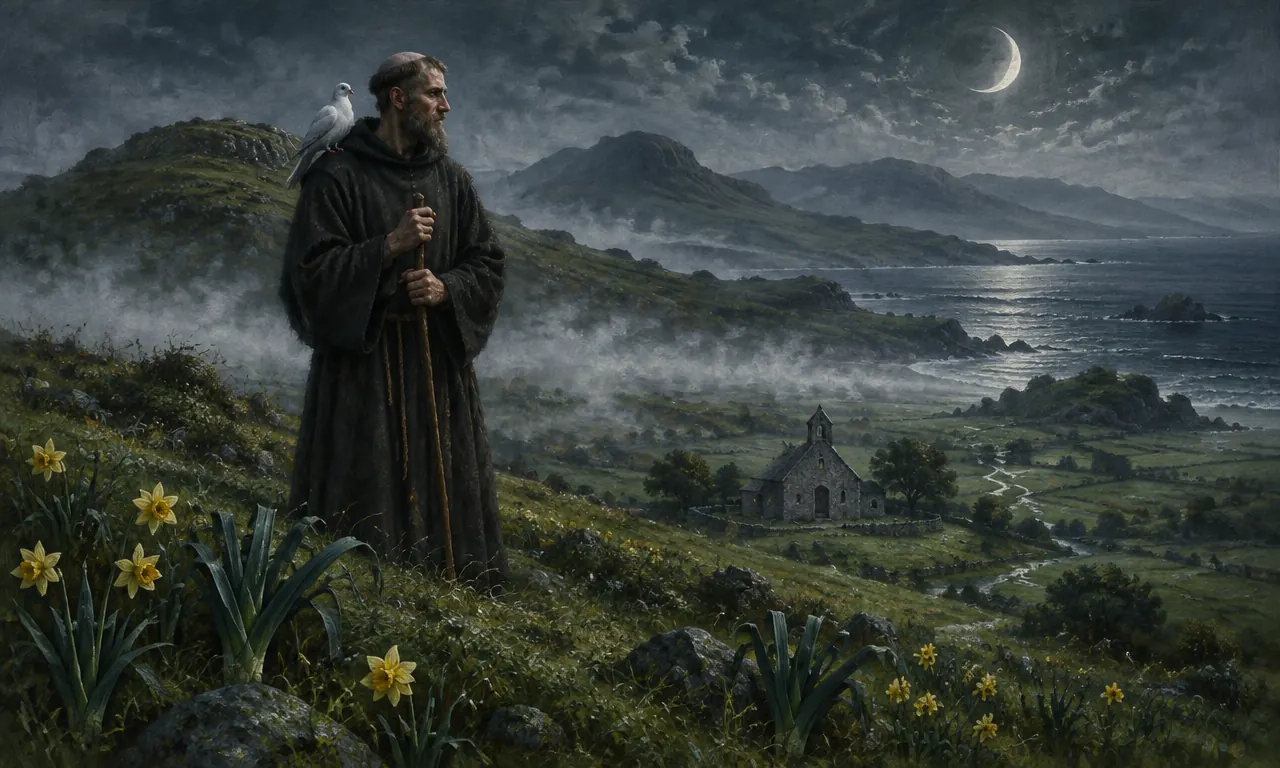
Two miracles stuck. The first is the dove: while David preached, a white dove came down and settled on his shoulder, and it has been his emblem ever since. The second is the hill. At a great synod at Llanddewi Brefi, the story goes, the crowd was too large for everyone to hear him — so the ground itself rose beneath his feet into a small hill, lifting him above the assembly. A church still stands on the spot.
His last sermon, preached the Sunday before he died — traditionally on 1 March, in 589 or 601 depending on the source — ended with the words Wales has never let go of: 'Gwnewch y pethau bychain' — 'Do the little things.' The phrase is everywhere in Wales now, on tea towels and tattoos and school walls, and it is not a bad summary of the man: no dragon-slaying, no armies, just a hard-working monk in a cold valley, doing small things well for a very long time.
David died on a Tuesday — the tradition insists on the day — and his shrine at St Davids became one of the great pilgrim destinations of medieval Europe. Two pilgrimages to St Davids were reckoned equal to one to Rome. The cathedral you see today is Norman, built over his foundations, and his bones were a prize fought over for centuries. The leek and the daffodil that Wales wears on his day are later badges than the dove, but they suit him: humble, local, and stubbornly alive every spring.
Wear something inspired by Saint David and you wear the far west of Wales: the smallest city, the white dove, the risen hill, and the instruction to do the little things.