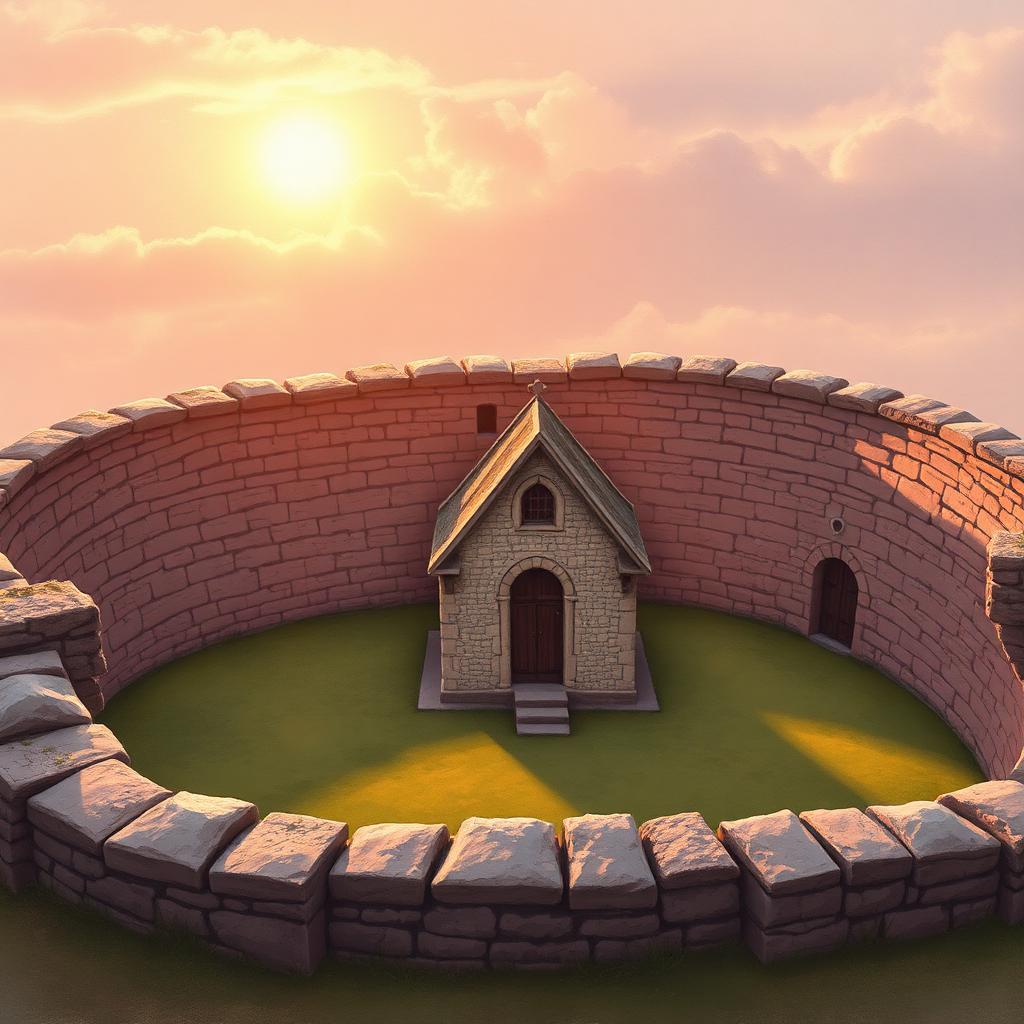
At the very western tip of Ynys Môn — really on the smaller tidal island of Holy Island, but the locals have always counted it as part of the same Mam Cymru — there is a remarkable thing: a working medieval church standing inside the surviving four corner towers of a Roman fort. The Romans called the fort Caer Gybi, and they built it in the late third or early fourth century as a coastguard station against Irish raiders. The walls, almost twenty feet high and made of rough mortared rubble, are still standing because in the sixth century a Cornish prince called Cybi was given them as a present.
Cybi — Saint Cybi, Cybi Felyn, Cybi the Tanned — was the son of a king of Cornwall called Selyf. He renounced his inheritance, made the pilgrimage to Jerusalem, came back to Britain, and travelled west by hops across south Wales until he reached Anglesey. The king of Gwynedd at the time, Maelgwn, gave him the abandoned Roman fort at Holyhead to use as a clas — a monastic community — and Cybi raised his church inside it. The arrangement was practical: he got a high stone enclosure already built for him, on a peninsula that catches every Atlantic gale, and Maelgwn got a saintly community standing guard at the only deep-water harbour on the western coast.
Cybi's friendship with Seiriol of Penmon is what most Anglesey schoolchildren still know about him. Once a week the two of them met halfway, at the holy well of Clorach. Seiriol walked east in the morning with the sun behind him and west in the evening with the sun behind him, and so he stayed fair. Cybi walked into the sun both ways, and so he stayed tanned. Cybi Felyn — Cybi the Yellow — is the dusk to Seiriol's dawn across the island.
Inside the fort today there are actually two churches. The main one is the parish church of Saint Cybi — Eglwys Sant Cybi — a substantial late-medieval cruciform building with very good early Tudor woodwork. The smaller one, tucked against the south wall, is Eglwys-y-Bedd — the Church of the Grave — which marks the traditional burial spot of Sirigi, an Irish chieftain whom Cybi is said to have personally defeated in single combat in his hot-blooded youth, before the saintliness took over.
Holyhead is now mostly known to outsiders as the ferry terminal for Dublin. The terminal is two minutes' walk from the church. Travellers stepping off the ferry into the rain rarely notice that they are inside a Roman fort given to a Cornish saint by a Welsh king fifteen hundred years ago, and they almost never notice the small worn cross by the south door of Eglwys Sant Cybi that is plausibly older than the church.
Wear something inspired by Saint Cybi of Holyhead and you wear the dusk-edge of Anglesey: a Roman fort recycled into a monastery, a wandering Cornish prince who liked the place enough to stay, and the long walk east he took every week to meet his pale friend in the middle.