Every mountain in Wales has a story, but Yr Wyddfa's is the biggest of all — literally. Welsh tradition says the name itself means something like 'the burial mound' or 'the cairn', and the man buried beneath it was no man at all. He was Rhita Gawr, Rhita the Giant, and the mountain is his grave.
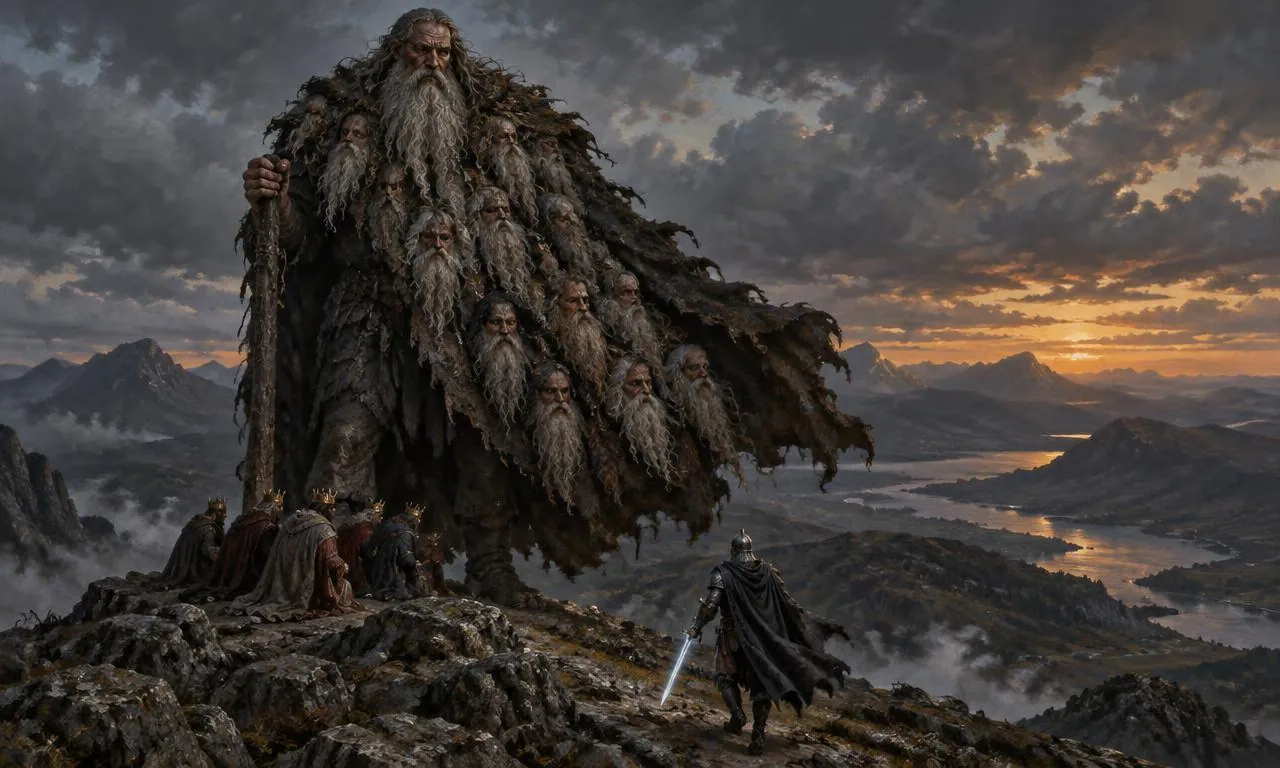
Rhita was huge even by giant standards, and vain even by the standards of kings. He made war on the rulers of Britain one after another, and he did not want their gold or their land. He wanted their beards. In a world where a king's beard was his honour, his manhood, his right to rule, Rhita defeated them in battle and shaved them, and with the beards he stitched himself a great cloak. It hung from his shoulders like a grey, grizzled storm cloud — kings' honour worn as a trophy.
Some tellings say the cloak was nearly complete. There was one space left, at the collar, the place of greatest honour. And Rhita knew exactly whose beard should go there: Arthur's.
He sent a message to the young king. It was, by giant standards, polite. Arthur should shave his own beard and send it to Rhita, and since he was the greatest of the kings, it would be sewn above all the others. If he refused, Rhita would come and take it — and the head with it.
Arthur did not send his beard. He came himself. The two met high in Eryri, and the fight that followed was the kind the old storytellers loved: rock splitting, the ground shaking, the valleys ringing with the clash. In the end Arthur struck the giant down. Some say the battle took place at Bwlch y Saethau, the Pass of the Arrows, on the flank of the mountain; others simply say it happened on the summit.
Then Arthur's men did what was done for a great enemy. They piled stones over Rhita's body, higher and higher, until the cairn became a peak. Gwyddfa Rhita, it was called: Rhita's cairn. Over time the giant's name dropped away, and only the cairn was left in the word we use today.
Geoffrey of Monmouth, writing in the twelfth century, tells a version of the tale in which Arthur says Rhita was a more dangerous opponent than any giant he had fought before — high praise from a king who had fought a lot of giants. But the Welsh telling keeps the best detail: the beard cloak, and the sheer cheek of the demand.
Next time you stand on the summit of Yr Wyddfa, with the whole of north Wales laid out below and Ynys Môn floating flat and green in the west, remember what the story says is under your boots. Wear Rhita Gawr and you wear the mountain's oldest joke: the giant who wanted to wear a king's honour, and ended up wearing Wales instead.