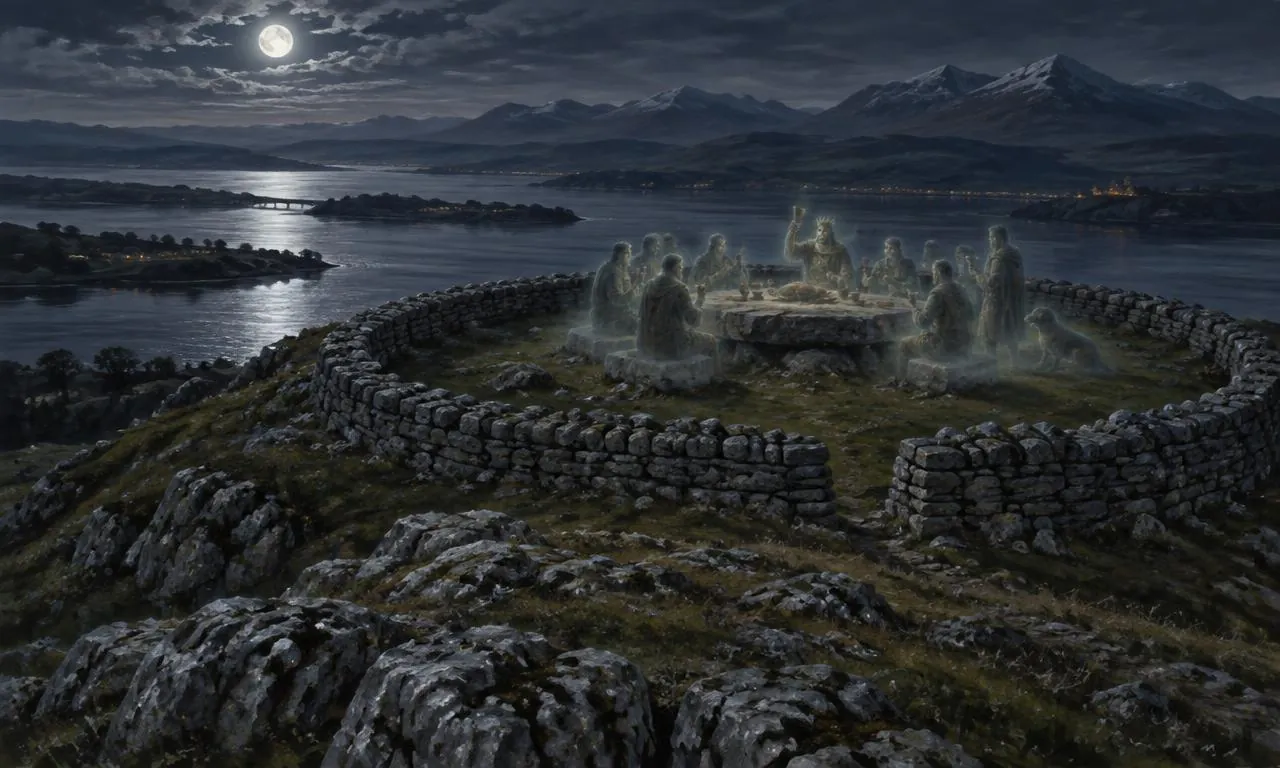
On the eastern tip of Ynys Môn, between Llanddona and Penmon, a hill rises out of the fields with its top sliced flat as if someone had taken a knife to it. Walk up through the gorse and you find yourself inside a great ring of tumbled limestone, a wall that once stood tall enough to keep out an army. Archaeologists call it Din Sylwy. Everyone who lives nearby calls it Bwrdd Arthur — Arthur's Table.
The ring is old, far older than any king named Arthur. It was raised in the Iron Age, when Môn was the grain-store and holy island of the druids, and people lived here long after, into the Roman years; coins and pottery from those centuries have turned up among the stones. It was a lookout, a refuge, and a statement: whoever held this hill could see every boat on the Menai and every sail coming round Penmon Point.
So how did it end up with Arthur's name on it? The same way half the high places of Wales did. Arthur is everywhere in the Welsh landscape — Arthur's Stone, Arthur's Seat, Arthur's Quoit, Arthur's Cave. Where there was a great rock, a strange hollow or a ring of stones too big for ordinary men to have built, people said: Arthur was here. The name clings to high ground like mist.
On Môn, the story told is simple and rather lovely. The flat summit was Arthur's feasting table, where the king sat with his companions after hunting on the island, looking out across the water to Eryri while the fires burned and the horns went round. Some say the ring of stones was the circle of his warriors' seats. Others say that on certain nights, if you climb up after dark, you may see a faint glow at the summit, and hear laughter carried on the wind from a feast that ended fifteen hundred years ago.
There is another reason the name fits. In the old Welsh tales, Arthur is not the polished knight of later French romance. He is a war-leader of Britain, raiding the otherworld, hunting the great boar Twrch Trwyth across Wales, fighting giants and witches with a band of heroes who can each do something impossible. He is a king of the land itself — and where better for such a king to eat than a table made from the island's own bones?
Stand inside the ring on a clear evening and you can see why people wanted a great story here. To the south the Menai Strait narrows toward the bridges; beyond it the mountains of Eryri stack up blue and grey, Yr Wyddfa at the back of them all. Behind you lie Red Wharf Bay and the open sea. It is a view made for kings, real or remembered.
Wear Bwrdd Arthur and you carry a small piece of the island's stubborn memory: a hill that has outlasted its builders, its Romans and its king — and still keeps his seat warm.