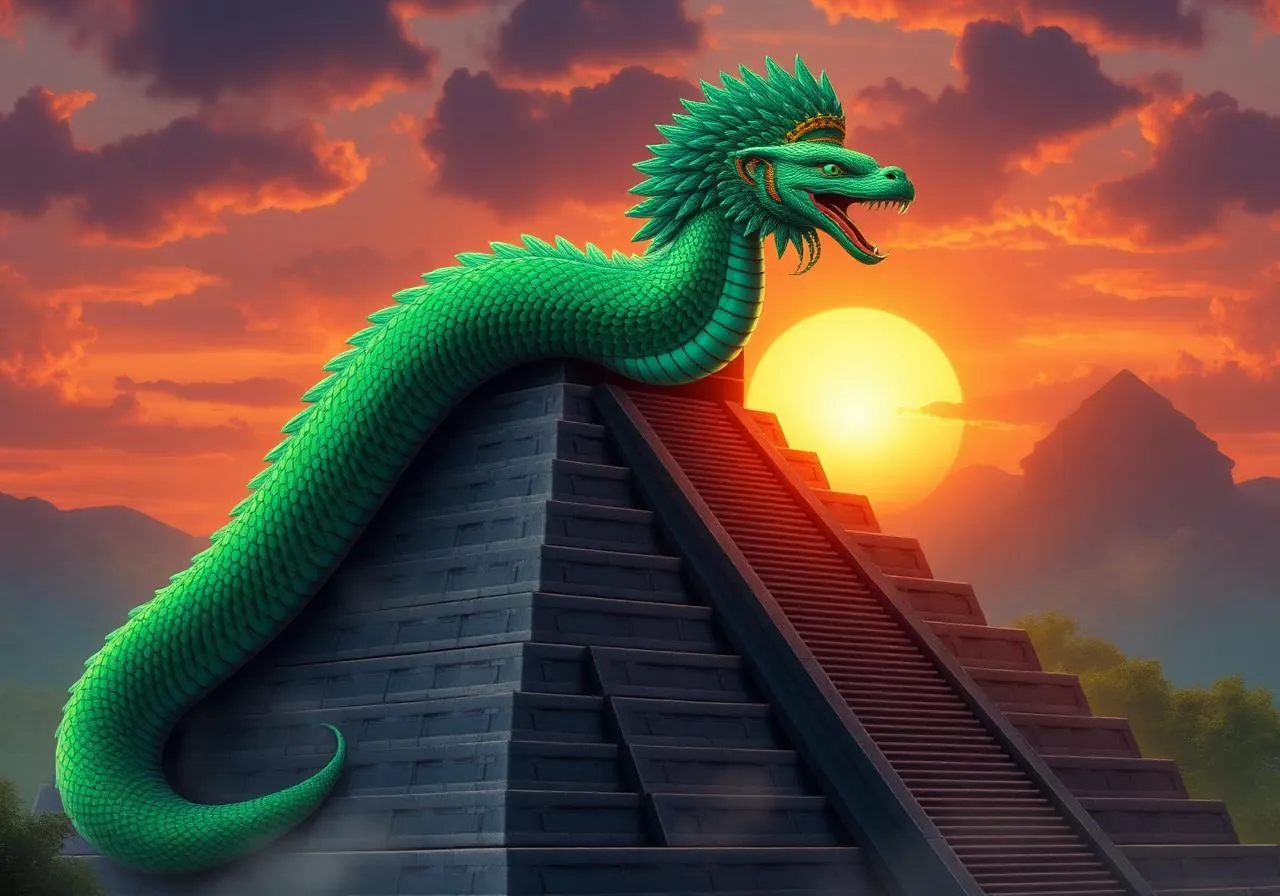
Long before the Aztecs, long before the Maya, the Feathered Serpent was already being carved into stone in the Mexican highlands. The earliest images come from Teotihuacán, the great pyramid-city north of modern Mexico City, more than two thousand years ago — a serpent body covered in the iridescent green tail-feathers of the quetzal bird, gliding through stars. Every culture that came after kept him. The Maya called him Kukulkan. The K'iche' called him Q'uq'umatz. The Aztecs called him Quetzalcoatl. The same god, walking from civilisation to civilisation across two millennia.
He is the wind. The Aztecs gave him a second name, Ehécatl, and built him round temples instead of square ones so the wind could blow around them without being cornered. He is the dawn-star, Venus rising in the morning before the sun. He is the patron of priests and of writing and of learning — the god who is said to have given the calendar and the codices to humanity. And he is one of the four creators of the present world. After the previous suns had ended in flood and fire and jaguars, it was Quetzalcoatl who descended into Mictlán, the underworld, and stole the bones of the old dead. He ground them with his own blood and made the first people of the fifth sun. Us.
There is one famous story that broke him. In the Toltec tradition he is also a man — a king of the city of Tollan, a priest-ruler so pure he refused human sacrifice and offered only butterflies and snakes. His rival, the dark sorcerer-god Tezcatlipoca, tricked him into drinking pulque, the sacred liquor, and shamed him. The next morning Quetzalcoatl set fire to his own house, walked east to the sea, and either sailed away on a raft of serpents or burned himself on a pyre and rose into the sky as the morning star. Either way, he promised to come back.
When Hernán Cortés arrived on the eastern coast of Mexico in 1519 — bearded, pale, in the year One Reed, the calendar year Quetzalcoatl had promised to return in — the Mexica emperor Moctezuma II did not, as the legend later claimed, simply hand over an empire because he thought a god had arrived. But the timing was terrible, and the story of the returning Feathered Serpent did real political damage in those first months. A myth can change the shape of a continent.
He is still everywhere in Mexico. He is carved across the great pyramid at Chichén Itzá, where every spring and autumn equinox the setting sun throws a moving shadow down the staircase that looks exactly like a serpent of light descending the stone. The Maya built the architecture to make the god appear on schedule. It still works.
Wear Quetzalcoatl and you wear the oldest creator-god of the Americas — the wind, the morning star, the priest-king who refused blood, and the serpent of light still gliding down the side of a Yucatec pyramid twice a year on the day the sun gets it exactly right.