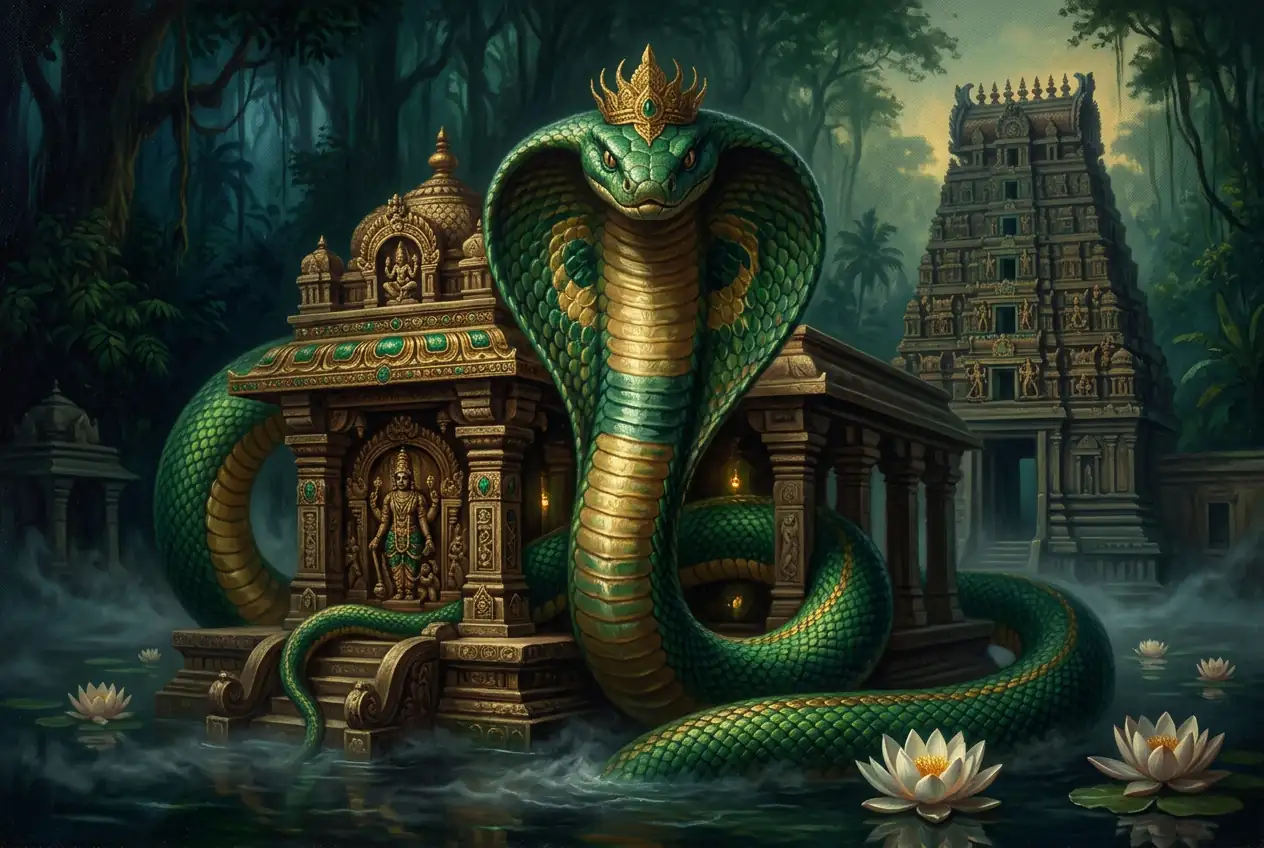
Across Hindu, Buddhist and Jain tradition — and from the Ganges to Angkor Wat — there is one being that guards the threshold between water and stone, life and death, the human world and the divine. The Naga. The serpent-kings.
In the oldest Sanskrit texts, Nagas are not snakes the way we think of snakes. They are a race of semi-divine beings who can take human form, jewelled cobra form, or any shape between. They live in Patala, a luminous underground realm beneath the rivers and oceans, in palaces built of pearl and coral. Their kings — Vasuki, Shesha, Takshaka — are figures of immense power. Vishnu sleeps on the coils of Shesha between cycles of the universe. Vasuki was used as the rope when the gods churned the Ocean of Milk to extract the nectar of immortality.
What makes the Naga distinctive is the role they play. They are guardians, not predators. They protect treasure, scripture, and sacred water. The most famous Buddhist image in the world — the Buddha seated in meditation while the seven-headed Naga king Mucalinda spreads his hood as an umbrella against the rain — is not a fight. It is a coronation. The serpent recognises the awakened one and shelters him.
Travel through Southeast Asia today and you will still see them. The long balustrades of Angkor Wat are Naga bodies. The roofs of Thai temples curl up at the ends because they end in Naga heads. Nepal still keeps Naga shrines beside springs. In the Mekong, river boats are blessed against the Naga's annoyance. They never went away.
Wear the Naga and you wear the oldest South Asian truth — that the guardian of every sacred place is a serpent, and the snake is not your enemy. The snake is the temple.