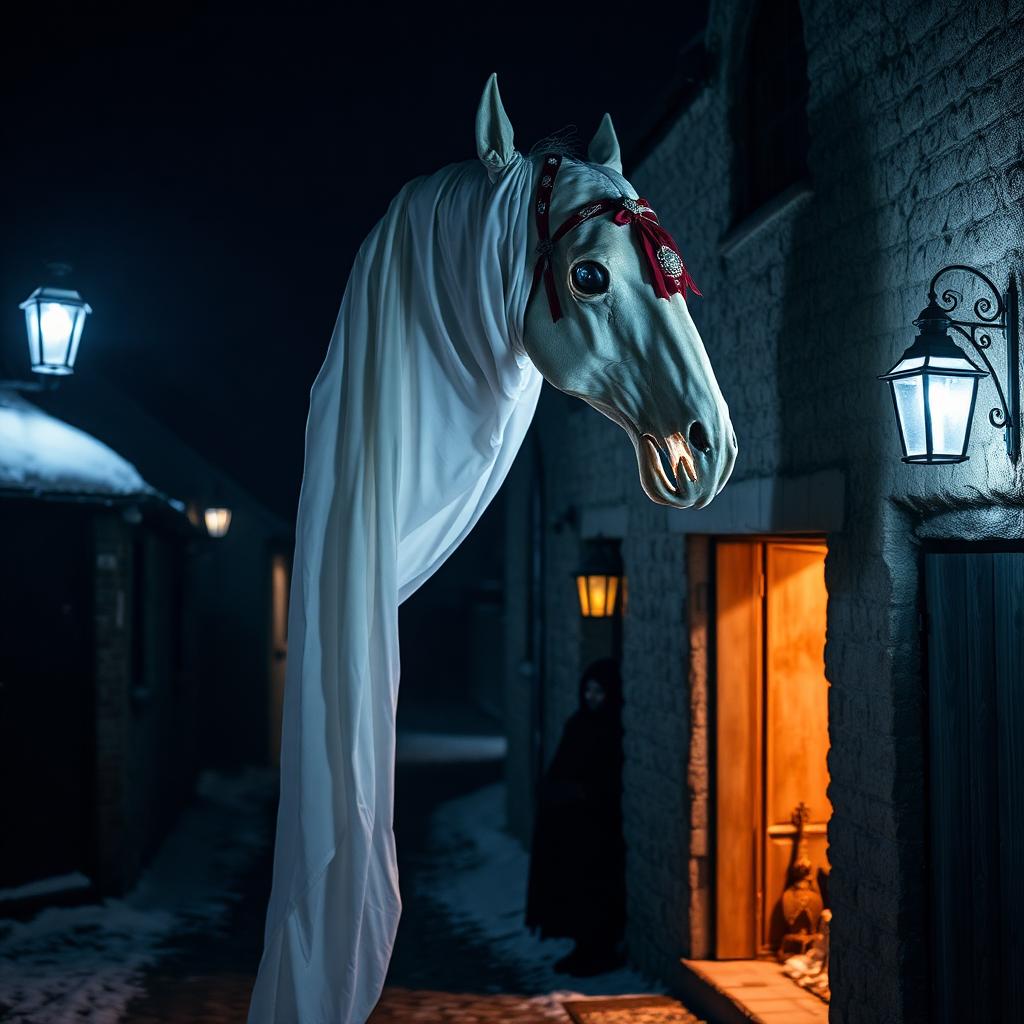
There is no folk custom in these islands quite like the Mari Lwyd. From late December through to Twelfth Night, in the old industrial valleys of South Wales — Llangynwyd, Aberavon, Maesteg, Chepstow — a group of men would go from house to house carrying a horse's skull. The skull was bleached, mounted on a pole, draped in a long white sheet, and dressed up with reins, bells, ribbons, and glass-bead eyes. Whoever held the pole hid under the sheet and worked the lower jaw with a string so the Mari could snap her teeth at you.
The name itself is a small mystery. 'Mari Lwyd' is usually translated as Grey Mare, but some scholars argue for 'Holy Mary' — a Christianised relic of an older midwinter horse-cult. Either way, the ritual is unmistakably pre-Christian in feel: a skull, a sheet, a song, a door.
She arrives at your house after dark. Her party sings the opening verses outside in Welsh, asking to be let in. You — the householder — are supposed to sing back, refusing them, ideally in clever rhyme. This is the pwnco: a verse battle, made up on the spot, traded back and forth across the closed door. If the Mari's party outwits you, you have to open up. She comes in, snaps at the children, dances around the room, and the household feeds her party with cake and ale before she moves on to the next house.
The custom almost died out. By the mid-twentieth century there were only a handful of villages still doing it. But it has come back. Today you will find Mari Lwyd parties on the streets of Cardiff, Chepstow, Llantrisant and Pontypridd every January, and the wassail at Chepstow now draws hundreds of people. The skull is still real. The pwnco is still in Welsh. The sheet is still white.
There is nothing else quite like her in the British Isles. Hooden horses in Kent, hobby horses in Padstow, the Old Tup in Derbyshire — all share the same midwinter shape, but none of them sing back. The Mari Lwyd is the only one who makes you fight for your own front door.
Wear the Mari Lwyd and you wear the strangest, most stubborn surviving fragment of Welsh midwinter — the grey mare on the doorstep, the lantern in the snow, and the verse you had better think up quickly.