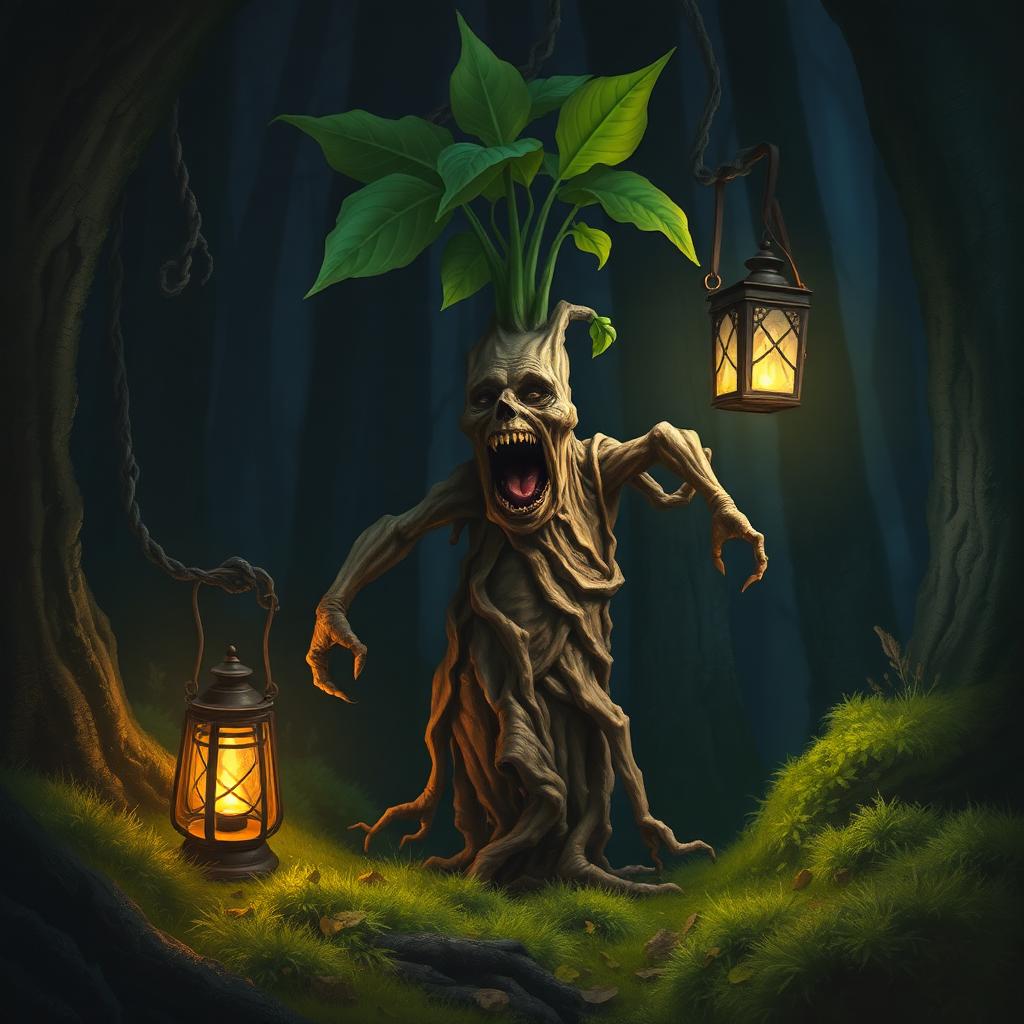
The mandrake (*Mandragora officinarum*) is a real, perfectly ordinary plant native to the Mediterranean — a low rosette of dark green leaves with small purple flowers and a long, thick, forked taproot. The taproot, when fully grown, can look uncannily like a tiny human figure: two splayed legs, a torso, sometimes even arms. That accident of botany is responsible for nearly every story ever told about it.
The Greeks knew it. The Romans knew it. The medieval Arab herbalists wrote at length about it. So did the great twelfth-century abbess and physician Hildegard of Bingen. The mandrake's root contains real, powerful tropane alkaloids — hyoscyamine, scopolamine, atropine — the same chemicals found in deadly nightshade. In tiny doses it is a genuine surgical anaesthetic; ancient surgeons gave wine soaked in mandrake to patients before amputations. In larger doses it causes hallucinations, paralysis, and death.
But what made the mandrake terrifying was not its chemistry. It was the scream. Medieval herbals — including the famous fourteenth-century *Tacuinum Sanitatis* — warned in plain language that the mandrake, when uprooted, lets out a shriek so loud and so terrible that any human who hears it directly will die on the spot. The standard advice, repeated in herbal after herbal across centuries, was elaborate: dig partially around the root by moonlight, expose its top, tie one end of a cord to the root and the other to a black dog, then stand far off with your ears stopped with wax and call the dog. The dog pulls. The mandrake screams. The dog dies. You walk over, collect the root, and you have what was, for fifteen hundred years, the single most valuable item in any European apothecary.
Once safely harvested, the root was used for everything: as an anaesthetic, as a sleeping draught, as a contraceptive, as a fertility charm (especially for couples who had struggled to conceive — see the Book of Genesis, chapter 30), as a love philtre, and as a ward against demons. It was carved into little figures and dressed in tiny robes and kept in homes as a guardian. The fully shaped mandrake-figures sold in market squares were, frankly, the most expensive herbs in Europe.
Wear the Mandrake and you wear the strangest entry in the whole European herbal — the plant that taught us that the line between medicine, magic and poison is mostly a matter of dose, and that some gifts genuinely do scream when you take them.