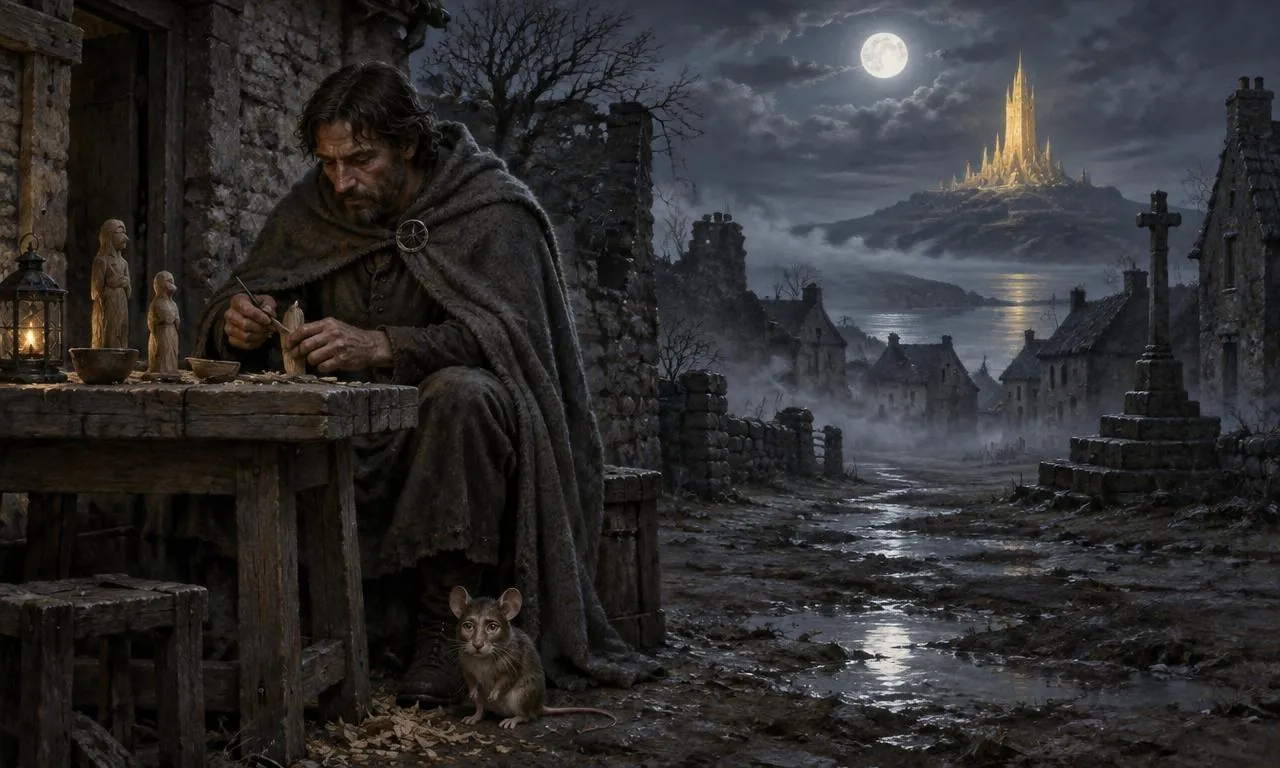
Manawydan came home from Ireland with nothing. He was one of the seven who survived the war that followed Branwen's wedding — the war that killed his brother Bendigeidfran, the giant king. His cousin Caswallon had seized the crown of Britain in their absence. Manawydan, son of Llŷr the sea-lord, could have fought for it. He shrugged, and let it go. 'I am not one to be restless,' he said, and that is the whole man in a sentence.
His friend Pryderi, Prince of Dyfed, would not see him landless. He gave Manawydan the seven cantrefs of Dyfed to enjoy, and the hand of his widowed mother, Rhiannon. The two were well matched: she clever and proud, he calm and clever in a different way. For a while there was feasting at Arberth, and the four of them — Manawydan, Rhiannon, Pryderi and his wife Cigfa — were as happy as anyone in the Mabinogi ever gets.
Then, as they sat on the magic mound of Gorsedd Arberth, came a peal of thunder and a mist so thick they could not see each other. When it lifted, Dyfed was empty. No people. No cattle. No smoke from any chimney. Only houses standing open and silent, and the four of them alone in a land that had been emptied like a cup.
They lived on hunting for a while, then went into England to earn a living. Manawydan turned out to be a master of any craft he tried. He made saddles, and made them so well that the other saddlers of the town lost all their trade and plotted to kill him. He moved on and made shields; the same happened. He made shoes, gilded with blue enamel, and again the local craftsmen reached for their knives. Each time Pryderi wanted to fight. Each time Manawydan refused and simply left. He would not buy his life with a brawl.
Back in Dyfed, a shining white boar led their hounds to a strange fort where no fort had been. Pryderi followed, despite Manawydan's warning, and found a golden bowl hanging on chains from the sky. He touched it and stuck fast, struck dumb. Rhiannon went after him and was caught too. Then, with a thunderclap, the fort vanished, and them with it.
Manawydan was left with Cigfa, and he did what he always did: he worked. He sowed three fields of wheat. The first, on the eve of harvest, was stripped bare in a night. So was the second. On the third night he watched, and saw an army of mice swarm the stalks. He caught one — a fat, slow female — put her in his glove, and announced that he would hang her for theft on Gorsedd Arberth.
A scholar came by, then a priest, then a bishop with all his retinue, each offering more and more money to spare the mouse. Manawydan refused them all until the bishop confessed: he was Llwyd son of Cil Coed, the mice were his household, the mouse was his pregnant wife, and he had laid waste to Dyfed to avenge an old insult done to Rhiannon's first suitor, Gwawl. Manawydan named his price: Rhiannon and Pryderi freed, Dyfed restored, and a promise that no vengeance would ever fall on them again. The mist lifted. The people came home.
No sword, no war, no battle cry. Just a patient man who would not be hurried, provoked or bought. Wear Manawydan and you wear the quietest kind of magic in Welsh myth: the craftsman's certainty that if you keep working, and keep watching, the answer will walk into your glove.