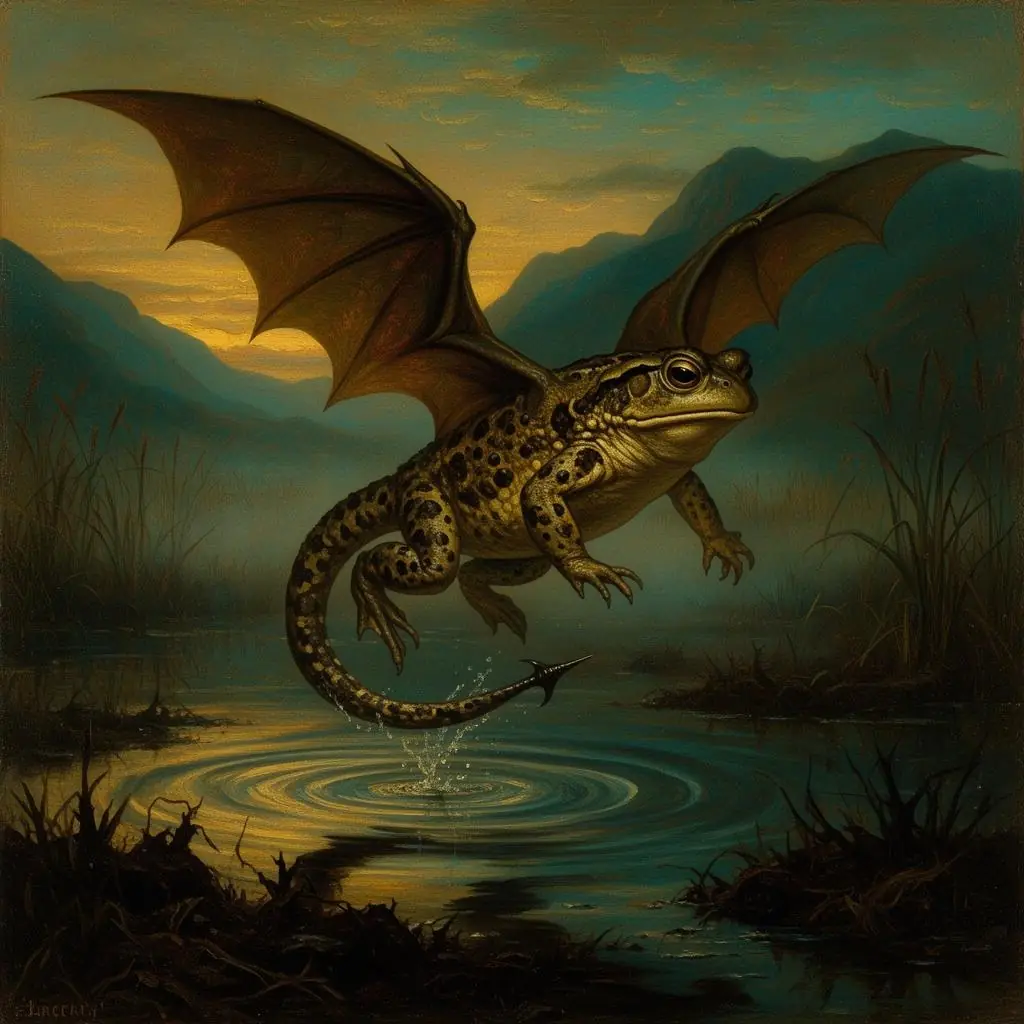
Of all the creatures Welsh shepherds and anglers swore lived in the high lakes and peat-bogs, the Llamhigyn Y Dŵr — 'the Water Leaper' — was perhaps the most peculiar. Part toad, part bat, part stingray, it had no business existing, and yet every quiet tarn in old Wales seemed to have one.
The folklorist John Rhŷs collected the clearest description in his 1901 'Celtic Folklore: Welsh and Manx'. The Water Leaper, he wrote, had the body of a giant toad, leathery bat-like wings instead of forelegs, no hind legs at all, and a long lashing tail tipped with a sting. It could not fly properly — only leap and skim across the surface of the water — and it lived in the deep, peaty lakes and slow rivers of mid and north Wales.
Fishermen blamed it for everything. A line that snapped without warning, a hook that pulled clean from the water with the bait gone — that was the Llamhigyn snatching the bait and breaking the line with its tail. Worse, it was said to give such a sudden, terrible scream as it leapt that an old man could be pulled bodily into the lake from the shock of it, never to surface again. Sheep that came to drink at the wrong tarn at dusk were dragged under and not seen again either.
Like many Welsh water-spirits, it was as much a warning as a creature: don't fish alone in unfamiliar waters, don't let the children play at the edge of the bog, don't trust still water. Behind the bat wings and the stinger is the same lesson the Afanc and the Ceffyl Dŵr were teaching — Welsh water keeps what it takes.
Wear the Llamhigyn Y Dŵr and you wear the strangest creature in the Welsh bestiary — the small, ridiculous, deeply local nightmare of every man who ever cast a line into a lonely peat-bog at dusk.